Nebuchadnezzar's Madness

A boast spoken from the palace roof
By the time this scene unfolds, Nebuchadnezzar has already ruled as one of the ancient world's most powerful kings, and Babylon under his reign has become the kind of city later remembered for its scale and splendor — including its famously fortified walls and celebrated architecture. Standing and looking out over the city he'd built, he allows himself a single, unguarded claim of full personal credit: "Babylon the great! Was it not I, with my great strength, who built it as a royal residence for my splendor and majesty?" (Daniel 4:27, NABRE). It's worth noticing exactly what the boast leaves out — not simply pride in an achievement, but a claim that erases any acknowledgment that the power making the achievement possible came from anywhere beyond his own strength.
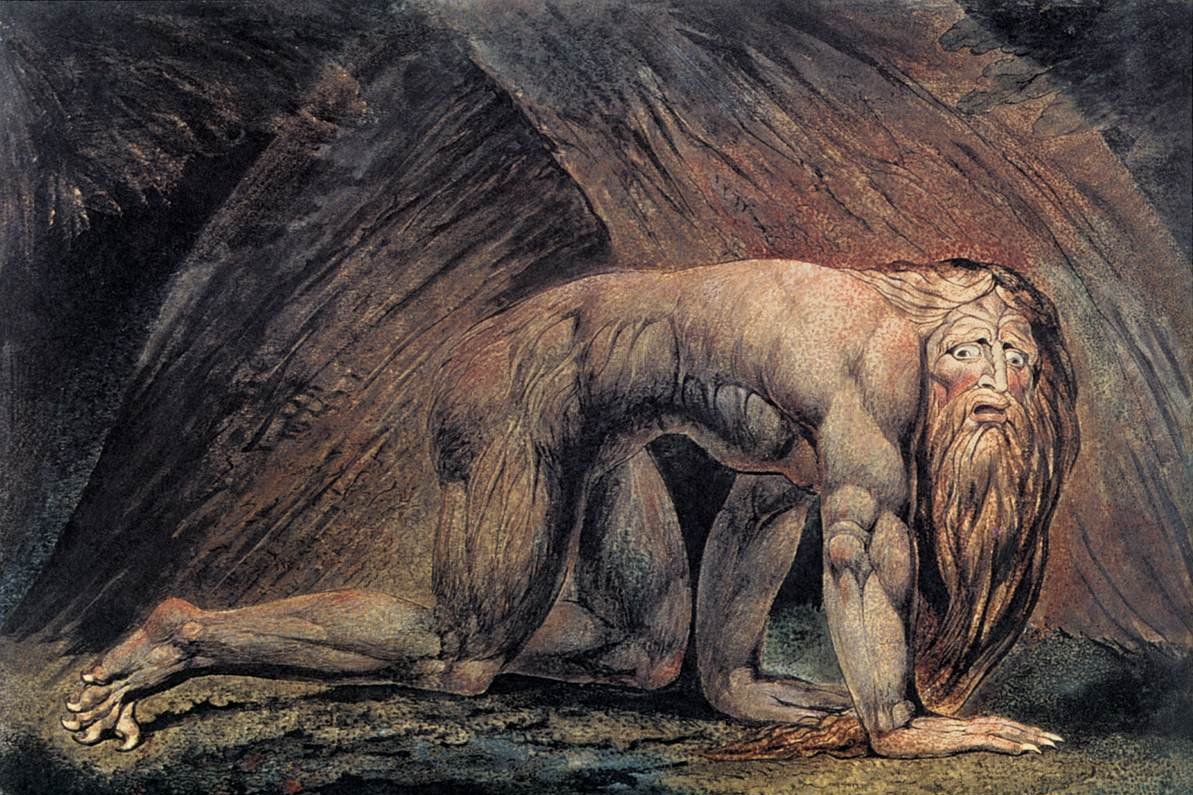
William Blake, Nebuchadnezzar (1795-1805), public domain via Wikimedia Commons
A judgment that arrives instantly
Daniel's narration makes the timing unmistakably deliberate: "While these words were still on the king's lips, a voice spoke from heaven" (Daniel 4:28, NABRE) — there's no delay between the boast and the response, no gradual buildup, just an immediate declaration that Nebuchadnezzar's kingship is being taken from him. The judgment is specific and severe: he will be "cast out from human society," made to live among wild beasts and "given grass to eat like an ox," for a period of "seven years," with an explicit stated purpose — "until you learn that the Most High is sovereign over human kingship and gives it to whom he will" (Daniel 4:29, NABRE). The punishment fits the offense with unusual precision: a king who claimed sole credit for his own greatness is stripped of every marker of human dignity and royal status entirely.
Seven years among the beasts
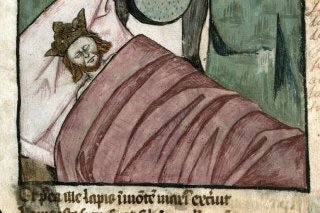
What follows is described in stark, almost clinical detail. "At once this was fulfilled. Nebuchadnezzar was cast out from human society, he ate grass like an ox, and his body was bathed with the dew of heaven, until his hair grew like the feathers of an eagle, and his nails like the claws of a bird" (Daniel 4:30, NABRE). The physical description — hair like feathers, nails like claws — emphasizes just how completely his appearance and condition had become unrecognizable as royal, or even fully human, by ordinary standards. The most powerful ruler in the region spends the judgment's full duration in a state that strips away every external marker of the greatness he had just finished claiming for himself.
Reason, and a kingdom, restored
The chapter's turn comes when the seven years conclude, and Nebuchadnezzar himself narrates his own restoration in the first person: "When this period was over, I, Nebuchadnezzar, raised my eyes to heaven; my reason was restored to me, and I blessed the Most High, I praised and glorified the One who lives forever, Whose dominion is an everlasting dominion, and whose kingdom endures through all generations." (Daniel 4:31, NABRE). His recovery isn't presented as automatic or separate from that change in posture — it's explicitly tied to the moment he turns his attention toward God rather than toward his own achievements. Once his reason returns, so does everything else: "my majesty and my splendor returned to me... I was restored to my kingdom and became much greater than before" (Daniel 4:33, NABRE) — not merely reinstated to his previous position, but described as ending up in an even stronger one than before the judgment began.
A king's own confession, closing the chapter
What makes this episode distinct among Daniel's many accounts of kings and their fortunes is that it ends in the king's own words, recorded as a direct, personal confession rather than narrated from outside. "Now, I, Nebuchadnezzar, praise and exalt and glorify the King of heaven, all of whose works are right and ways just; and who is able to humble those who walk in pride" (Daniel 4:34, NABRE) — naming pride explicitly as the fault the whole seven-year ordeal had been designed to correct, and doing so not as a lesson delivered by Daniel or another prophet on his behalf, but as his own recognition, spoken in his own voice, once his reason and his kingdom had both been given back to him.
A downfall with an unusually direct lesson attached
Few episodes anywhere in Scripture connect cause and consequence quite as explicitly as this one — a specific boast, an immediate judgment, a stated purpose for the punishment, and a restoration tied directly to the king's change of heart. Nebuchadnezzar's madness has remained a frequently cited example, across centuries of commentary, precisely because the text refuses to leave its point implicit: even the greatest human power, the story insists, remains entirely subject to a sovereignty far beyond itself — a lesson delivered here not through gentle warning, but through seven years spent, quite literally, on all fours.
Trivia
What did Nebuchadnezzar say right before he was struck with madness?
What did the voice from heaven declare in response?
How exactly did the judgment play out?
What happened when the seven years ended?
Did Nebuchadnezzar learn anything from the experience?
Related Reading