Susanna and the Elders

A Trap Set in a Garden
Susanna was known in her community as a woman "very beautiful and God-fearing," married to a wealthy and respected man named Joakim. Two elders, appointed that year as judges over the people, began visiting Joakim's house regularly on legal business — and each, separately, became consumed with desire for Susanna, though neither told the other. When they finally admitted their obsession to each other, rather than feel shame, they conspired together to find a moment to corner her alone.
Heinrich Aldegrever, Susanna and the Elders (from The Story of Susanna), 1555 -- public domain.
Their chance came on a hot day when Susanna decided to bathe in her enclosed garden, sending her maids away to fetch oils and close the garden gates for privacy. The two elders, who had been hiding, emerged the moment she was alone and delivered their ultimatum plainly: submit to us, or we will testify that we caught you here with a young man, and no one will believe your word against ours.
"It Is Better for Me Not to Do It"
Susanna's response, given in a moment with genuinely nothing to gain either way, is one of Scripture's clearest statements of moral resolve under coercion: "I am completely trapped... If I yield, it will be my death; if I refuse, I cannot escape your power. Yet it is better for me not to do it and to fall into your power than to sin before the Lord." (Daniel 13:22-23). She screamed for help, and the elders, to cover themselves, shouted their fabricated accusation over her cries and had the garden gates opened to "reveal" the scene they had invented.
Condemned on False Testimony
The next day, at a public assembly, the two elders testified formally against Susanna, describing in detail an encounter with a young man that had never happened. Because they were respected judges, "the assembly believed them, since they were elders and judges of the people," and Susanna was condemned to death (13:41). As she was led out for execution, she cried out to God, protesting her innocence and asking to be vindicated — "you know that they have testified falsely against me. Here I am about to die, though I have done none of the things for which they have condemned me!" (13:42-43).
Daniel's Intervention
God heard her prayer and stirred "the holy spirit of a young boy named Daniel" to object publicly to the verdict, insisting the assembly return to investigate rather than execute an unverified sentence. Given authority to question the witnesses, Daniel separated the two elders and interrogated them individually about the same specific detail: under which tree in the garden they claimed to have witnessed the act. One said a mastic tree; the other said an oak. The contradiction was total and unmistakable, and it exposed the entire testimony as fabricated on the spot.
"The whole assembly cried aloud, blessing God who saves those who hope in him," and turned on the elders instead, convicting them under the law of Moses for bearing false witness and putting them to death — "Thus was innocent blood spared that day" (13:60-62). Susanna's family "praised God for their daughter Susanna... because she was found innocent of any shameful deed" (13:63).
A Story Painters Kept Returning To
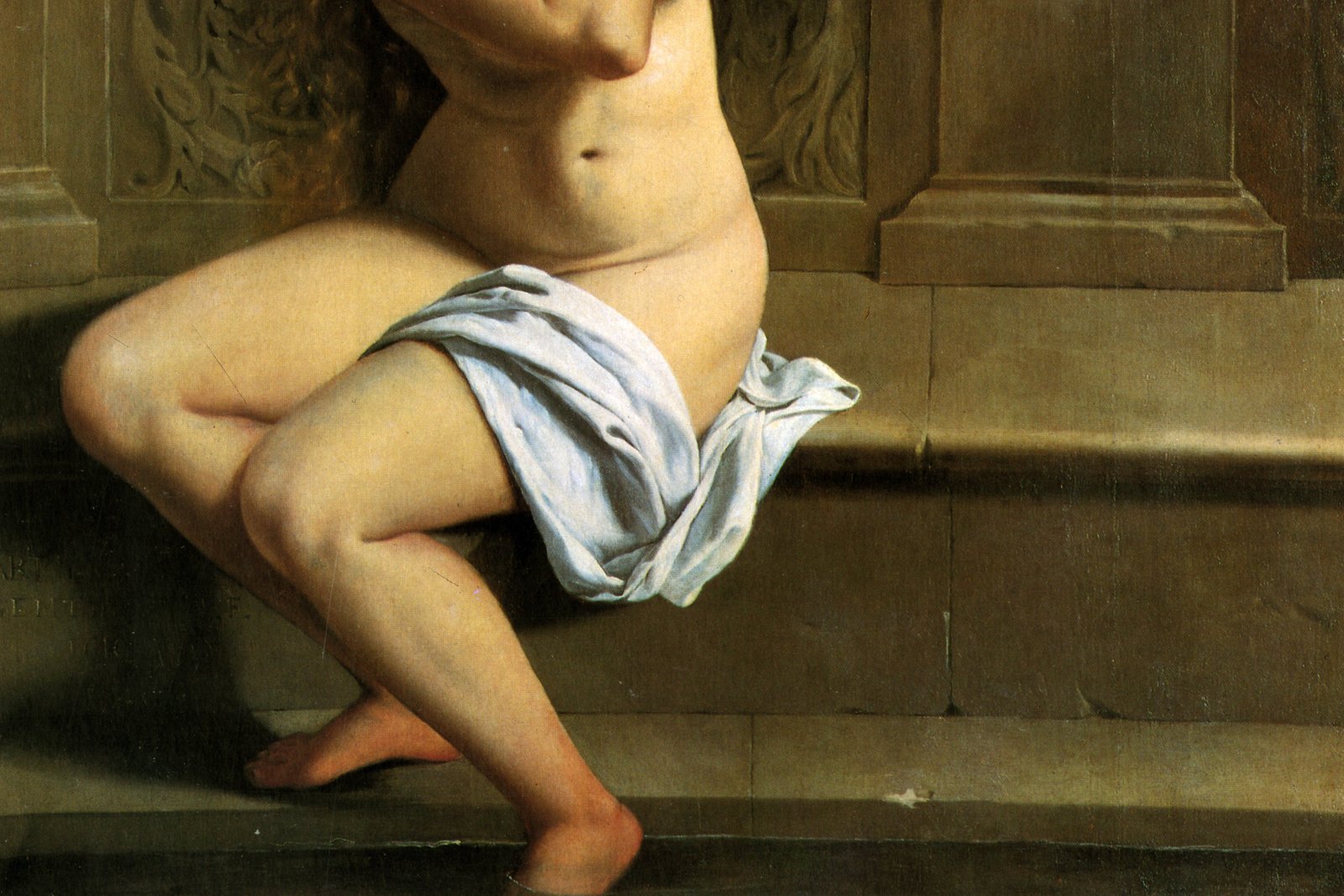
Susanna's confrontation in the garden became one of the most frequently painted subjects in Western religious art, precisely because it combines a moment of intense psychological pressure with a clear moral stakes that artists could render dramatically. Artemisia Gentileschi's 1610 version, painted when she was still a teenager, is often singled out for how differently it handles the scene compared to earlier male painters: rather than presenting Susanna as a passive, decoratively posed nude observed by the viewer alongside the leering elders, Gentileschi shows her twisting away in visible distress, her body language communicating genuine violation rather than availability. Art historians have long connected that difference in treatment to Gentileschi's own biography — she survived a sexual assault and a public trial only a few years after completing this painting — though the work stands on its own as an unusually direct depiction of Susanna's fear rather than her exposure, a reading much closer to the text's own emphasis on her anguish and resolve than many earlier treatments of the same subject.
Catholic Reading: Integrity Without Guarantee of Rescue
Susanna's story belongs to the longer Greek version of the Book of Daniel, included as chapter 13 in the Catholic canon of Scripture, one of several passages the Church holds as canonical that fall outside the shorter Hebrew text used in Protestant and Jewish tradition. Catholic teaching has long held Susanna up specifically as a model of chastity and courage — she makes her choice to refuse the elders before knowing whether God will vindicate her at all. Her prayer as she is led to execution is not a bargain for rescue; it is simply a request to be heard truthfully, whatever the outcome.
The story also functions as a pointed warning about the abuse of legitimate authority. The elders' power as judges is precisely what makes their false testimony believable, and precisely what Daniel's careful, patient cross-examination is needed to unravel. Susanna's vindication depends not on her own defense — she has none to offer beyond her innocence — but on someone willing to question authority rather than simply defer to it.
Related reading: see Daniel in the Lions' Den for another episode of Daniel's discernment under threat, and Judith and Holofernes for another Old Testament woman whose courage saves innocent lives.
Trivia
Who was Susanna and what happened to her?
What did Susanna choose to do?
What happened at Susanna's trial?
How did Daniel prove Susanna's innocence?
How is Susanna's story regarded in the Catholic Bible?
Related Reading