The Calling of Samuel

A quiet time, and a boy in training
The scene opens with a detail the text places deliberately before anything else happens: "the word of the Lord was scarce and vision infrequent" in the days when this story takes place (1 Samuel 3:1, NABRE). Samuel, a boy being raised in service at the sanctuary of Shiloh under the aging priest Eli, is sleeping near the sacred ark one night when he hears his name called clearly. There's nothing in the setup to suggest Samuel expects anything unusual to happen — he's a child in training, and the spiritual climate around him, the text implies, hadn't prepared anyone in Shiloh to expect a direct divine encounter that particular night.

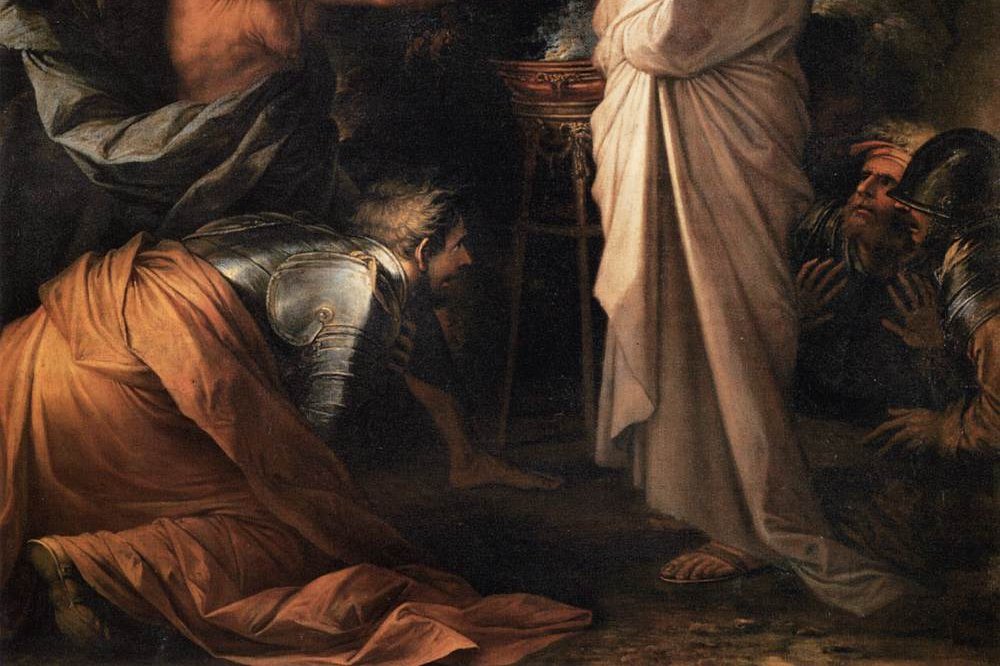
Sir Joshua Reynolds, The Calling of Samuel (1776), public domain via Wikimedia Commons
Three trips to the wrong door
What follows repeats with almost comic precision. Samuel hears his name, assumes it's Eli calling him, and runs to him: "The Lord called to Samuel, who answered, 'Here I am.' He ran to Eli and said, 'Here I am. You called me.'" Eli, confused, sends him back: "'I did not call you,' Eli answered. 'Go back to sleep.' So he went back to sleep" (1 Samuel 3:4-5, NABRE). It happens again almost identically a second time — "Again the Lord called Samuel, who rose and went to Eli" — with the same denial and the same instruction to return to bed (1 Samuel 3:6, NABRE). The text pauses here to explain what's actually going on beneath the surface of this repeated confusion: "Samuel did not yet recognize the Lord, since the word of the Lord had not yet been revealed to him" (1 Samuel 3:7, NABRE) — Samuel isn't being obtuse or slow; he simply has no framework yet for what he's experiencing, because he's never experienced it before.
The moment Eli understands
It's only after the third identical exchange that the story's real turn happens — and notably, it doesn't happen to Samuel first. "The Lord called Samuel again, for the third time. Getting up and going to Eli, he said, 'Here I am. You called me.' Then Eli understood that the Lord was calling the youth" (1 Samuel 3:8, NABRE). It's Eli, not Samuel, who first recognizes what's actually taking place — an old priest, whose own relationship with God elsewhere in this narrative is presented as troubled and compromised, is nonetheless the one who correctly reads the pattern and understands its source before the boy at its center does.
Given the words he doesn't yet have
Rather than explaining the theology of what's happening, Eli does something more practical: he equips Samuel with an exact response. "Go to sleep, and if you are called, reply, 'Speak, Lord, for your servant is listening'" (1 Samuel 3:9, NABRE). It's a small, concrete gift from an older, more experienced man to a boy who has just been through something he couldn't interpret three times running — not a lecture on discernment, just the specific words needed for the moment that's about to come again.
"Speak, for your servant is listening"
The fourth call arrives exactly as the previous three had: "the Lord came and stood there, calling out as before: Samuel, Samuel!" This time, though, Samuel is ready. "Samuel answered, 'Speak, for your servant is listening'" (1 Samuel 3:10, NABRE) — recognition finally arriving, made possible not by Samuel figuring it out entirely on his own, but by an older mentor's guidance meeting the boy's own willingness to keep getting up and responding, even after three confused, unsuccessful attempts.
A hard message for the man who raised him
What God actually says to Samuel that night isn't comforting. "I am about to do something in Israel that will make the ears of everyone who hears it ring. On that day I will carry out against Eli everything I have said about his house, beginning to end" (1 Samuel 3:11-12, NABRE), condemning Eli's own household specifically "because of this crime: though he knew his sons were blaspheming God, he did not reprove them" (1 Samuel 3:13, NABRE). It's a striking first assignment for a boy who has just learned to recognize God's voice at all — not a word of comfort or promise for himself, but a severe judgment against the very man who raised him, trained him, and had just given him the words to answer with.
Telling Eli everything, holding nothing back
The next morning, Samuel is in no hurry to share what he's heard: "He was afraid to tell Eli the vision" (1 Samuel 3:15, NABRE). Eli has to draw it out of him directly, calling Samuel by name and insisting, "What did he say to you? Hide nothing from me!" (1 Samuel 3:16-17, NABRE). Samuel obeys, telling Eli the whole hard message "and held nothing back" (1 Samuel 3:18, NABRE) — and Eli's response is a quiet acceptance rather than anger or denial: "It is the Lord. What is pleasing in the Lord's sight, the Lord will do" (1 Samuel 3:18, NABRE). Even receiving the news of his own household's condemnation, Eli doesn't turn on the boy who delivered it.
A reputation that spreads across the whole land
The chapter closes by noting what this one night eventually became: "Samuel grew up, and the Lord was with him, not permitting any word of his to go unfulfilled," so that "all Israel from Dan to Beer-sheba came to know that Samuel was a trustworthy prophet of the Lord" (1 Samuel 3:19-20, NABRE) — Dan and Beer-sheba marking, in effect, the northern and southern limits of the land, a way of saying his reputation reached everywhere. The boy who had run back and forth three times to the wrong door became, in time, a prophet whose word the entire nation came to trust.
A calling that needed someone else to name it
What makes this story distinct among Scripture's many calling narratives is how much it depends on partnership rather than a single dramatic, self-evident encounter. Samuel hears something real from the very first call, but he can't identify it alone — it takes Eli's accumulated experience, however imperfect a figure Eli is elsewhere in the same book, to recognize the pattern and hand Samuel the words he needs. Samuel goes on to become one of Israel's most significant prophets and the one who eventually anoints both Saul and David as king — but that whole later role traces back to a single night as a confused boy, running back and forth in the dark, needing someone else to notice what was actually happening to him before he could answer it himself.
Trivia
Who was Samuel, and where was he living when this happened?
How many times did God call Samuel before he understood who it was?
How did Eli figure out what was actually happening?
What instruction did Eli give Samuel for the next time he was called?
What happened when God called a fourth time?
Related Reading