The Twelve Spies and the Promised Land

One mission, twelve men, one shared set of facts
After the Exodus and the long journey through the wilderness, Israel finally arrives near the edge of the land God had promised them. Before attempting to enter it, Moses sends twelve men, one leader from each of the twelve tribes, to scout the territory ahead — its terrain, its cities, its inhabitants, and whether the land was as fertile as promised. What makes the story that follows so striking is that the twelve spies don't disagree about what they saw. They return with the same basic observations. What splits them entirely is what conclusion to draw from those observations.
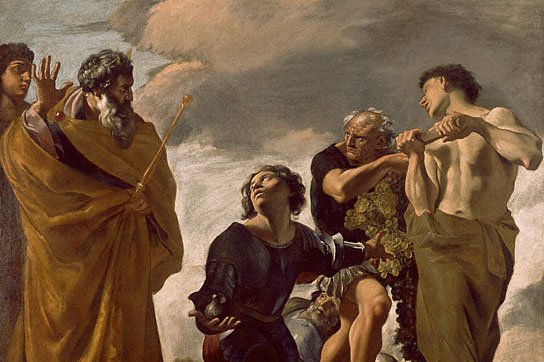
Giovanni Lanfranco, Moses and the Messengers from Canaan (1621-1624), J. Paul Getty Museum, public domain via Wikimedia Commons
Milk, honey, and giants — reported by everyone
When the spies report back to Moses and the assembled people, the positive part of their account is unanimous: "We came to the land to which you sent us. It does indeed flow with milk and honey, and here is its fruit" (Numbers 13:27, NABRE), backing the claim with physical evidence they'd carried back. But the same report immediately turns sober: "However, the people who are living in the land are powerful, and the towns are fortified and very large. Besides, we saw descendants of the Anakim there" (Numbers 13:28, NABRE) — the Anakim being, according to the text, an unusually large and intimidating people. So far, every one of the twelve spies is telling essentially the same story.
Ten voices of despair
It's what happens next that divides the group. Ten of the twelve spies take this shared information and turn it into a case for abandoning the whole endeavor, spreading what the text calls "discouraging reports" among the wider community: "The land that we went through and reconnoitered is a land that consumes its inhabitants. And all the people we saw there are huge" (Numbers 13:32, NABRE). Their closing line is the one that has echoed across centuries of retelling: "In our own eyes we seemed like mere grasshoppers, and so we must have seemed to them" (Numbers 13:33, NABRE) — a self-assessment offered as though it were observed fact, when it's really only the ten spies' own fear, projected outward and presented to the people as settled reality.
Two voices of a different spirit
Caleb, one of the twelve, tries to stop the panic before it spreads further, cutting through the crowd's rising fear with a direct counter-claim built on the very same facts: "We ought to go up and seize the land, for we can certainly prevail over it" (Numbers 13:30, NABRE). Joshua, another of the twelve, joins him in this same conviction. Neither man disputes what the other ten had observed — the cities really were fortified, the inhabitants really were formidable — but neither one accepts the conclusion that those same facts made conquest impossible. The disagreement isn't over evidence; it's over whether the evidence is the whole story, or whether God's earlier promises and demonstrated power belong in the equation too.
A whole generation, and two exceptions
The people side overwhelmingly with the ten discouraging voices, and their fear curdles quickly into despair and open rebellion against Moses and God. The consequence God announces is severe and specific: of the entire adult generation that had left Egypt, witnessed the plagues, the sea crossing, and God's repeated provision in the wilderness, and had still failed again and again to trust him, none would live to enter the land they now refused to trust God for — with two named exceptions. "As for my servant Caleb, because he has a different spirit and follows me unreservedly, I will bring him into the land which he entered, and his descendants shall possess it" (Numbers 14:24, NABRE); Joshua receives the same exemption. The rest of that generation, the text indicates, would instead spend the following decades wandering in the wilderness, dying there before their children eventually entered the land in their place.
What the ten spies actually got wrong
It's worth being precise about the nature of the ten spies' failure, since it wasn't dishonesty about what they saw. The cities were fortified. The people were formidable. Nothing in their physical description was false. Their failure was in what they left out of the equation entirely — the God who had already parted a sea and rained bread from the sky wasn't factored into their assessment of whether the conquest was possible. Caleb and Joshua saw the identical obstacles and reached the opposite conclusion, not because they minimized the danger, but because they refused to leave God's track record out of their calculation. That distinction — not what the twelve saw, but what ten of them chose to leave out of the story — is what the text ultimately holds each of them accountable for.
Trivia
Why did Moses send twelve spies into Canaan?
What did the spies report when they returned?
How did the majority of the spies describe their chances against the people of Canaan?
What did Caleb say in response to the discouraging report?
What consequence did God impose because of the people's fear?
You May Also Like

Related Reading