The Ten Plagues of Egypt

A confrontation that starts small and escalates fast
The plagues don't open with catastrophe. The first one is almost symbolic: Aaron strikes the Nile with his staff, and "all the water in the Nile was changed into blood," killing the fish and fouling the river Egypt's entire civilization depended on (Exodus 7:20-21, NABRE). It's a direct strike at the river the Egyptians worshipped as divine, and Moses's demand attached to every plague never wavers: "Let my people go to serve me" (Exodus 8:16, NABRE). Pharaoh's magicians can copy this first sign, so he shrugs it off. That pattern — disaster, brief concession, then a hardened refusal once the pressure lifts — repeats with almost mechanical regularity for the next eight plagues, and each repetition raises the stakes a little further.
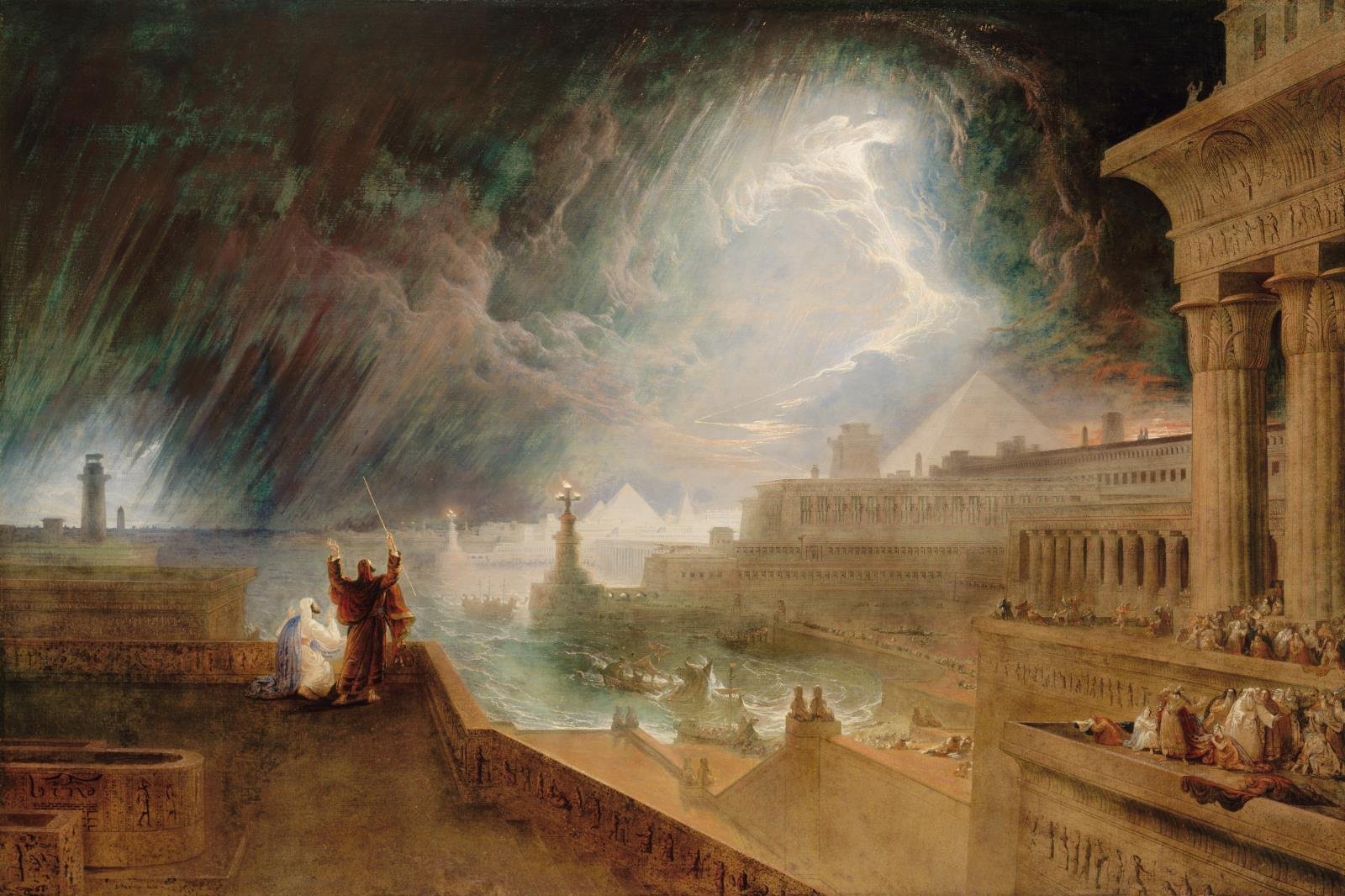
John Martin, "The Seventh Plague of Egypt," 1823, Museum of Fine Arts, Boston — public domain.
From nuisance to national catastrophe
Frogs follow the blood, swarming out of the Nile into "the houses of Pharaoh and the houses of his servants" until Egypt is overrun (Exodus 8:2, NABRE). Then come gnats, which the magicians finally cannot reproduce, forcing them to admit to Pharaoh, "This is the finger of God" (Exodus 8:15, NABRE) — the first crack in Egypt's confidence that its own power could match what Moses was doing. Flies follow, then a pestilence that kills Egyptian livestock while sparing every animal belonging to the Israelites (Exodus 9:6), then boils, and then a hailstorm so violent that Exodus calls it "such fierce hail as there has never been in Egypt from the day it was founded" (Exodus 9:18, NABRE) — the very storm painter John Martin captured in the dramatic canvas reproduced above, lightning splitting a blackened sky over a landscape already in ruins.
The moment Pharaoh's own advisers turn on him
By the eighth plague, locusts, something shifts that's easy to miss: Pharaoh's own servants start pushing back on him. "How long will he be a snare for us?" they ask. "Do you not yet realize that Egypt is being destroyed?" (Exodus 10:7, NABRE). The king who once ruled unchallenged is now being second-guessed by his own court, a detail the text includes almost in passing but which marks a real turning point — the cost of Pharaoh's stubbornness is no longer abstract to the people around him. Locusts strip whatever the hail had left standing; then three days of darkness "one can feel" fall over Egypt while, notably, "all the Israelites had light where they lived" (Exodus 10:21-23, NABRE) — a detail that turns a natural disaster into something unmistakably targeted.
The plague that changes everything
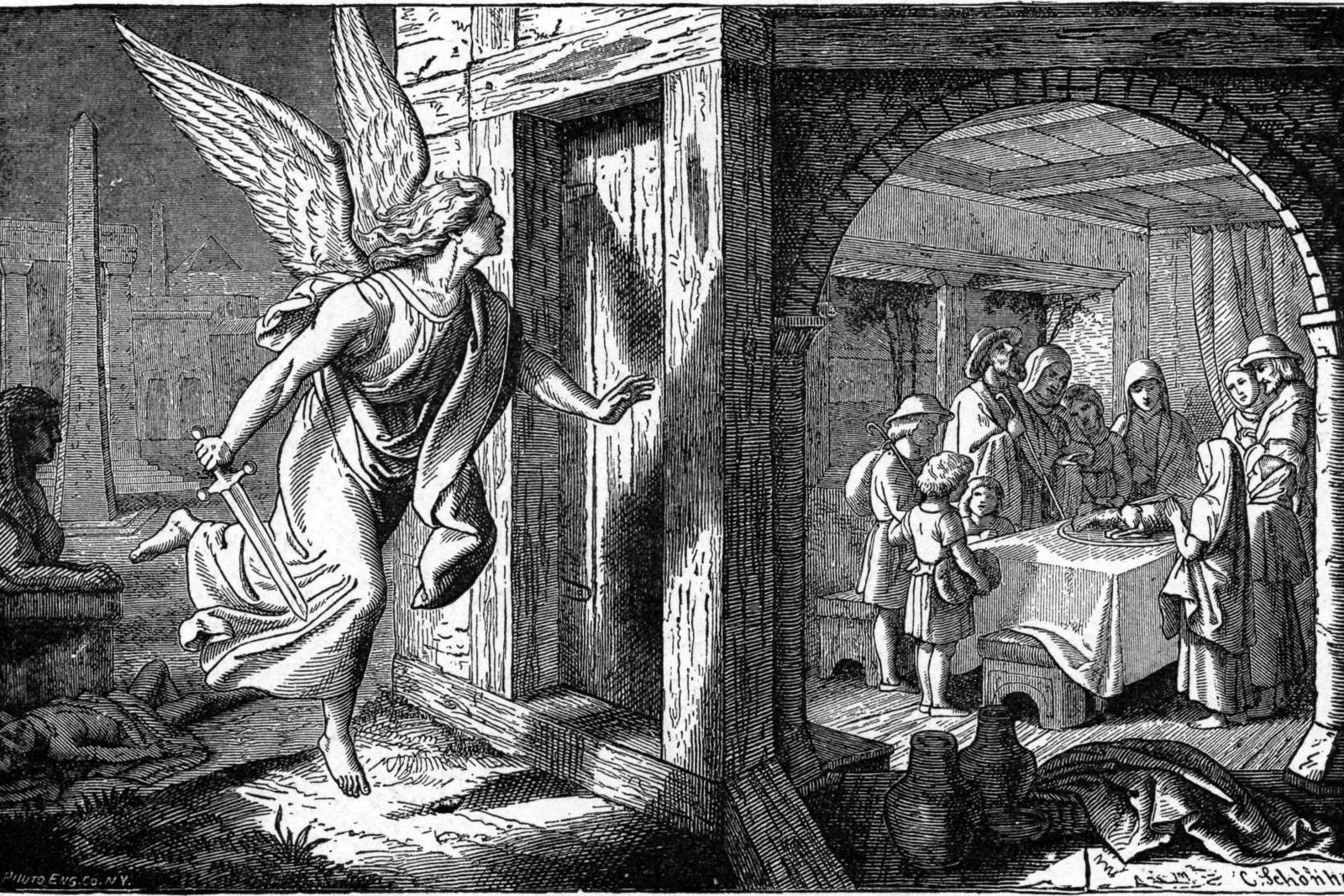
The tenth plague is different in kind, not just degree. At midnight, "the Lord struck down every firstborn in the land of Egypt, from the firstborn of Pharaoh sitting on his throne to the firstborn of the prisoner in the dungeon" (Exodus 12:29, NABRE), and the text adds a line that lands harder than any description of the earlier plagues: "there was not a house without its dead" (Exodus 12:30, NABRE). What spares the Israelite households is specific and deliberate — lamb's blood applied to the doorposts and lintel, so that, in God's own words to Moses, "Seeing the blood, I will pass over you" (Exodus 12:13, NABRE). That single verb, pass over, becomes the name of the festival Jewish families still celebrate every year: Passover.
Why the story insists on ten, not one
A skeptical reader might reasonably ask why an all-powerful God would need ten separate disasters to accomplish what the first one, in theory, could have forced. The text itself seems aware of the question and answers it directly: God tells Moses the plagues exist partly "that you may recount to your son and grandson" what happened (Exodus 10:2, NABRE) — the drawn-out confrontation is framed as a deliberate, memorable demonstration, not an inefficiency. Each plague also targets something Egypt specifically worshipped or depended on — the Nile, livestock, the sun itself blotted out in the ninth plague — turning the sequence into a systematic dismantling of Egyptian religious confidence, one god at a time, rather than a single indiscriminate catastrophe.
The escape that follows
Once the tenth plague breaks him, Pharaoh doesn't merely release the Israelites — Exodus says the Egyptians "urged the people on," desperate to see them gone, "for they said, 'All of us will die!'" (Exodus 12:33, NABRE). It's the last and most complete of Pharaoh's reversals, and this time it holds, at least long enough for Israel to leave Egyptian territory before he changes his mind one final time and pursues them to the edge of the Red Sea.
A story still retold every spring
Few episodes in the Old Testament have left as deep a mark on ongoing religious practice as the plagues and the Passover that closes them. Jewish families still recite all ten plagues at the Seder table each year, deliberately tempering their own joy at the recitation — a tradition that treats even a deserved judgment on an oppressor as something to mourn rather than celebrate outright. Christian tradition inherited the same story as the backdrop against which the Ten Commandments and the covenant at Sinai take shape: a people delivered first, given the Law only afterward. Martin's painting, exhibited to enormous crowds in London in the 1820s, captures the plagues at their most theatrically overwhelming — but the text itself is more interested in the slow, repeated collapse of one man's resistance than in spectacle for its own sake.
Trivia
What were the ten plagues of Egypt, in order?
Why did God harden Pharaoh's heart if he wanted Pharaoh to let the Israelites go?
Which plague finally convinced Pharaoh to let Israel go?
Did the Egyptian magicians really duplicate some of the plagues?
How many of the plagues are still commemorated today?
Related Reading