Balaam's Donkey

A Prophet for Hire
Balak, the king of Moab, watched Israel's enormous camp settle near his border and panicked. Rather than fight them outright, he sent messengers to a renowned prophet named Balaam with an offer: come curse this people for me, and name your price. God permitted Balaam to go, on one condition — he was to say only what God told him to say, nothing more.
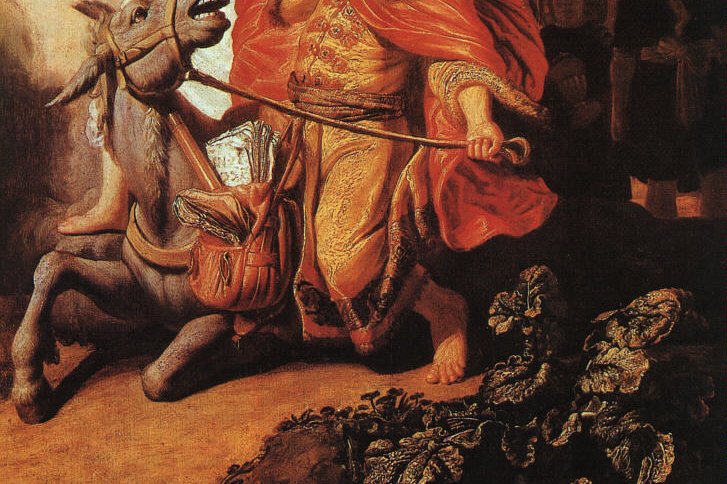
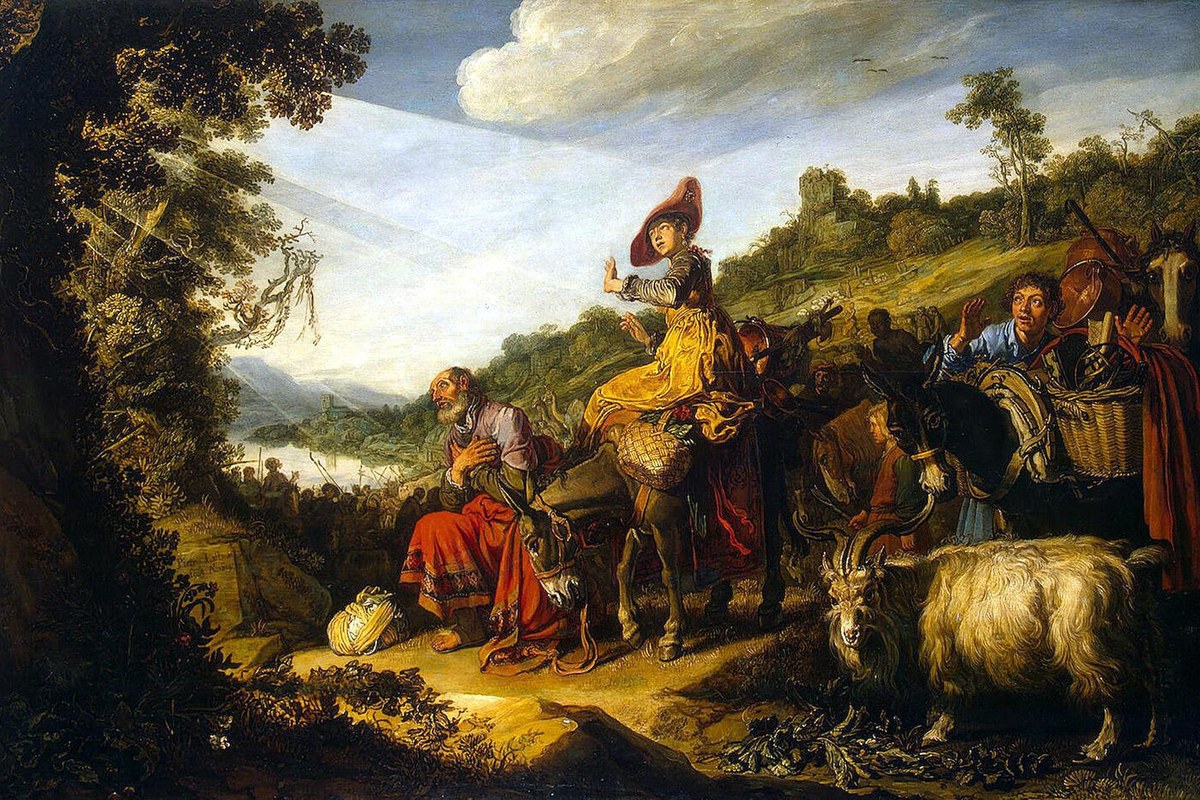
Rembrandt van Rijn, Balaam and the Ass, 1626 — public domain.
Balaam set out the next morning riding his donkey, accompanied by two servants. What he did not know, and his donkey did, was that God's anger had been kindled at his going, and an angel of the Lord had positioned himself in the road, sword drawn, to block the way.
The Donkey Sees What the Prophet Cannot
Three times the donkey reacted to a threat entirely invisible to her rider. First she "turned off the road and went into the field" to avoid the angel; Balaam beat her back onto the path. Next, in a narrow lane between two vineyard walls, she pressed herself so hard against the wall to avoid the angel that she crushed Balaam's foot; he beat her again. Finally, with nowhere left to swerve, she simply lay down under him (Numbers 22:23-27).
Balaam's anger flared, and he struck her a third time with his stick — at which point Scripture records one of its strangest sentences: "Then the Lord opened the mouth of the donkey, and she asked Balaam, 'What have I done to you that you beat me these three times?'" (Numbers 22:28). Balaam, remarkably, answers her as though talking animals were an unremarkable inconvenience: "You have acted so willfully against me that if I only had a sword at hand, I would kill you here and now" (22:29). The donkey presses her case reasonably — "Am I not your donkey, on which you have always ridden until now? Have I been in the habit of treating you this way before?" — and Balaam, cornered by his own animal's logic, admits: "No" (22:30).
The Prophet's Eyes Are Opened
Only then does God open Balaam's own eyes. He "saw the angel of the Lord standing on the road with sword drawn; and he knelt and bowed down to the ground" (22:31). The angel's rebuke makes clear how close Balaam had come to disaster: the donkey had turned aside from him three times, and had she not, the angel says plainly he would have killed Balaam and spared the animal. The creature Balaam had been furious with for disobedience had, in fact, been the only one on the road obeying correctly.
Balaam confesses his sin and offers to turn back, but the angel tells him to continue — with the same instruction God had already given: speak only what is commanded. True to that warning, when Balaam finally stands before Balak expecting to curse Israel, blessings come out of his mouth instead, four times over, regardless of the king's growing fury.
Blessings Instead of Curses
What happens once Balaam finally reaches Balak makes the donkey episode read almost as a warning shot before the main event. Four separate times, Balak leads Balaam to a different vantage point overlooking the Israelite camp, expecting a curse each time, and four times blessing comes out instead — despite the king's mounting fury and repeated attempts to relocate the ritual to somewhere the outcome might change. The most striking of these oracles looks well beyond the immediate conflict with Moab: "I see him, though not now; I observe him, though not near: A star shall advance from Jacob, and a scepter shall rise from Israel" (Numbers 24:17). Jewish and Christian tradition alike have long read this "star" oracle as messianic in scope, a prophecy pointing toward a future ruler rather than describing anything in Balaam's own lifetime — which is part of why some early Christian commentators connected it to the Star of Bethlehem centuries later, even though Balaam himself never intended, and Balak certainly never wanted, any of it spoken aloud.
Catholic and Christian Reading: A Warning Against Greed
The episode became proverbial well beyond its original context. The Second Letter of Peter cites Balaam directly as an example of a man who "loved payment for wrongdoing" but "was rebuked for his own crime: a mute beast, speaking with a human voice, restrained the prophet's madness" (2 Peter 2:15-16). Balaam's name becomes shorthand in the New Testament for a spiritual authority compromised by love of money, someone technically capable of prophecy who nearly wrecks himself by pursuing it for hire.
The comedy of the scene — a donkey out-arguing a prophet, an angel visible to livestock but not to the man supposedly attuned to God's voice — carries a serious point underneath it. Spiritual blindness in Scripture is rarely about lacking information; Balaam has already been told plainly what God wants. It's about willful movement in a direction convenient to one's own interest, even while insisting the actual plan is obedience. God's willingness to use a donkey, of all creatures, to stop him is a reminder that the instrument of correction rarely arrives from where the proud expect it.
Related reading: see Samson and Delilah for another Old Testament figure whose gifts nearly become his undoing, and Moses — Leader of the Exodus, Receiver of the Law for the larger story of Israel's wilderness journey Balaam's road intersects.
Trivia
Who was Balaam and why was he traveling?
Why did the donkey stop and refuse to move?
What did the donkey say when God let her speak?
What happened after Balaam's eyes were opened?
How is this episode understood in Christian tradition?
Related Reading