The Golden Calf

A people who couldn't wait forty days
The golden calf episode sits at an uncomfortable point in the Exodus story — not during Egyptian oppression, when fear and desperation might explain a lapse, but immediately after deliverance, while Moses is still up on Mount Sinai receiving the covenant that will define Israel as a people. Exodus is specific about the trigger: it isn't outright apostasy so much as anxious impatience. Moses has been gone forty days, an eternity to a crowd with no way of knowing what's happening on the summit, and Exodus records their demand to Aaron plainly: "Come, make us a god who will go before us; as for that man Moses who brought us out of the land of Egypt, we do not know what has happened to him" (Exodus 32:1, NABRE). It's worth noticing what they're actually asking for — not necessarily a rejection of the God who parted the Red Sea for them, but a visible substitute for a leader they've concluded has abandoned them.
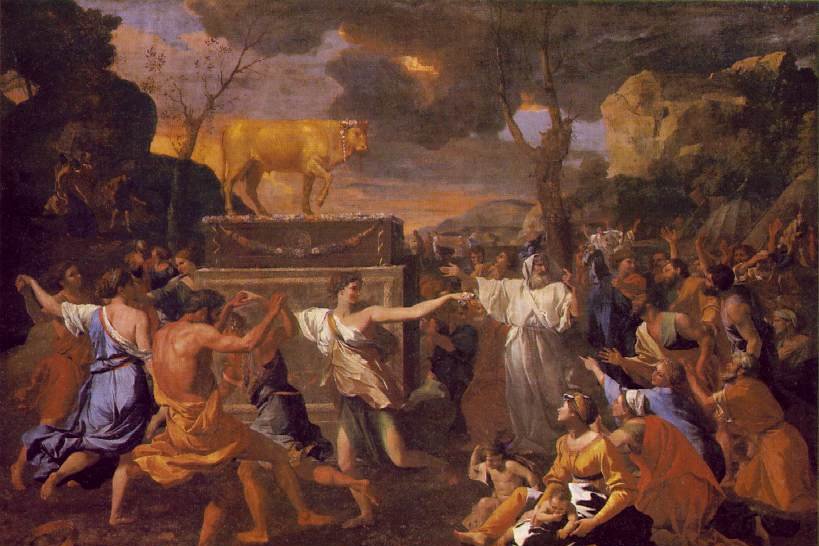
Nicolas Poussin, "The Adoration of the Golden Calf," c. 1634, The National Gallery, London — public domain.
Gold given twice, for two very different purposes
There's a detail here that later readers of Exodus have long found pointed: the same gold jewelry the Israelites had carried out of Egypt — much of it given to them by Egyptians eager to see them go — is what Aaron melts down to build the calf. Gold that had marked their freedom becomes, within the space of a few chapters, the material of their relapse. Aaron collects the earrings, "fashioning it with a tool, made a molten calf," and the people's response leaves no room for misinterpretation about what they believed they now possessed: "These are your gods, Israel, who brought you up from the land of Egypt" (Exodus 32:4, NABRE). Aaron then builds an altar and proclaims a feast "of the Lord" for the next day (Exodus 32:5) — a strange, blended gesture that seems to try to fold the old covenant and the new idol into a single celebration, as if the people could keep both.
What was happening on the mountain at the same moment
The narrative's cruelest irony is architectural: while the camp below celebrates its new idol, God is on the summit handing Moses the tablets of the Ten Commandments — including the prohibition, delivered only chapters earlier, against making "for yourself an idol" of anything in heaven, earth, or the waters (Exodus 20:4). God interrupts the giving of the Law to tell Moses what's happening below, calling the people "stiff-necked" and declaring his intention to "consume them" and start over with Moses alone (Exodus 32:9-10, NABRE). It's here that Moses does something the text treats as pivotal rather than incidental: he argues God out of it, invoking not Israel's merit but God's own promises to Abraham, Isaac, and Jacob (Exodus 32:11-13). Exodus says plainly that "the Lord changed his mind about the punishment he had threatened to inflict on his people" (Exodus 32:14, NABRE) — mercy secured through intercession before Moses has even come down the mountain.
Descending into the scene, and breaking what he was carrying
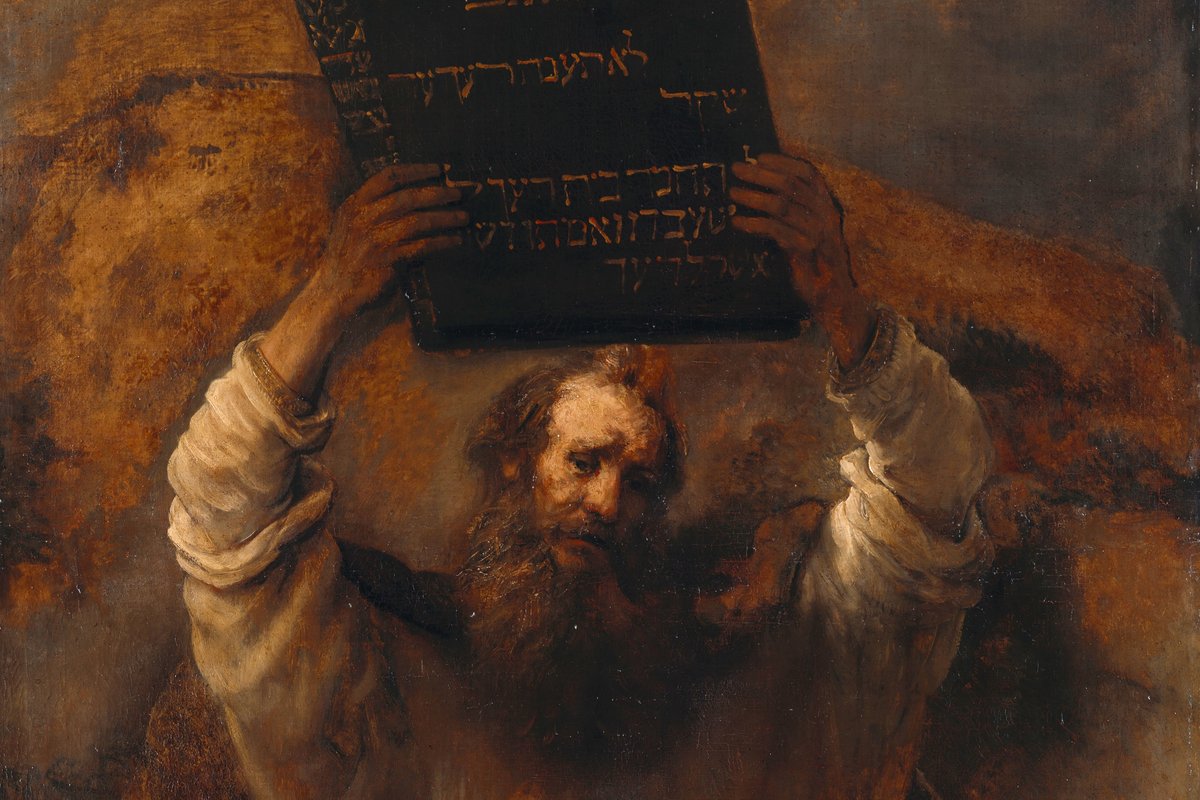
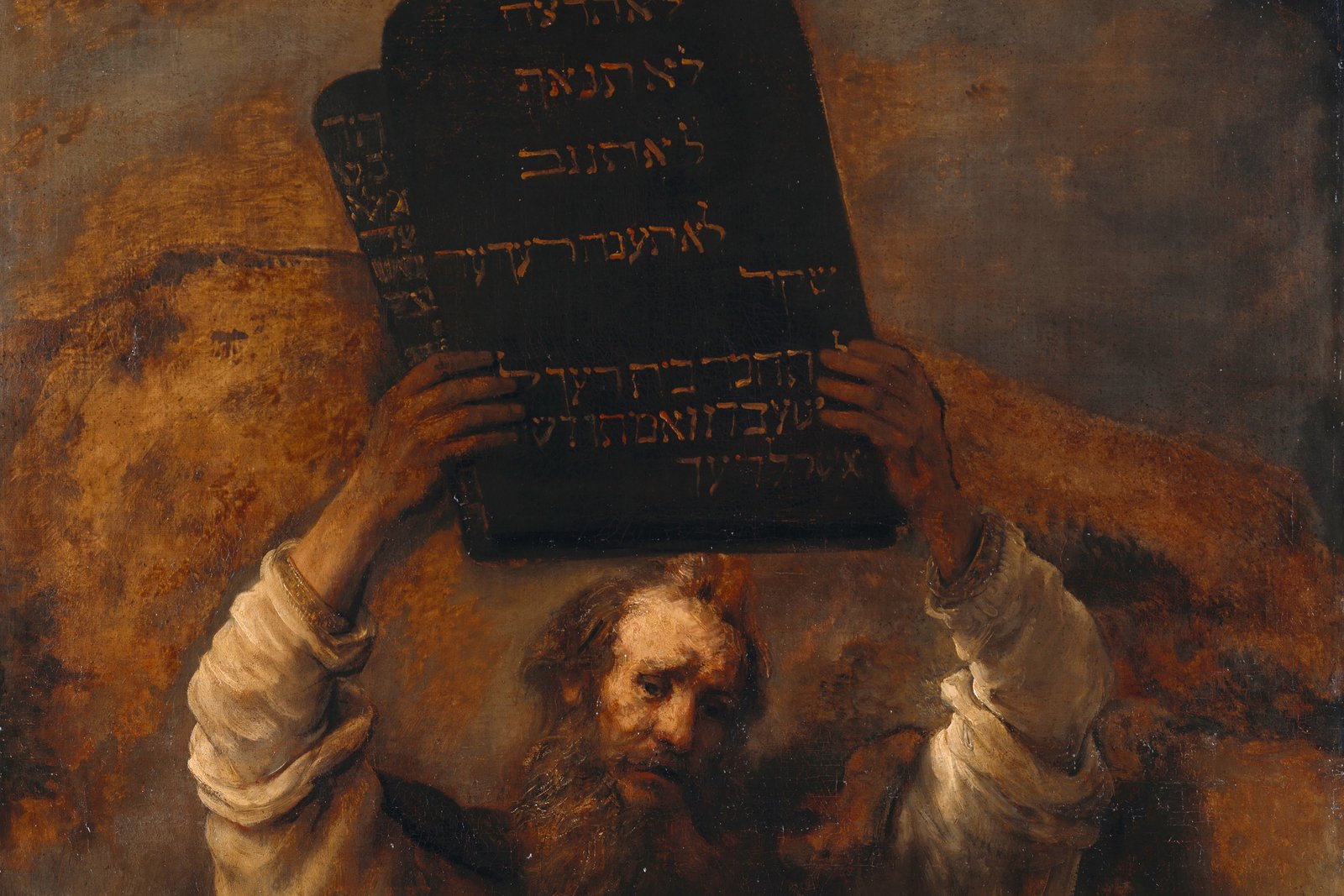
When Moses finally reaches the camp and sees the calf and the dancing firsthand, his reaction is immediate and physical: "Moses' anger burned, and he threw the tablets down and broke them on the base of the mountain" (Exodus 32:19, NABRE). It's easy to read this only as an outburst of rage, but the act carries its own symbolic logic — the tablets represent the covenant, and the covenant has already been broken by the people's idolatry before Moses ever lifts his arm. Poussin's painting, reproduced above, captures the scene at the height of the celebration: the calf raised on its pedestal, the crowd caught mid-dance, oblivious to the two tiny figures — Moses and Joshua — just visible descending in the distance, carrying judgment they don't yet see coming.
Confronting Aaron, and a forgiveness that still carries cost
Moses turns next to his own brother, asking what the people did to lead him "into a grave sin" (Exodus 32:21, NABRE). Aaron's defense — that he merely threw gold into a fire and "this calf came out" (Exodus 32:24) — is one of Scripture's more transparent dodges, and the text simply lets it stand without editorial comment, trusting the reader to weigh it against what actually happened. Moses destroys the idol completely, grinding it to powder and making the people drink it dissolved in water (Exodus 32:20), then intercedes for the nation a second time, offering to be blotted out of God's own book rather than let the people go unforgiven (Exodus 32:32). God spares the nation as a whole, but the chapter doesn't end painlessly — a plague follows, and roughly three thousand people die in the aftermath (Exodus 32:28, 35), a reminder that in this account, mercy and consequence aren't presented as opposites.
Why the episode still matters
Catholic tradition has long read the golden calf less as an isolated lapse than as a case study in what happens when trust falters under delay — a warning less about idolatry in the literal, statue-building sense and more about impatience with God's timing, and the human tendency to demand something visible and controllable in place of promises that require waiting. It's also, notably, one of the clearest Old Testament portraits of intercessory prayer: Moses doesn't excuse the people's sin, but he stands between them and judgment and argues, twice, on their behalf. That pattern of a mediator pleading for a faithless people echoes throughout the rest of Scripture, and it's part of why the golden calf, despite depicting Israel at its worst, remains one of the Old Testament's clearest pictures of what mercy costs the one who asks for it.
Trivia
Why did the Israelites build the golden calf?
What exactly did Aaron do, and did he really claim the calf made itself?
What did Moses do when he saw the calf?
Did God ultimately forgive the Israelites for the golden calf?
What happened to the golden calf itself?
Related Reading