The Washing of the Feet

A servant's job, taken up by the teacher
John places the scene precisely: "before the feast of the Passover," at the meal that would become the Last Supper, Jesus "He took a towel and tied it around his waist. Then he poured water into a basin and began to wash the disciples’ feet and dry them with the towel around his waist." (John 13:4-5, RSV-CE). In first-century Judea, where sandaled feet picked up the dust and grime of unpaved roads, washing a guest's feet before a meal was a basic courtesy — but it was work assigned to the household's lowest servant, sometimes even withheld from Jewish servants and left specifically to non-Jewish slaves. That a teacher his disciples addressed as "Rabbi" and "Lord" would take up a basin and towel himself, working his way around the table on his knees, upended the social expectations of everyone reclining there.
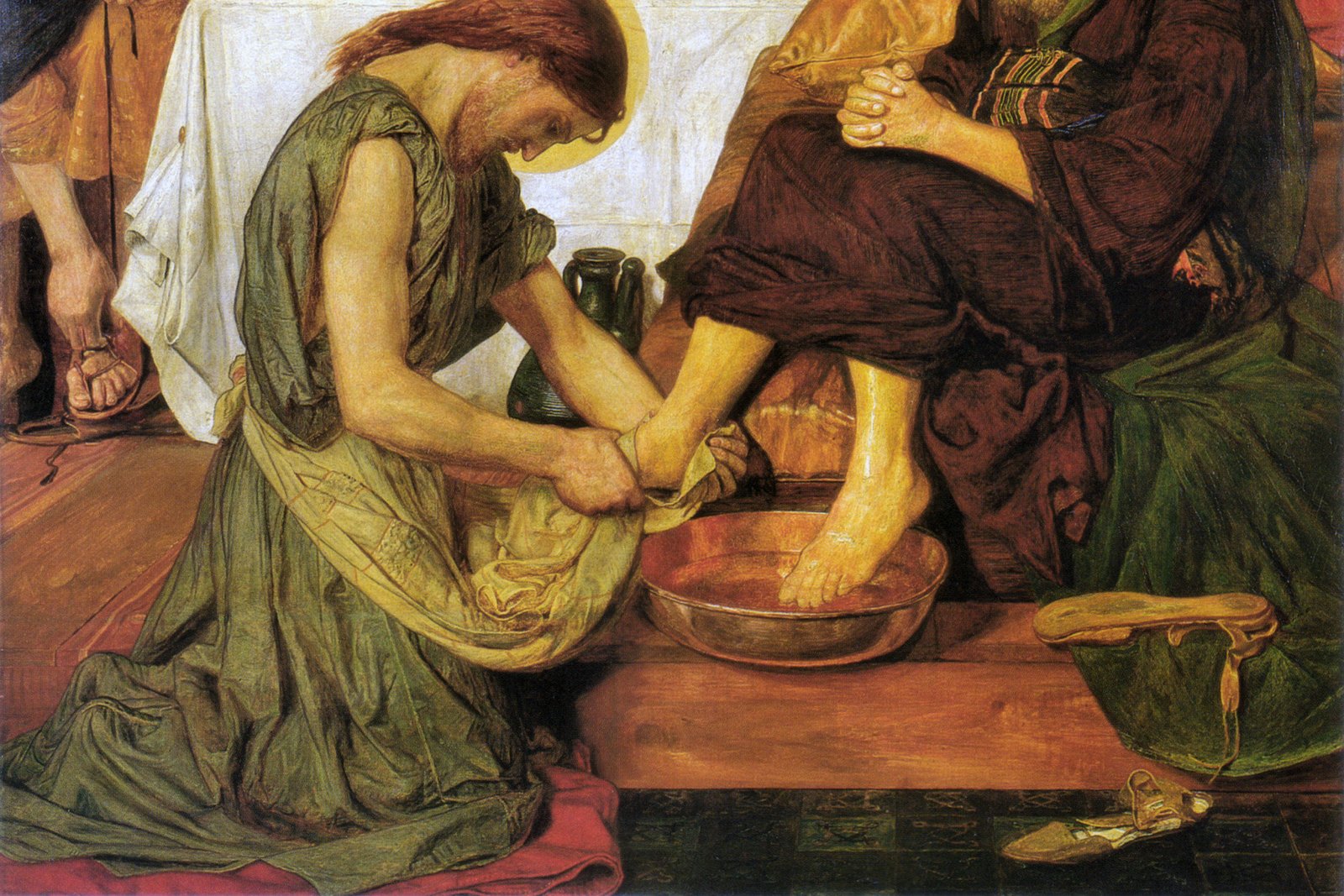
Ford Madox Brown, "Jesus Washing Peter's Feet," 1852–56, Tate Gallery, London — public domain.
Peter's protest
Simon Peter's reaction, true to character throughout the Gospels, is immediate and blunt: "Master, are you going to wash my feet?" (John 13:6, RSV-CE), followed moments later by an outright refusal — "You will never wash my feet." (John 13:8, RSV-CE). Jesus's response reframes the entire gesture as something more than hospitality: "Unless I wash you, you will have no inheritance with me." (John 13:8, RSV-CE). Peter, characteristically, swings to the opposite extreme at once, asking Jesus to wash not only his feet but his hands and head as well (John 13:9) — a small, human moment of overcorrection that appears again and again in Peter's story, including, not long after this same meal, in his own three denials of Jesus later that same night.
"You also ought to wash one another's feet"
Once he finished, Jesus put his outer garments back on, returned to the table, and explained what he had done — not as a private act of affection, but as a model: "If I, therefore, the master and teacher, have washed your feet, you ought to wash one another’s feet. I have given you a model to follow, so that as I have done for you, you should also do." (John 13:12-15, RSV-CE). The lesson isn't abstract. Jesus states it as a practical command directed at people who, by his own description moments earlier, had just watched their Lord perform the lowest servant's task without hesitation. He follows it, later in the same discourse, with a further command that has since taken on its own liturgical name: "I give you a new commandment: love one another. As I have loved you, so you also should love one another." (John 13:34, RSV-CE) — the origin of the term Maundy Thursday, from the Latin mandatum, "commandment."
One exception in the room
John notes something darker running beneath the scene: Jesus, aware of what was coming, tells the disciples plainly that not all of them are clean, an allusion — John makes explicit a few verses later — to Judas Iscariot, who would leave the table that same night to set the events of the arrest in motion (John 13:10-11, 21). The detail sharpens the scene considerably: Jesus knelt and washed the feet of the man who was, within hours, going to betray him, extending the same servant's gesture to Judas that he extended to every other disciple at the table.
Why the Church still washes feet
The washing of the feet developed, over centuries of Christian practice, into a liturgical rite of its own — the Mandatum, performed in many Catholic parishes during the Holy Thursday evening Mass, when a priest or bishop kneels to wash the feet of several members of the congregation in direct imitation of the Gospel scene. This is a matter of liturgical tradition rather than formal dogma; the practice's exact form has varied across centuries and regions, but its purpose has stayed consistent with the words John records Jesus speaking that night — a physical enactment of humility and service meant to be lived out, not merely admired as history. Pope Francis drew particular attention during his pontificate by choosing to wash the feet of prisoners, the disabled, and people of other faiths during this same rite, a choice widely read as extending the Gospel scene's original point about service crossing social boundaries.
A lesson placed at the threshold of the Passion
What makes the washing of the feet so striking within John's narrative is its placement. It comes immediately before the events John's Gospel treats as the true center of the story — the Last Supper discourse, the agony in the garden, the arrest, and the crucifixion itself. Set against the fuller sequence traced in The Passion of Christ — A Complete Walkthrough, John chooses to open that entire sequence not with a teaching delivered from a position of authority, but with Jesus on his knees, performing the lowest task in the room for the very men who would scatter and, in Peter's case, deny him within hours. Read that way, the scene functions almost as a key to everything that follows: whatever else the Passion means, it begins with Jesus demonstrating, in the plainest physical terms available, what he meant when he told his disciples that "For the Son of Man did not come to be served but to serve and to give his life as a ransom for many." (Mark 10:45, RSV-CE).
Trivia
Why did Jesus wash his disciples' feet?
Why did Peter initially refuse to let Jesus wash his feet?
When did the washing of the feet take place?
Is the washing of the feet mentioned in all four Gospels?
What is the Mandatum, or Holy Thursday foot-washing ceremony?
Related Reading