The Crucifixion of Jesus

A hill outside the walls
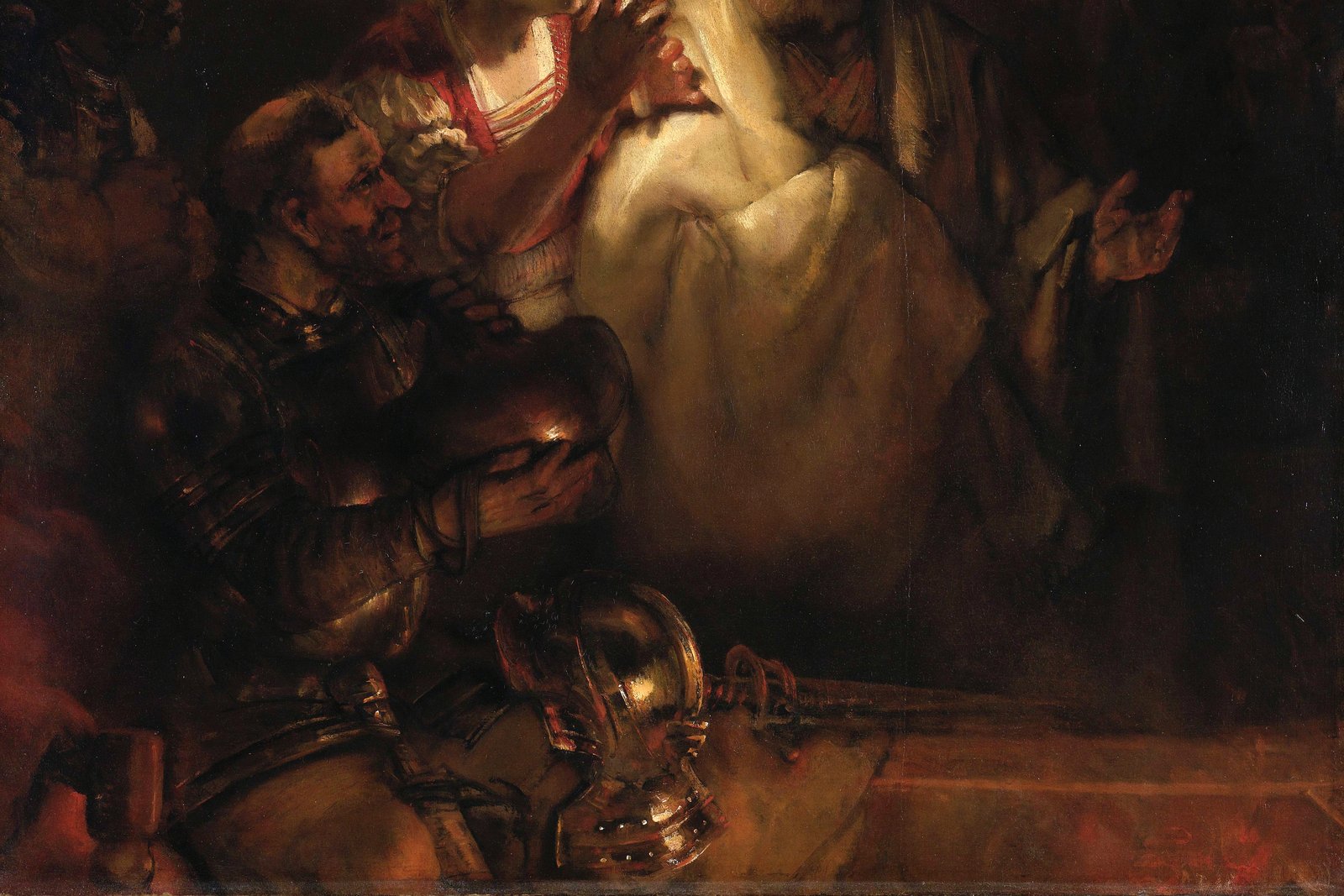
The crucifixion sits at the center of a much longer sequence of events traced in full in The Passion of Christ — A Complete Walkthrough. By the time Jesus reached Golgotha — "place of a skull," as John's Gospel translates the name (John 19:17, RSV-CE) — he had already been flogged, mocked, and forced to walk through Jerusalem's streets carrying the crossbeam of his own execution. The Gospels record the crucifixion itself with a kind of restraint that can surprise readers used to more graphic retellings: Mark's account of the moment itself opens as simply as this — "Then they crucified him" (Mark 15:24, NABRE) — with the surrounding detail carrying the emotional weight instead. Two criminals were crucified on either side of him, and above his head the soldiers fixed a sign reading "The King of the Jews," intended as mockery but recorded by John as written in three languages — Hebrew, Latin, and Greek — so that no one passing by could miss it (John 19:19-20).
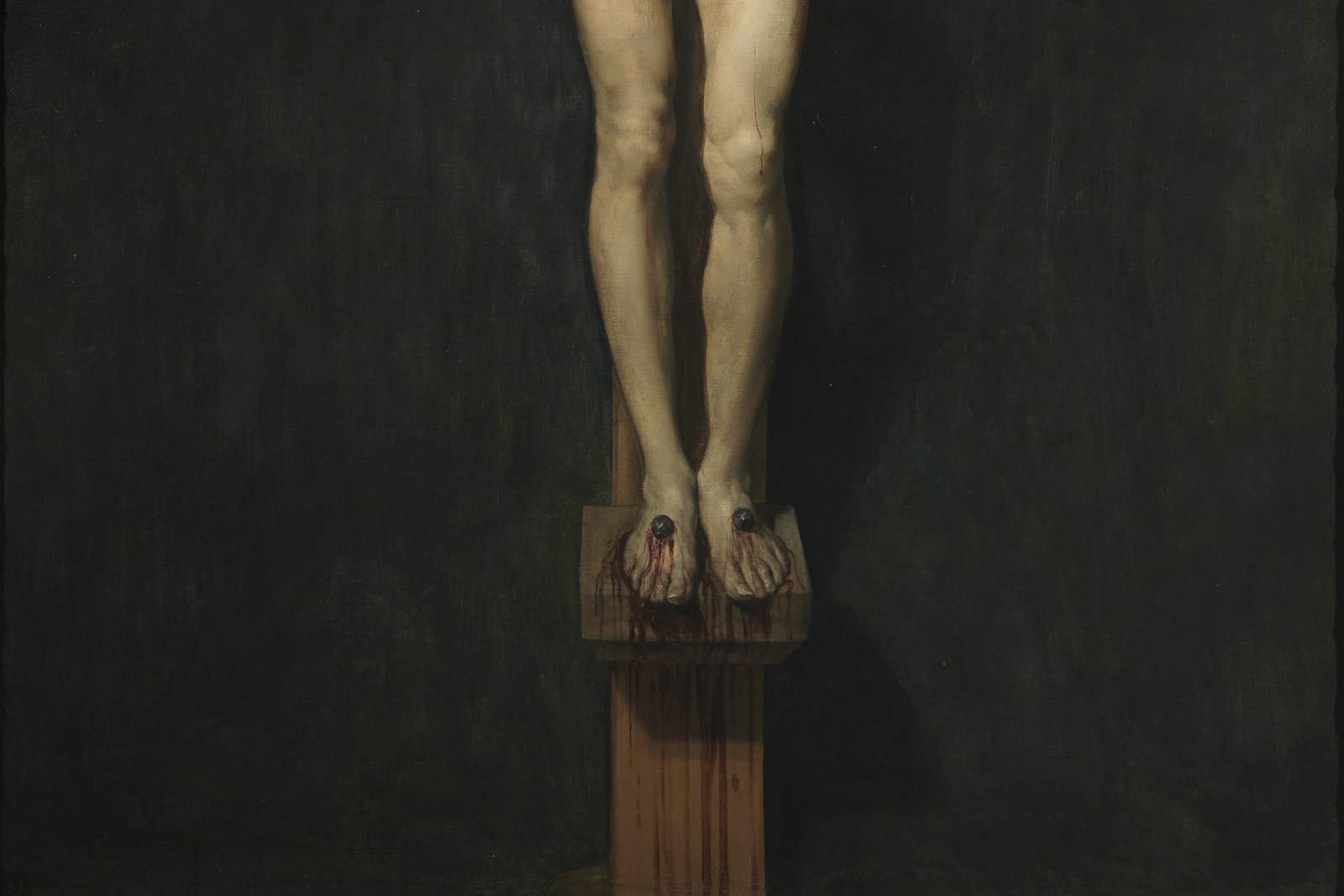
Diego Velázquez, "Christ Crucified," c. 1632, Museo del Prado, Madrid — public domain.
Darkness at noon
All three synoptic Gospels — Matthew, Mark, and Luke — record an extraordinary detail: "From noon onward, darkness came over the whole land until three in the afternoon." (Matthew 27:45, RSV-CE), roughly noon until three in the afternoon. Scripture doesn't explain the darkness scientifically; it functions instead as a sign, echoing Old Testament imagery of divine judgment and mourning. It was at the end of that darkness that Jesus cried out in the words of Psalm 22, "My God, my God, why have you forsaken me?" (Matthew 27:46, RSV-CE) — a line that has troubled and moved readers for two thousand years, understood by most Christian commentators not as despair but as Jesus praying the opening of a psalm that itself moves from anguish toward trust and vindication.
The seven last words
Tradition has gathered seven statements Jesus makes from the cross across all four Gospels — no single Gospel contains all of them — into a sequence often called the "seven last words." They range from mercy ("Father, forgive them, for they know not what they do," Luke 23:34, RSV-CE) to intimate care for his mother ("Woman, behold your son," John 19:26, RSV-CE, addressed to Mary and the beloved disciple) to simple physical need ("I thirst," John 19:28, RSV-CE). The final words vary by Gospel: John records "It is finished" (John 19:30), while Luke has Jesus commending himself entirely to the Father — "Father, into your hands I commend my spirit" (Luke 23:46, RSV-CE) — a line itself drawn from Psalm 31:5. Read together, the seven statements move from forgiveness of his executioners to assurance for a dying criminal beside him, to care for his mother, to raw physical and spiritual anguish, and finally to completion and surrender — a shape many readers have found theologically deliberate rather than incidental.
A criminal's request
One of the two men crucified alongside Jesus turns, in Luke's account, from mockery to an unexpected plea: "Jesus, remember me when you come into your kingdom" (Luke 23:42, RSV-CE). Jesus's answer is immediate and without qualification: "Amen, I say to you, today you will be with me in Paradise." (Luke 23:43, RSV-CE) — a promise of salvation extended not to a disciple or a righteous man by any conventional measure, but to someone dying for his own crimes in his final hour. Christian tradition, drawing on later apocryphal sources rather than the Gospels themselves, has given this figure the name Dismas, though Luke's own text leaves him unnamed.
The veil and the confession
At the moment of Jesus's death, Matthew, Mark, and Luke each record that "The veil of the sanctuary was torn in two from top to bottom." (Mark 15:38, RSV-CE) — the veil that separated the temple's inner sanctuary, the Holy of Holies, from the rest of the building. Traditionally read as a sign that the barrier between God and humanity had been removed, the tearing is paired in Matthew's Gospel with an earthquake and the opening of tombs (Matthew 27:51-52). It's in the immediate aftermath of these signs that a Roman centurion — a professional soldier with no religious stake in Jewish messianic claims, present at the scene purely as an officer overseeing an execution — makes his own declaration: "Truly this was the Son of God!" (Matthew 27:54, RSV-CE). Mark records a nearly identical line (Mark 15:39), and in both Gospels it stands as one of the earliest confessions of Jesus's divine identity, spoken by an outsider rather than a follower.
What the Church teaches about the cross
The Catechism of the Catholic Church describes Christ's crucifixion not merely as a historical event but as the center of the story of salvation: "Christ's death is both the Paschal sacrifice that accomplishes the definitive redemption of men... and the sacrifice of the New Covenant" (CCC 613). This is a matter of doctrine, distinct from devotional traditions that have grown up around the crucifixion over the centuries — the fourteen Stations of the Cross, for instance, or the imagery associated with the Sacred Heart of Jesus, both of which meditate on the crucifixion without themselves being part of the Church's formal dogmatic teaching. The Exaltation of the Holy Cross, a feast celebrated every September 14, developed centuries later specifically to honor the cross as an instrument that Christian tradition holds to have become, through the crucifixion, a sign of victory rather than only of suffering.
Burial before sundown
John's Gospel notes a detail rooted in Jewish law: because the following day was the Sabbath, and Passover as well that year, the bodies could not be left on the crosses overnight (John 19:31). Soldiers broke the legs of the two criminals to hasten death, but finding Jesus already dead, one instead "thrust his lance into his side, and immediately blood and water flowed out" (John 19:34, NABRE) — a detail John presents as eyewitness testimony and that later Christian reflection has connected to the sacraments of baptism and the Eucharist. Joseph of Arimathea, described as a secret disciple, requested the body from Pilate and, with Nicodemus, buried Jesus in a new tomb before sundown — setting the stage for the events of Easter morning still to come.
Trivia
What are the seven last words of Jesus on the cross?
Where was Jesus crucified?
What did the centurion say after Jesus died?
Why is the crucifixion central to Christian belief?
How long did Jesus hang on the cross?
Related Reading