Jesus Christ the Good Shepherd

Roots in Israel's shepherd-kings
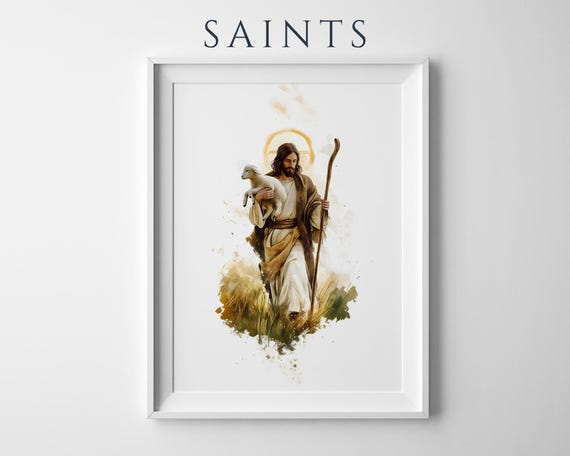
The image didn't appear out of nowhere. Shepherding language runs throughout the Hebrew Scriptures, most famously in Psalm 23's opening line — "The Lord is my shepherd; I shall not want" (Psalm 23:1, RSV-CE) — a psalm traditionally attributed to King David, who had literally worked as a shepherd before he became Israel's most celebrated king. The prophet Ezekiel goes further, condemning Israel's leaders as false shepherds who "did not strengthen the weak" or "seek the lost" (Ezekiel 34:4, NABRE), and promising that God himself would step in to search for and rescue the scattered flock (Ezekiel 34:11-12, RSV-CE). When Jesus calls himself the Good Shepherd in John's Gospel, he is deliberately picking up this thread — claiming, for a Jewish audience steeped in these texts, the very role that the prophets said only God could truly fulfill.
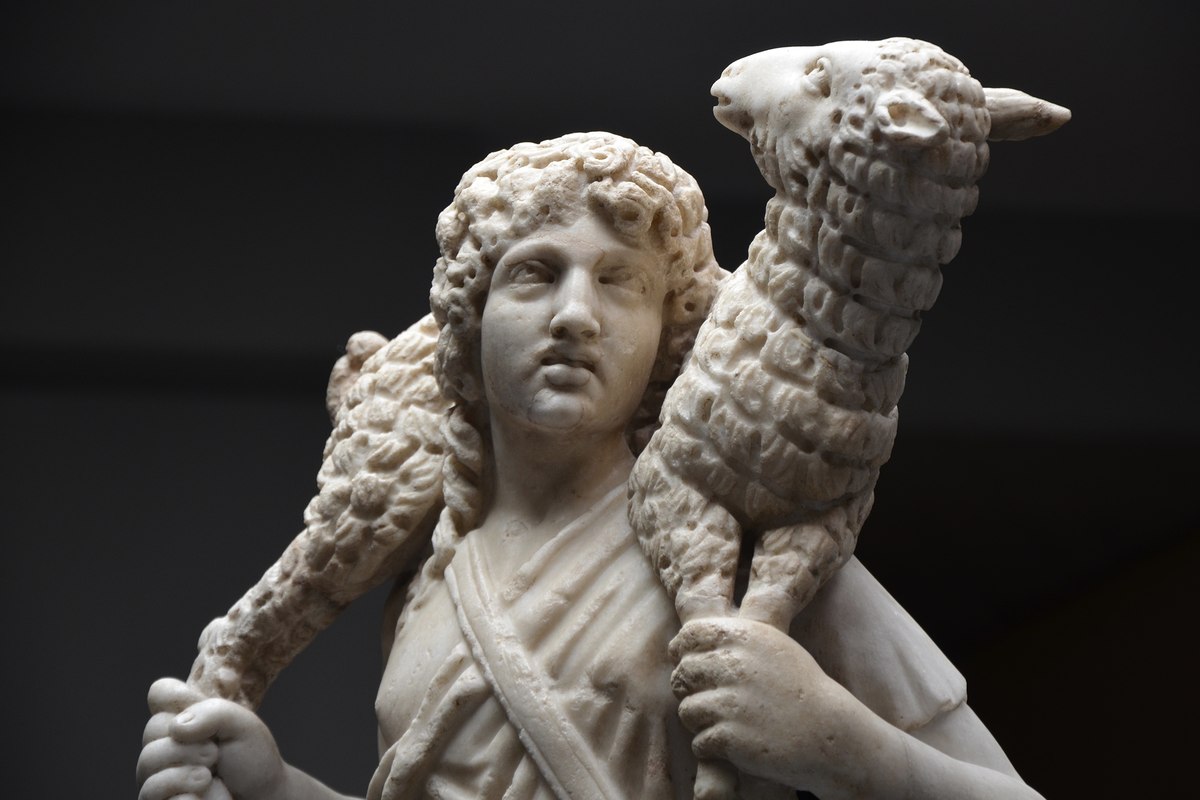
Marble statue of the Good Shepherd, c. 300-350 AD, from the Catacombs of Domitilla, Vatican Museums — photo by Carole Raddato, CC BY-SA 2.0.
A title Jesus claims for himself
Unlike many of the titles later applied to Jesus, "Good Shepherd" comes directly from his own words. In John's Gospel, he states it plainly: "I am the good shepherd. The good shepherd lays down his life for the sheep" (John 10:11, RSV-CE). He immediately draws a contrast with someone who only appears responsible: "A hired man, who is not a shepherd and whose sheep are not his own, sees a wolf coming and leaves the sheep and runs away" — "because he works for pay and has no concern for the sheep" (John 10:12-13, NABRE). The distinction isn't about skill. It's about whether the one responsible actually has something at stake.
The one sheep worth searching for
Jesus develops the same idea narratively elsewhere in the Gospels, in the parable of the lost sheep. A shepherd with a hundred sheep, on discovering that one has wandered off, leaves the ninety-nine to search for the single missing animal, and when he finds it, he "And when he does find it, he sets it on his shoulders with great joy" (Luke 15:5, RSV-CE) — the exact posture captured in the catacomb statue above, the lamb draped across the shepherd's shoulders rather than driven ahead with a staff. Jesus explains the point of the story directly afterward: "I tell you, in just the same way there will be more joy in heaven over one sinner who repents than over ninety-nine righteous people who have no need of repentance." (Luke 15:7, RSV-CE). It's a strikingly different arithmetic than most people would apply to managing a flock — the one who is lost matters more, in this telling, than the ninety-nine who are safe.
Knowledge that runs both directions
Jesus extends the image further, describing a relationship rather than just a duty: "I am the good shepherd, and I know mine and mine know me, just as the Father knows me and I know the Father; and I will lay down my life for the sheep." (John 10:14-15, RSV-CE). The comparison to his own relationship with the Father raises the stakes of the metaphor considerably — this isn't a hireling's arrangement, but something closer to a bond that runs both ways.
The most common image in the catacombs
That image resonated with the earliest Christians more than almost any other. The Catacombs of Rome alone preserve roughly 150 depictions of the Good Shepherd, making it the single most frequent symbolic portrayal of Christ from the 2nd through the 6th centuries — well before the crucifix or other now-familiar images became common. The statue pictured above, carved sometime around 300-350 AD and recovered from the Catacombs of Domitilla, is a typical example: a young, beardless shepherd, not a bearded judge or a crowned king.
Art historians note that the visual type itself predates Christianity — sculptors in the Greco-Roman world had long produced similar figures, usually called kriophoros ("ram-bearer"), showing a young herdsman carrying an animal for sacrifice or simply as a pastoral scene. Early Christian artists borrowed this familiar, unthreatening form and gave it new meaning, which is part of why the image could appear so frequently in a period when Christianity itself was still an illegal or barely tolerated religion within the Roman Empire — to an outsider glancing at catacomb art, a shepherd carrying a lamb looked like ordinary decoration, not a coded profession of faith.
Why rescue came before authority
That choice reflects something specific about the moment in which it was made. Painted and carved during periods of real uncertainty and persecution, the image doesn't present Christ first as ruler or judge — it presents him as one who seeks, finds, and carries. For communities living under threat, that emphasis on rescue and personal care, rather than power or judgment, was evidently the version of Christ's identity that mattered most to picture first.
From catacomb walls to the parish today
The Good Shepherd image never disappeared from Christian life, even as other portrayals of Christ — the crucified Christ, Christ Pantocrator enthroned in majesty, the Sacred Heart — came to dominate later centuries of art. The fourth Sunday of Easter is still known in the Catholic liturgical calendar as Good Shepherd Sunday, when the Gospel reading each year is drawn from John 10, and it has traditionally served as a day set aside for prayer for vocations to the priesthood and religious life, tying the image of Christ the shepherd to the Church's ongoing need for people willing to shepherd others in his name. The crook or shepherd's staff carried by bishops to this day, called a crosier, is a direct descendant of the same idea — a visual reminder that the office of bishop is meant to be pastoral care, modeled on Christ's own description of himself, rather than simple authority for its own sake.
Trivia
Where does the title 'Good Shepherd' come from?
How common was this image in early Christian art?
Why did early Christians choose this image specifically?
What does Jesus say sets the good shepherd apart from a hired hand?
Related Reading