The Communion of Saints Explained

A phrase hiding a whole doctrine
The Apostles' Creed is short by design, a compressed summary of belief meant to be memorized and recited, not a theological treatise. So it's easy to say "I believe in the communion of saints" at Mass on a Sunday without pausing over what a dense claim that single phrase actually makes. The Catechism doesn't treat it as a minor footnote to the article on the Church that precedes it — it treats it as an unpacking of that same article, going so far as to state outright: "The communion of saints is the Church" (CCC 946). Whatever this doctrine means, it isn't peripheral. It's close to a definition of what the Church actually is.
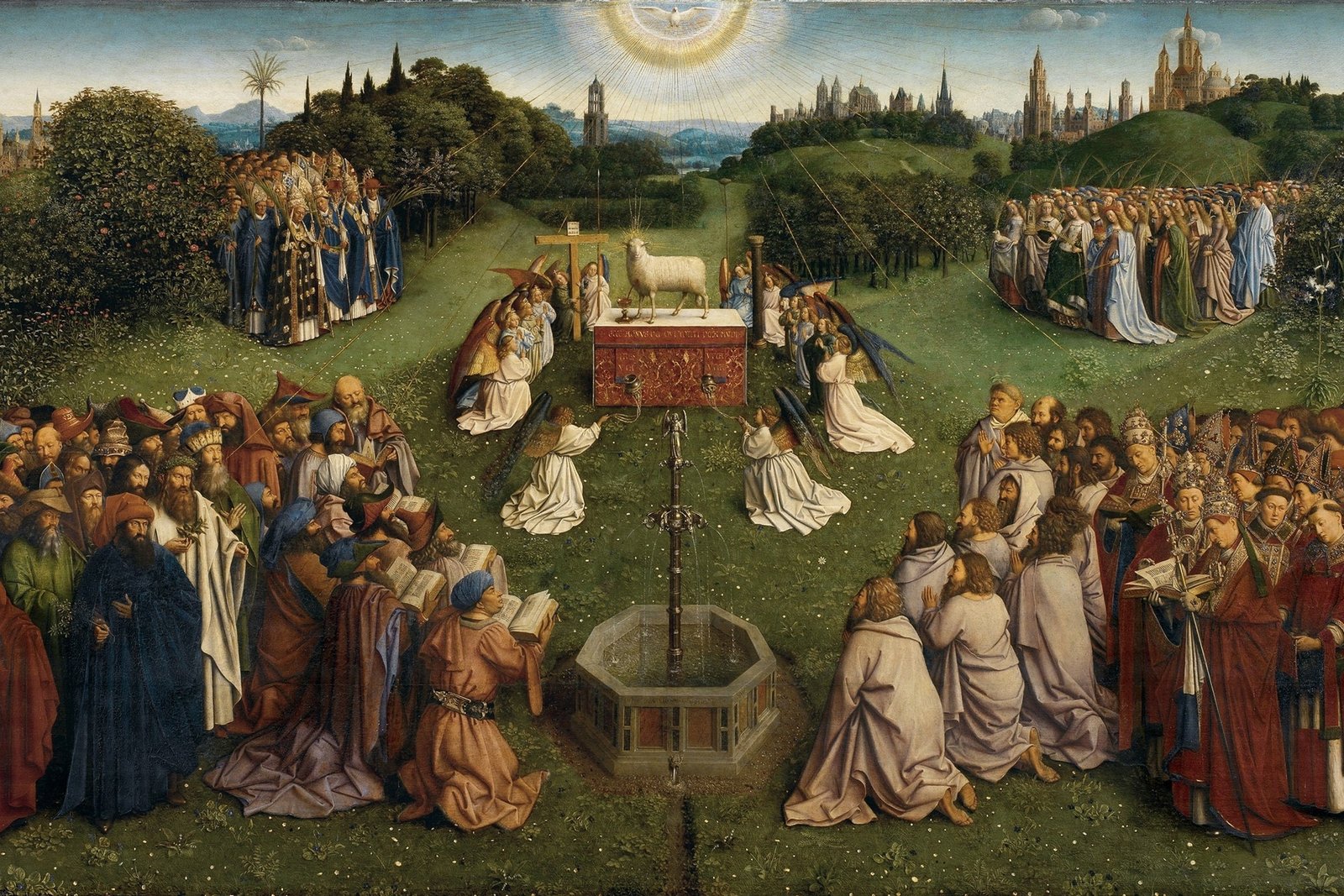
Jan van Eyck, Adoration of the Mystic Lamb (Ghent Altarpiece, central panel), 1432, Saint Bavo Cathedral, Ghent — public domain.
Two meanings folded into one phrase
The Catechism identifies two senses bound up together in the term "communion of saints," drawing on the double meaning of the Latin word sancta — holy things — and sancti — holy persons: "communion 'in holy things (sancta)' and 'among holy persons (sancti)'" (CCC 948).
The first sense, communion in holy things, points primarily to the sacraments — above all the Eucharist, in which believers share the one Body and Blood of Christ and, through that sharing, are joined to one another. The second sense, communion among holy persons, points to the actual bond between believers themselves, a spiritual family knit together by grace rather than mere shared belief or shared attendance at the same church building.
Neither sense is meant to stand entirely alone. The sacraments create and sustain the bond between persons; the bond between persons is expressed and deepened through the sacraments. The phrase holds both meanings at once, the way a single word can carry more than one sense without the meanings competing.
Three states, one communion
Catholic tradition describes this communion as spanning three distinguishable states, sometimes called the Church Militant, the Church Suffering, and the Church Triumphant:
The Church on earth (traditionally "militant," a term describing spiritual struggle, not violence) consists of believers still living out their faith day to day, still capable of sin, still working toward the holiness God calls them to.
The Church being purified ("suffering," or more commonly today "the souls in purgatory") consists of those who have died in God's grace and friendship but still need purification before entering the fullness of heaven — a state Catholic teaching holds is temporary, not permanent.
The Church in glory ("triumphant") consists of those who have already completed that purification and stand in the full presence of God, including canonized saints but also, Catholic teaching holds, countless others never formally recognized.
What makes this a communion rather than three separate, disconnected groups is the claim that real spiritual exchange still happens across all three states — prayer, intercession, solidarity — not merely shared membership in the same abstract category.
What the living can do for the dead
One of the more practically significant implications of this doctrine is that the bond doesn't end at death. The Catechism teaches that "since the faithful departed now being purified are also members of the same communion of saints, one way we can help them is to obtain indulgences for them" (CCC 1479), alongside prayer and almsgiving offered on their behalf. This is the theological basis behind the Catholic custom of praying for the dead — the assumption that such prayer isn't a symbolic gesture toward someone beyond help, but a real act of solidarity that Catholic teaching holds can actually assist a soul still being purified.
What the dead in glory can do for the living
The relationship runs the other direction too. Catholics ask saints already in heaven to intercede for them — to pray on their behalf before God — in much the same spirit as asking a friend still living to pray for a difficult situation. This practice sometimes gets mistaken, by those unfamiliar with Catholic teaching, for worship of the saints themselves. Catholic doctrine is explicit that worship (latria, in the traditional theological vocabulary) belongs to God alone; the honor given to saints (dulia) is a different category entirely — closer to admiration and requested friendship than adoration. Asking a canonized saint to pray for you presumes the same basic logic as asking a living friend: the person addressed is understood to be alive, aware, and capable of interceding, not a historical figure being remembered.
Why the doctrine matters beyond the Creed
It would be possible to treat the communion of saints as an abstract theological idea with little bearing on ordinary practice. In reality it underwrites a wide swath of everyday Catholic life: praying for a deceased relative, asking a favorite saint's intercession before a difficult decision, feeling a sense of continuity with believers from centuries past whose names appear on the calendar. Each of those ordinary acts rests on the same claim the Creed makes in a single compressed phrase — that death does not sever the bond joining believers together, and that the Church, properly understood, includes far more members than the ones currently seated in the pews on any given Sunday.
Trivia
What does 'communion of saints' actually mean?
Does the Communion of Saints only refer to canonized saints in heaven?
What are the three states included in the Communion of Saints?
Why do Catholics ask saints in heaven to pray for them?
Can the living help the souls of the dead who are in purgatory?
Related Reading