Why Get to Know a Saint Every Day?

A structure older than most people realize
The habit of naming a day after a saint isn't a modern devotional gimmick. It goes back to the persecuted Church of the second and third centuries, when Christian communities began gathering each year at the tombs of martyrs on the anniversary of their deaths. They didn't call it a death day, though — they called it a birthday, a dies natalis, because they believed the martyr had just been born into the only life that mattered. Local Christians would read an account of the martyrdom, celebrate the Eucharist, and remember. That local, grassroots custom is the direct ancestor of what today spans the entire Church calendar.
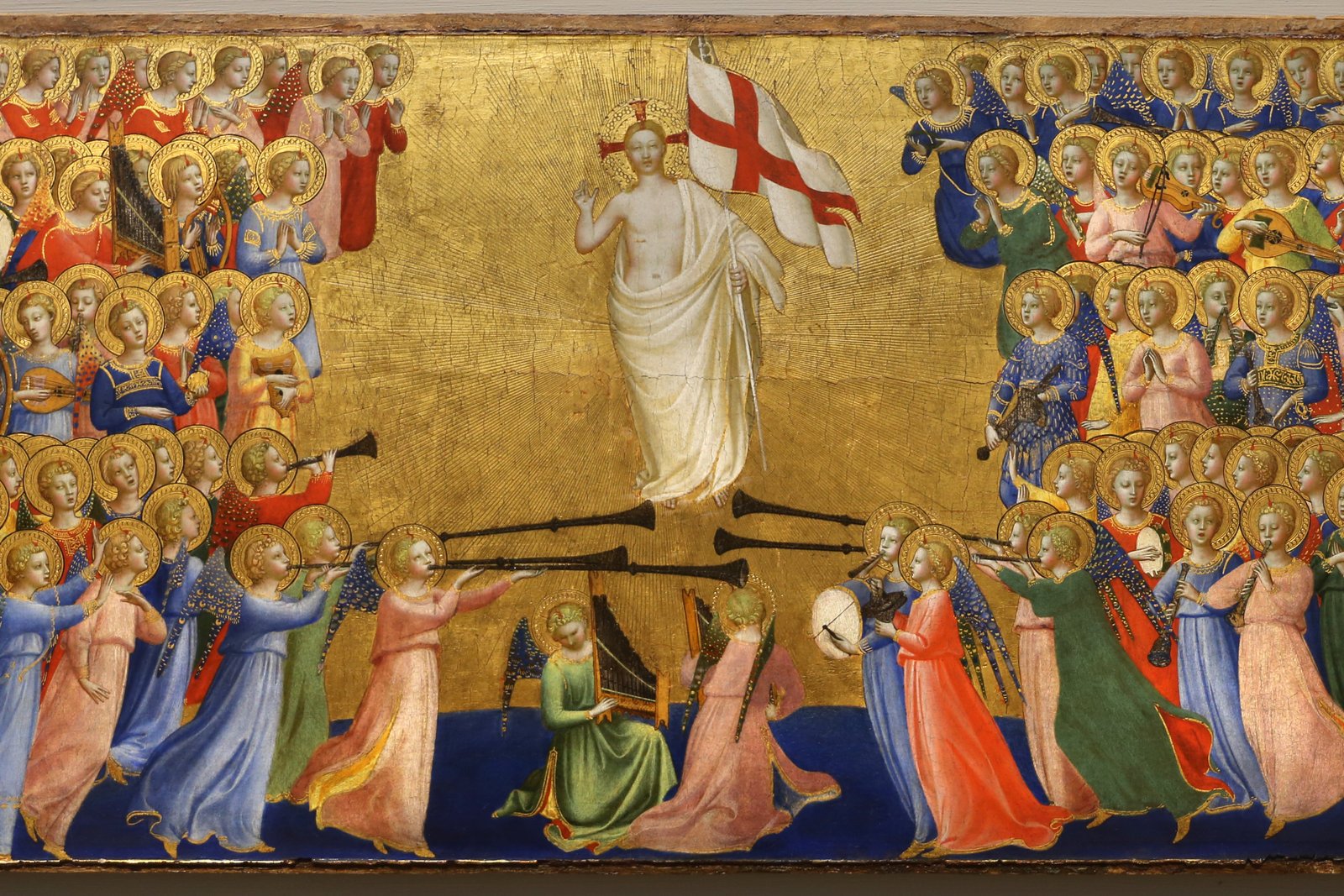
Fra Angelico, Christ Glorified in the Court of Heaven (predella panel), 1423–24, National Gallery, London, CC BY 3.0.
As Christianity spread and more of these local commemorations accumulated, bishops and later Rome began assembling them into shared calendars, so that a community in Milan and a community in Antioch could, in principle, be marking the same names on the same days. What resulted is what liturgists call the sanctoral cycle — the year-long cycle of saints' feasts that runs alongside the temporal cycle, the unfolding story of Christ's own life from Advent through Christmas, Lent, Easter, and Ordinary Time. The Catechism describes the liturgical year itself as the Church "unfolding the whole mystery of Christ" across the months (CCC 1163), and the saints' feasts are woven directly into that same fabric — not a separate program bolted onto it.
Why the Church bothers with individual biography at all
It would be simpler, in one sense, for a religion to stick to abstract doctrine and skip the sprawling cast of individual names. Catholic tradition doesn't take that route, and the reasoning is specific: the saints are held up not as spiritual celebrities to admire from a distance, but as evidence. Evidence that holiness is achievable in an actual human life, lived in an actual century, with an actual set of flaws and constraints. A single line from the Catechism captures the logic directly — the saints are "witnesses" whose lives "constitute a memorial" of God's work in ordinary history (CCC 828 discusses canonization in this vein), and the Church proposes them as models precisely because they weren't abstractions.
That's also why the calendar leans so heavily on variety rather than picking a handful of favorites and repeating them. A given week might carry a fourth-century desert hermit, a nineteenth-century French parish priest, a queen, and a teenage martyr, one after another. The range is the point. Different states of life, different centuries, different temperaments — all of it aimed at the same claim, that the call to holiness described by the Second Vatican Council as universal, extended to "all the faithful of Christ whatever their condition or state" (CCC 2013, quoting Lumen Gentium), isn't limited to people who look a particular way.
What honoring a saint actually means
It's worth being precise here, because the language can sound stronger than it is. Catholic teaching draws a firm line between the honor given to saints (veneration, called dulia in older theological vocabulary) and the worship owed to God alone (latria). Asking a saint to pray for you works on the same logic as asking a living friend to pray for you — you're not routing a request through them as a substitute for God, you're asking someone already close to God to add their prayer to yours. The Catechism puts it directly: the saints' "intercession is their most exalted service to God's plan" (CCC 2683). It's a relationship of friendship and imitation, not a separate channel of devotion competing with prayer to God.
That distinction matters because it's exactly what keeps daily saint devotion from becoming empty trivia collecting. Learning that a particular saint lived through famine, or ran an orphanage, or spent decades in a monastery no one visited, isn't meant to end as an interesting fact. The traditional shape of the practice is to read a little, notice something specific and imitable — a habit of patience, a willingness to forgive, a stubborn honesty — and let it sit for the rest of the day. Some Catholics use the saint of the day as a subject for a short prayer; others simply read the biography over morning coffee, the way you might read a short reflection or a page of a book you're slowly working through. Neither approach is a doctrinal requirement — it's a pious custom, one of many ways the Church makes room for personal devotion within a shared structure.
A concrete way to start
If the sanctoral cycle sounds appealing but abstract, the easiest entry point is simply to look up whichever date it happens to be. Every day on the Church's universal calendar (and many days on more specific national or diocesan calendars) has an assigned saint or, on Sundays and major solemnities, a celebration of a mystery of the faith rather than an individual. This site's own liturgical calendar tool works exactly this way — pick today's date and you'll see who the Church is remembering, along with the day's readings and liturgical color, so following the practice doesn't require a specialized missal or memorizing three hundred and sixty-five names in advance.
Consistency matters more than intensity here. A minute spent reading about the day's saint, repeated across a year, adds up to something a single long biography read once never quite achieves — a working familiarity with an enormous, varied communion of people the Church considers already home. That's the entire aim of the sanctoral cycle: not trivia, but company.
Trivia
Why does the Catholic Church assign a saint to almost every day of the year?
Is following a daily saint the same as praying to the saint?
What's the difference between a saint's feast day and their actual birthday?
Do I need a missal or special book to follow the saint of the day?
What happens when two saints share the same feast day?
You May Also Like
Related Reading