What Happens at a Catholic Funeral — A Walk Through the Rites

Death reframed as a Passover
The Catechism opens its treatment of Christian funerals with a claim that shapes everything that follows: "the Christian meaning of death is revealed in the light of the Paschal mystery of the death and resurrection of Christ" (CCC 1681). A Catholic funeral is designed around that claim, not around biography. It is, in the Church's own words, "the last Passover of the child of God" (CCC 1680) — using the same image applied to Christ's own passage through death into resurrected life. That framing explains why the rites look the way they do: less a farewell speech about who someone was, more a liturgical statement about where the Church believes they're headed.
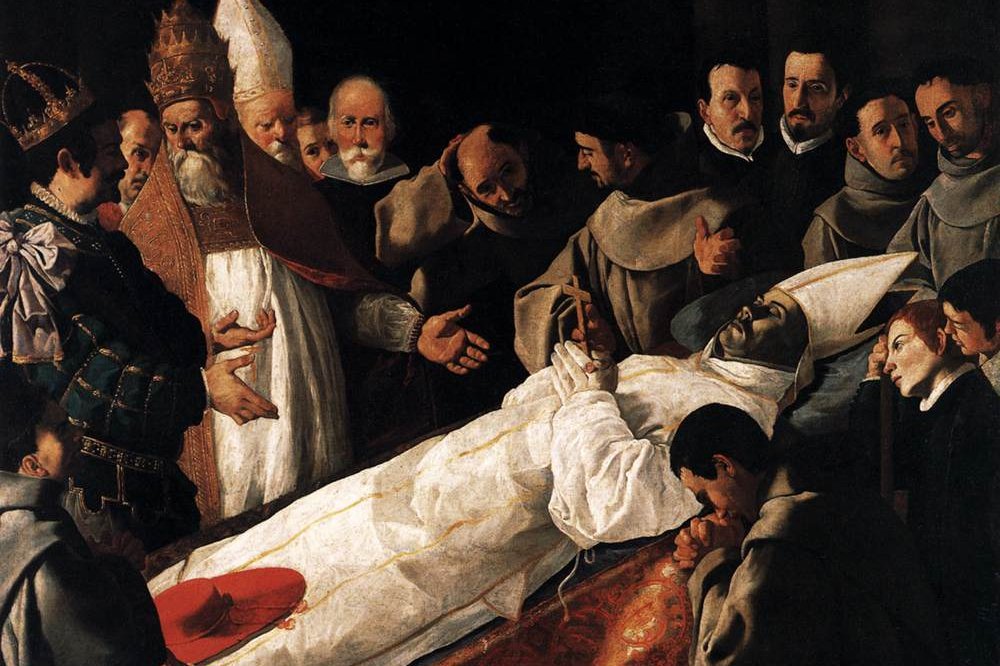
Francisco de Zurbarán, The Lying-in-State of St Bonaventure, 1629, Musée du Louvre, Paris — public domain.
The full sequence the Church provides is called the Order of Christian Funerals, and it lays out three connected rites tied to three different locations — traditionally the home (or funeral home), the church, and the cemetery (CCC 1686). Not every family uses all three in full, and practice varies by diocese and personal circumstance, but this three-part structure is the Church's standard template.
The vigil: the first gathering
The vigil, often still called a wake, is usually held the evening before the funeral Mass, frequently at a funeral home. It centers on Scripture readings, prayers, and often the recitation of the rosary, giving family and friends a first formal opportunity to gather in prayer around the body. The Church describes the purpose of this opening stage plainly: "a greeting of faith begins the celebration... Relatives and friends of the deceased are welcomed with a word of 'consolation'" (CCC 1687), consolation understood in the New Testament sense — the Holy Spirit's power at work in hope, not mere sympathy.
This is typically the setting where family members or close friends share memories more freely than the funeral Mass itself will allow, since the vigil doesn't carry the same liturgical restrictions on tone and content that the Mass does.
The funeral Mass: the heart of the rite
The funeral Mass, when the family chooses one (not every funeral includes a full Mass, and some, particularly for those outside full communion with the Church, use a funeral liturgy without Mass instead), is described by the Catechism as the point where "the Eucharist is the heart of the Paschal reality of Christian death" (CCC 1689). Several specific elements mark this Mass as distinct from an ordinary Sunday liturgy:
The pall. A white cloth is draped over the casket as it's received at the church door, recalling the white garment given at Baptism — a visual statement that the deceased was clothed in Christ at the start of their Christian life and is now, in the Church's prayer, being welcomed into the fullness of what that Baptism promised.
The readings. Scripture selections are drawn from an approved set of funeral texts centered on resurrection and hope, chosen by the family in consultation with the priest or deacon, rather than left open to any passage that might feel personally meaningful but doesn't fit the funeral lectionary's themes.
The homily. The Church is explicit that the homily "must 'avoid the literary genre of funeral eulogy'" (CCC 1688) and instead "illumine the mystery of Christian death in the light of the risen Christ." This surprises some families expecting a biographical tribute — the Mass isn't structured to deliver one, though many parishes make room for brief remembrances separately, before or after the Mass itself, depending on diocesan and pastoral norms.
Liturgical color. White, violet, or black are all permitted colors for a funeral Mass, and the choice can vary by region and personal or family tradition (CCC 1685). White has become the more common choice in recent decades, emphasizing resurrection hope, though it doesn't erase the real sorrow the liturgy also holds space for.
The rite of committal: the final farewell
The last stage happens at the cemetery, where the body or cremated remains are buried or entombed. The Church calls this "the last farewell by which the Christian community greets one of its members before his body is brought to its tomb" (CCC 1690), and describes an ancient tradition — the Byzantine kiss of farewell — as expressing something central to how the Church understands this final moment: sorrow at separation held together with confidence in eventual reunion. The Catechism quotes a funeral prayer capturing that dual note directly: "we sing for his departure from this life and separation from us, but also because there is a communion and a reunion... we shall all be together in Christ" (CCC 1690).
The rite of committal is typically brief — a blessing of the grave, final prayers, and the actual burial or entombment — but it's the liturgical bookend that closes out the sequence begun at the vigil.
Cremation and the modern funeral
Cremation is permitted by the Catholic Church, a change from stricter historical prohibitions, as long as it isn't chosen as a denial of belief in the resurrection of the body. Current Church guidance asks that cremated remains be treated with the same reverence as a body would be — present at the funeral Mass where possible, and ultimately buried or entombed in a sacred place, rather than scattered, divided among family members, or kept indefinitely at home. This reflects the same underlying logic running through the whole rite: even after death, and even in whatever physical form remains, the human body retains a dignity worth treating with real ceremony, not simply disposing of efficiently.
A structure built for grief and hope together
What ties the three stages together — vigil, Mass, committal — is the Church's insistence that neither grief nor hope should be sacrificed for the other. The liturgy doesn't ask mourners to pretend they aren't grieving, and it doesn't let the occasion collapse into pure sorrow either. Every element, from the white pall to the resurrection-themed readings to the final prayer at the grave, points toward the same claim made at the very start: for a baptized Christian, the Church teaches, death is a Passover — a passage through, not a full stop.
Trivia
What are the three main parts of a Catholic funeral?
Why is the casket covered with a white cloth during a Catholic funeral Mass?
Is a eulogy allowed at a Catholic funeral Mass?
Why does the Catholic Church now often use white vestments at funerals instead of black?
Can a Catholic be cremated, and does the Church still hold a funeral Mass for cremated remains?
Related Reading