What Makes a Site a Marian Shrine?

Millions of claims, a handful of shrines
Reports of Marian apparitions surface with some regularity, in every era and on every continent. Almost none of them become anything the wider Church formally recognizes. Understanding what separates a recognized Marian shrine — a place like Lourdes or Fátima — from the far larger pile of unverified or rejected claims means understanding a process that is deliberately slow, deliberately skeptical, and run at the level of the local bishop rather than by popular acclaim.
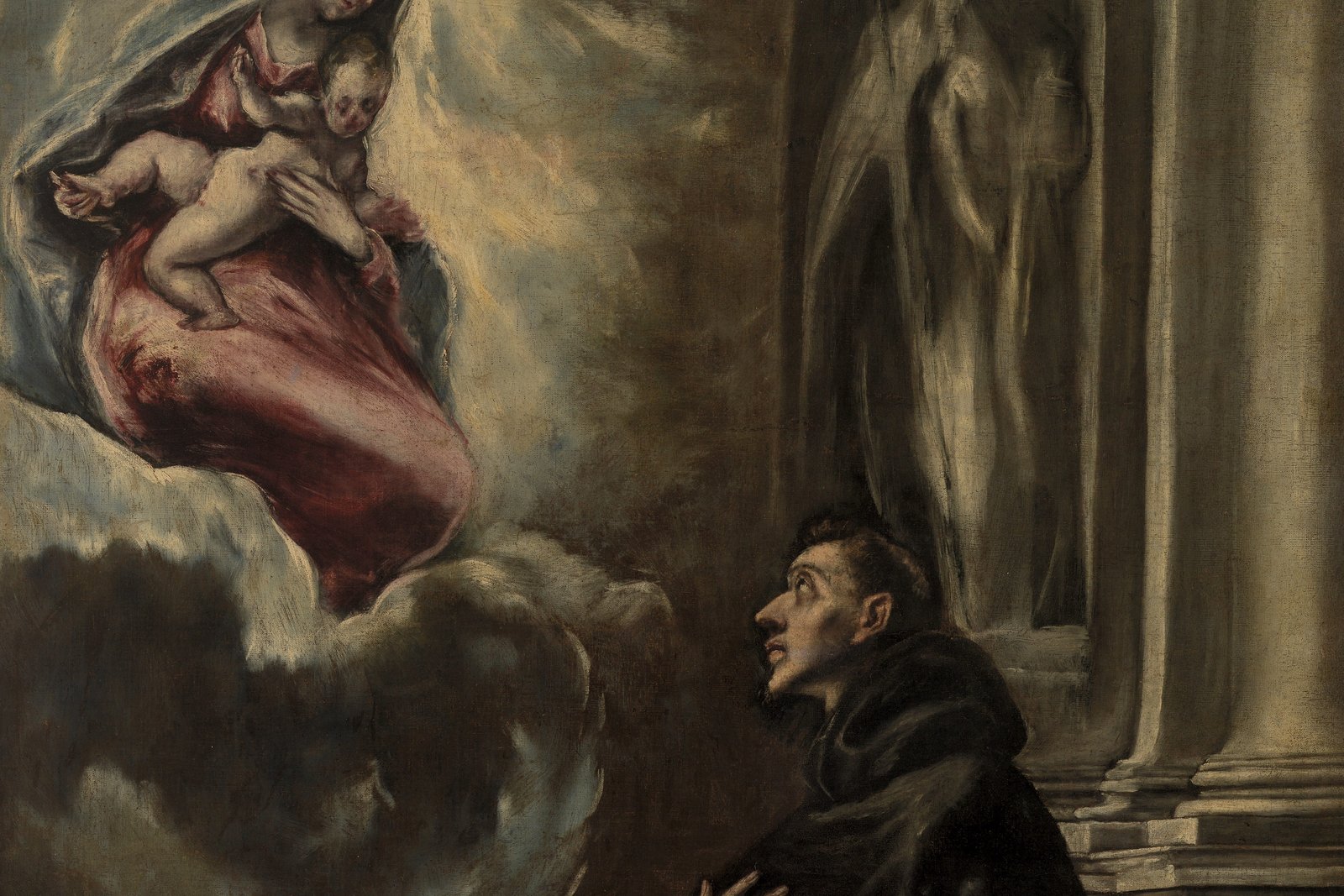
El Greco, Apparition of the Virgin and Child to Saint Hyacinth, c. 1605-1610, Barnes Foundation — public domain.
The bishop investigates first
When a reported apparition surfaces, the first and primary authority is not Rome — it's the local diocesan bishop, in whose territory the events took place. Church norms, most recently updated by the Congregation for the Doctrine of the Faith in 2012, lay out a structured process: the bishop typically forms a commission to interview the visionaries, gather medical and psychological evaluations, examine the content of any reported messages for consistency with Catholic doctrine, and assess the spiritual fruits — whether conversions, increased prayer, and works of charity have followed, or whether the claim has instead produced confusion, financial exploitation, or division.
Only after this process can a bishop issue one of a range of judgments, from constat de non supernaturalitate (a finding that the event does not show evidence of a supernatural origin) up through full approval — a declaration that the faithful may, with the Church's confidence, believe the events occurred and treat the site as a legitimate place of pilgrimage. Most cases never reach that top tier. Many are formally rejected. A significant number are simply left unresolved, neither approved nor condemned, sometimes for generations.
Approval is not the same as doctrine
This is the distinction that trips people up most often: even a fully approved Marian apparition is never elevated to the level of defined Catholic doctrine. The Church draws a firm line between public revelation — what God revealed once, definitively, through Scripture and the apostolic tradition, closed with the death of the last apostle — and private revelation, the category every apparition, however well-attested, falls into (CCC 67). A Catholic can decline to believe in Lourdes or Fátima entirely and remain completely orthodox. What approval actually grants is narrower and more practical: permission for public devotion, and the Church's own assurance that nothing about the reported events contradicts the faith.
That's precisely why the language used around even the most famous shrines stays careful. The Church doesn't say Mary certainly appeared at Guadalupe the way it says Christ certainly rose from the dead. It says the evidence is credible enough, and the fruits good enough, that the faithful may reasonably trust it — a real endorsement, but a different category of statement altogether.
Four sites that made it through
Lourdes is often treated as the model case: Bernadette Soubirous's 1858 apparitions were investigated by the local bishop and formally approved within four years, helped by the sudden emergence of a spring at the grotto and a sequence of events that held together consistently across eighteen separate apparitions.
Fátima followed a similar pattern in Portugal, where the 1917 apparitions to three shepherd children culminated in a publicly witnessed phenomenon — reported by a large crowd gathered specifically because a miracle had been promised — that gave investigators an unusually public event to examine, alongside the private messages given only to the children.
Guadalupe is older still, dating to 1531, and its approval rests heavily on the image itself — the tilma tradition holds was imprinted with Mary's likeness — which has been studied, debated, and venerated for nearly five centuries.
The Shrine of Our Lady of Walsingham in England traces to an 11th-century vision reported by a noblewoman named Richeldis de Faverches, making it one of the oldest Marian shrines in Christendom — destroyed at the Reformation, and only revived as a working pilgrimage site in the 20th century, a reminder that a shrine's history can be interrupted for centuries and still resume.
Why the process matters
None of this caution is meant to dampen devotion; it's meant to protect it. A Church that approved every reported vision without scrutiny would make devotion to Mary indistinguishable from credulity, and would leave ordinary Catholics with no way to tell a genuine, spiritually fruitful shrine from a manufactured or mistaken one. The slow, procedural, often decades-long path from a private claim to a recognized shrine is exactly what allows a site like Lourdes or Fátima to carry the weight it does — not because the Church rushed to embrace it, but because, after real scrutiny, it didn't have to.
That same caution extends to how the Church talks about approved shrines once recognition is granted. Even at a fully approved site, Catholics are never required to believe a specific apparition occurred as a matter of faith the way they are required to accept, say, the Resurrection — private revelation, however credible the Church judges it, always remains distinct in kind from the deposit of faith itself. A recognized shrine is a place the Church considers safe and spiritually fruitful to visit and pray at, not a new article of required belief.
Trivia
What makes a Marian apparition 'approved' by the Catholic Church?
Do Catholics have to believe in approved Marian apparitions?
What's the difference between a shrine and an ordinary parish church?
How long does the Church usually take to investigate an apparition?
Can a site lose its status as an approved shrine?
Related Reading