Saint Louis

A king raised for holiness as much as rule
Louis was born in 1214 and became king of France at just twelve years old, in 1226, following the sudden death of his father, Louis VIII. For the early years of his reign, actual governance rested largely with his mother, Blanche of Castile, a formidable regent who is generally credited by historians with steering the young kingdom through a genuinely dangerous period of noble rebellion and instability, while also shaping her son's religious formation with evident intensity. Blanche reportedly told Louis directly that she would rather see him dead than see him commit a mortal sin, a severe sentiment that nonetheless left a permanent mark on the pious, disciplined character Louis carried into his adult reign.
Louis Matout, portrait of Saint Louis IX of France, 19th century — public domain.
By the time Louis assumed full personal control of the kingdom in his twenties, France had become one of the most stable and powerful monarchies in medieval Europe, and Louis used that stability to pursue an ambitious program of legal and administrative reform alongside an equally ambitious and, in the end, far less successful program of crusading warfare in the eastern Mediterranean.
Justice under an oak tree
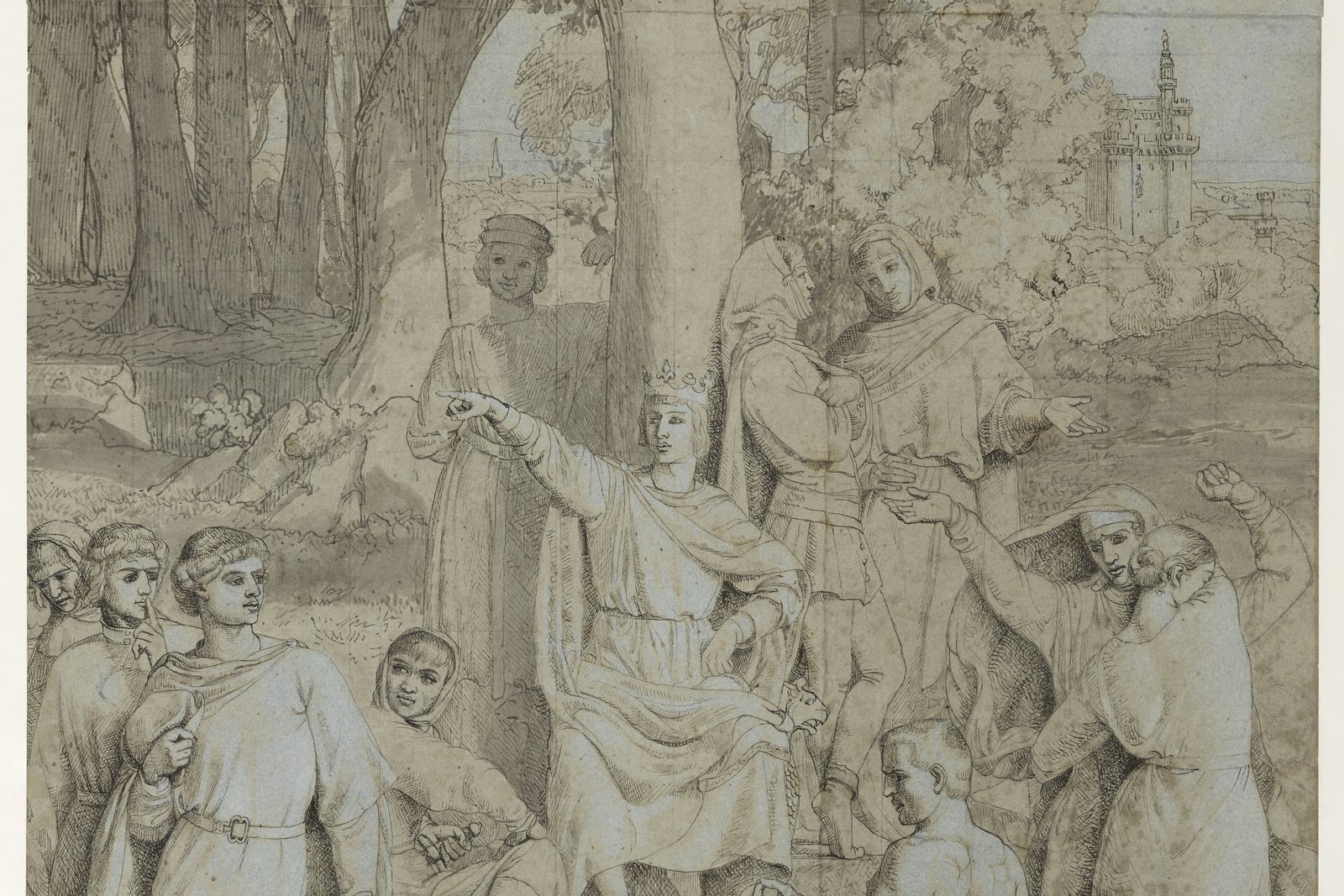
Among the most enduring images associated with Louis's reign is his personal, direct practice of hearing legal petitions from his subjects, famously said to have sat beneath an oak tree in the royal forest of Vincennes, near Paris, where any subject with a grievance could in principle approach him directly for judgment, bypassing the layers of officials and courtiers who might otherwise have blocked their access to royal justice. Whether this specific image reflects literal, routine practice or a somewhat idealized later tradition built around a genuine habit of personal accessibility, it captures something real about the reputation Louis built during his lifetime as an unusually engaged and personally conscientious judge.
Beyond this symbolic accessibility, Louis pursued substantive reforms of French royal administration, working to curb the private warfare that nobles had long waged against one another largely outside royal control, expanding the availability of appeals to royal courts as an alternative to local seigneurial justice, and introducing measures intended to standardize currency and reduce corruption among royal officials sent to administer the provinces. Medieval and modern historians alike have generally credited these reforms with meaningfully strengthening the rule of law within the kingdom, even if the practical reach of royal justice remained limited by the standards of a later, more centralized state.
Two crusades, one costly failure
Louis's religious devotion extended into a deep personal commitment to the crusading movement, then still a live and, in Western Christendom, broadly admired undertaking, framed as the defense and recovery of Christian access to the holy places of the Bible. In 1248, he led the Seventh Crusade, an ambitious campaign aimed initially at Egypt, whose control over trade routes and proximity to the Holy Land made it a strategic target. Louis's forces captured the port city of Damietta relatively easily, but the subsequent advance toward Cairo ended in disaster at the Battle of Al Mansurah in 1250, where the crusading army suffered a severe defeat and Louis himself was taken prisoner.
He was eventually released after payment of a substantial ransom and the surrender of Damietta, and rather than returning immediately to France, he spent several additional years in the crusader states of the eastern Mediterranean, working to strengthen their fortifications and negotiate on behalf of Christian communities there before finally returning home in 1254. Despite the crusade's military failure, Louis's personal conduct throughout, his evident courage under captivity and his continued commitment to the cause even after such a severe setback, only enhanced his reputation for piety and steadfastness among contemporaries.
Sainte-Chapelle and a final crusade
Louis's religious devotion also found lasting architectural expression in Sainte-Chapelle, the exquisite Gothic royal chapel he had built within the royal palace complex on the Île de la Cité in Paris, completed in 1248 specifically to house relics Louis had acquired at extraordinary expense, including what was venerated as the Crown of Thorns, purchased from the financially desperate Latin Emperor of Constantinople. The chapel's soaring stained glass, among the finest surviving examples of thirteenth-century glasswork anywhere in Europe, remains one of the great monuments of medieval French art and a testament to the scale of resources Louis was willing to devote to housing relics of Christ's Passion.
In 1270, despite the earlier disaster in Egypt, Louis committed himself to a second crusading expedition, the Eighth Crusade, this time directed toward Tunis in North Africa. The campaign proved even more calamitous than the first: shortly after the crusading army landed near Tunis, disease, most likely dysentery or typhoid, swept through the camp, and Louis himself fell gravely ill and died there in August 1270, never engaging in any significant military action on this final expedition at all.
The only French king declared a saint
Louis's reputation for personal holiness, combined with the evident sincerity of his piety and his substantive record of legal reform, led to his canonization by Pope Boniface VIII in 1297, remarkably swift by the standards of the era, less than thirty years after his death. He remains, to this day, the only king of France ever formally canonized by the Catholic Church, a distinction that has made him an enduring reference point in French national and religious identity alike, invoked across the centuries by later French monarchs eager to associate their own reigns with his example. His feast is celebrated on August 25, and Sainte-Chapelle continues to stand in Paris as the most visible surviving monument to the intensity of his religious devotion.
Trivia
Who was Saint Louis?
Why is Louis IX remembered for his commitment to justice?
What happened to Louis IX during the Seventh Crusade?
How did Louis IX die?
When was Louis IX canonized, and what is his feast day?
You May Also Like
Related Reading