Christ the Redeemer, Rio de Janeiro

A monument born from a campaign against secularism
The idea for a colossal statue over Rio de Janeiro didn't come from a single artist's vision — it came from a Catholic public campaign. In the early 1920s, the Archdiocese of Rio de Janeiro and several Brazilian Catholic lay organizations grew alarmed at what they saw as a rapidly secularizing society, and proposed building a monumental religious landmark as a public counter-statement, timed to coincide with the 1922 centennial of Brazil's independence from Portugal. Fundraising ran slowly through the decade, drawing on donations from Brazilian Catholics rather than government money, and it took until 1926 for construction to actually begin on Corcovado — the "hunchback" mountain that already offered the most dramatic vantage point over the city, at roughly 2,300 feet above sea level.
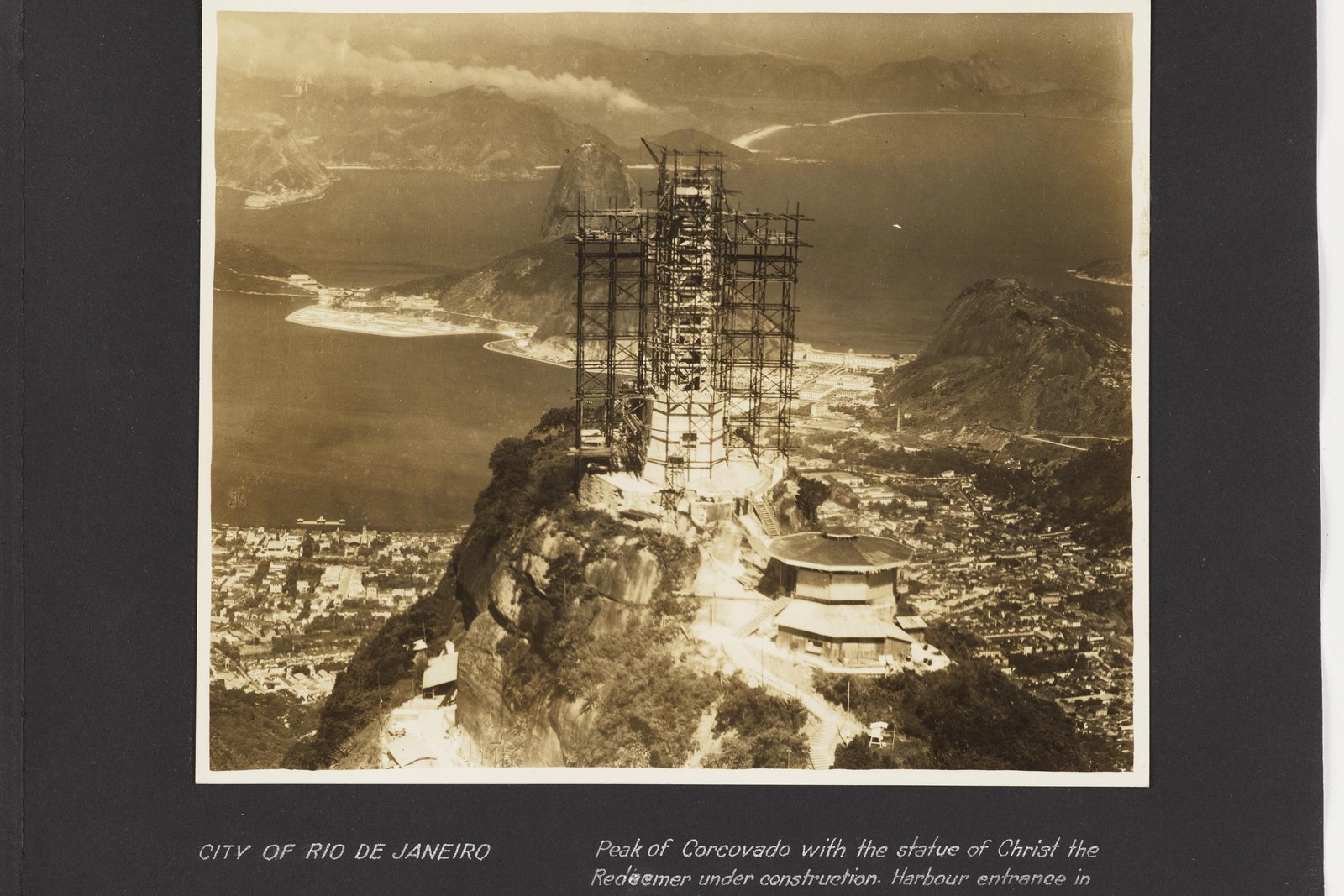
Photograph, circa 1930-31, Núcleo de digitalização / Instituto Moreira Salles -- public domain, Wikimedia Commons.
The design that eventually won out came from Brazilian engineer Heitor da Silva Costa, who considered several concepts — including a statue of Christ carrying a globe and cross — before settling on the far simpler, more striking image that became famous worldwide: Christ standing with arms fully outstretched, a pose read simultaneously as a blessing, an embrace, and a cross shape visible from any angle. French sculptor Paul Landowski, already an established figure in the Art Deco movement then sweeping European sculpture and architecture, was brought in to design and model the statue's head and hands — by far its most technically difficult and expressive elements — while Silva Costa oversaw the Brazilian side of the project on the ground.
Building a giant on a mountain with no elevator
Actually constructing a 98-foot statue on top of an isolated peak in the 1920s posed engineering problems that had no obvious precedent. French engineer Albert Caquot, a specialist in reinforced concrete already well known in Europe for large-span structures, designed the statue's internal skeleton — a load-bearing concrete frame strong enough to support the weight of the outstretched arms without collapsing under their own leverage, a genuinely difficult structural problem given how far those arms extend from the statue's central mass.
Rather than cast the exterior directly in concrete, which would have been prone to cracking and weathered poorly in Rio's tropical humidity, the team chose to clad the finished frame in thousands of small triangular tiles of soapstone, a soft, durable stone quarried in Brazil, assembled by hand piece by piece over the concrete shell. Materials were hauled up Corcovado on a small cog railway built decades earlier for tourists, since no crane of the period could have lifted finished statue sections onto the peak directly — meaning the entire statue was essentially built in place, tile by tile, by workers laboring on a mountaintop scaffold for five years. Landowski's studio in Paris built and shipped several of the more delicate elements, including a scale model of the head and hands, for local Brazilian workers to reference and enlarge on-site.
The statue was finally completed and formally inaugurated on October 12, 1931 — a date chosen deliberately to coincide with the feast of Our Lady of Aparecida, Brazil's patroness, whose own basilica at Aparecida remains the country's most visited pilgrimage site to this day. President Getúlio Vargas presided over the dedication ceremony, cementing the statue's status from its very first day as a monument that belonged simultaneously to the Catholic Church and to the Brazilian state.
More than a postcard image
It's easy, looking at Christ the Redeemer on a postcard or a phone screen, to see only the landmark — the silhouette that appears on nearly every list of the world's most photographed monuments, voted one of the New Seven Wonders of the World in a 2007 global poll. But the statue's base actually contains a functioning chapel dedicated to Our Lady of Aparecida, where Mass, baptisms, and even weddings are celebrated on a regular basis, drawing a much smaller but genuinely devout stream of visitors distinct from the roughly two million tourists who ride the train or drive up Corcovado's winding road each year mainly for the view.
That dual identity — global tourist icon and functioning site of Catholic worship — puts Christ the Redeemer in an unusual category among the world's great religious monuments. Unlike an ancient pilgrimage church such as Santiago de Compostela Cathedral, built up over centuries around a tomb tradition, Rio's Christ was conceived from the outset as a modern, public, civic statement of faith, and it has kept both halves of that original purpose intact for nearly a century: a place people visit to be awed by a view, and a place some of them still come specifically to pray.
A silhouette that keeps needing repair
Standing exposed on an exposed granite peak, hit regularly by lightning and constant tropical humidity, the statue requires ongoing maintenance that periodically makes headlines of its own — soapstone tiles have had to be replaced after lightning strikes chipped or cracked sections of the head and hands more than once in recent decades, and a major restoration campaign in the early 2010s replaced deteriorated tiles and repaired cracks across the whole structure. Each restoration uses the same basic soapstone-cladding technique Landowski and Silva Costa's original workers pioneered in the 1920s, a small but real continuity between the statue's original construction crew and the technicians who keep Christ the Redeemer standing over Rio today.
Trivia
How tall is the Christ the Redeemer statue, and where does it stand?
Who designed and engineered Christ the Redeemer?
Why is the statue built from soapstone?
Is Christ the Redeemer a religious pilgrimage site or only a tourist attraction?
What prompted the decision to build a giant statue of Christ over Rio?
Related Reading