Mount Nebo: Where Moses Saw the Promised Land

The mountain at the edge of the journey
Mount Nebo stands in western Jordan, part of a modest mountain ridge known in Scripture as Abarim, rising to a little over 800 meters and offering a genuinely commanding view across the deep depression of the Jordan Valley toward the Dead Sea, Jericho, and, on especially clear days, the distant hills around Jerusalem and Bethlehem. Geographically, it's an unassuming summit compared to some of the region's more dramatic peaks — but its significance in the biblical narrative has little to do with its height and everything to do with what happened there at the very end of one of Scripture's central figures' life.
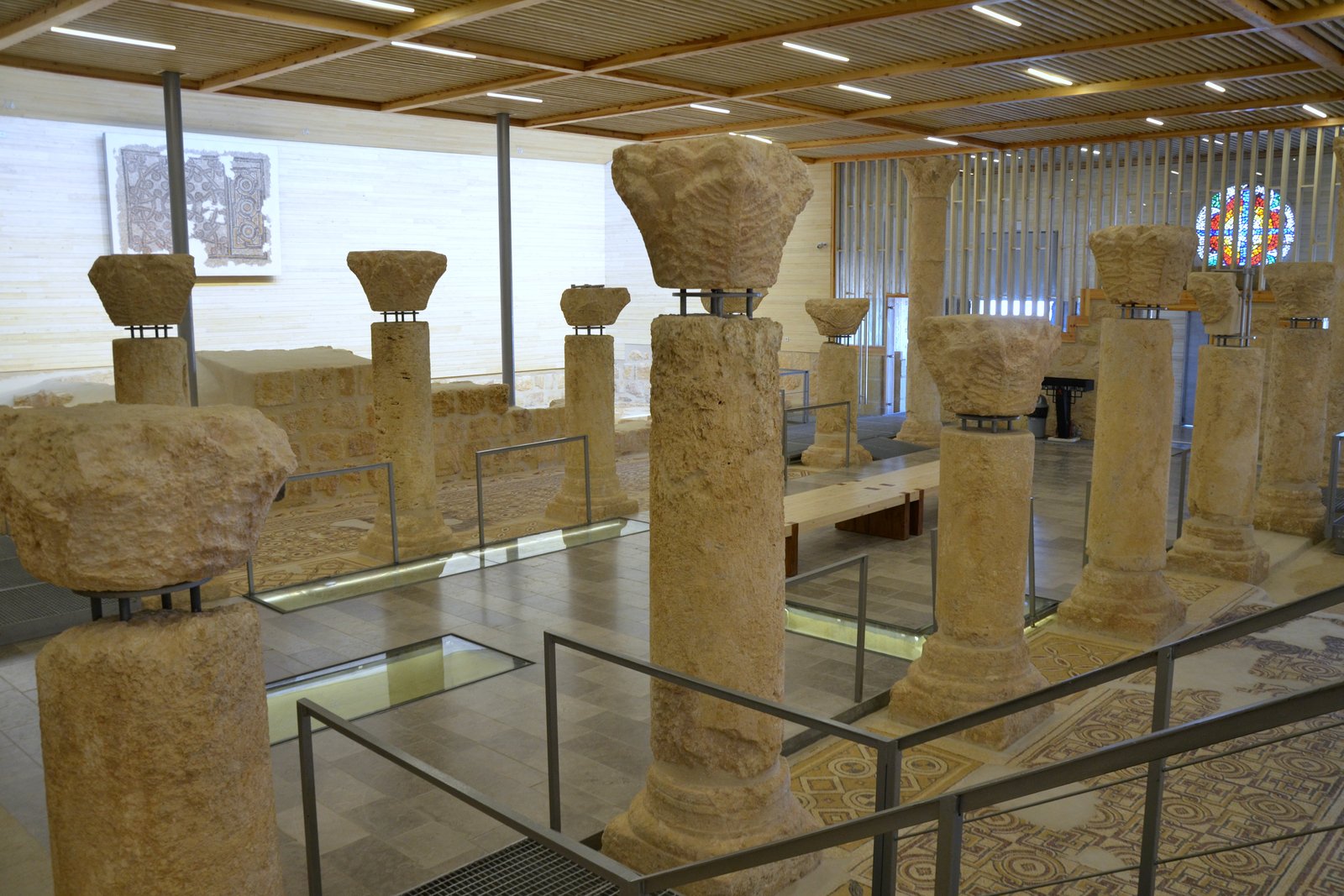
Photograph by Carole Raddato, Memorial Church of Moses, Mount Nebo, Jordan, 2017 — CC BY-SA 2.0, Wikimedia Commons.
Forty years, and one final view
The book of Deuteronomy records that after forty years leading the Israelites through the wilderness following their escape from slavery in Egypt, Moses was brought by God to the summit of Mount Nebo for a specific, deliberate purpose: to see, at last, the land he had spent his life's final chapter leading his people toward, but which he himself would never enter. The text describes the moment with a striking sweep of geography: "Then Moses went up from the plains of Moab to Mount Nebo, the peak of Pisgah which faces Jericho, and the Lord showed him all the land—Gilead, and as far as Dan, all Naphtali, the land of Ephraim and Manasseh, all the land of Judah as far as the Western Sea, the Negeb, the plain (the valley of Jericho, the City of Palms), and as far as Zoar" (RSV-CE, Deuteronomy 34:1-3).
What follows is one of the more quietly devastating moments in the Hebrew Scriptures: "The Lord then said to him, This is the land about which I promised on oath to Abraham, Isaac, and Jacob, 'I will give it to your descendants.' I have let you see it with your own eyes, but you shall not cross over" (Deuteronomy 34:4). The reason for this denial traces back to an earlier episode at the waters of Meribah, when, frustrated with the people's complaints about a lack of water, Moses struck a rock with his staff to bring forth water rather than simply speaking to it as God had instructed (Numbers 20:1-13) — a moment of disobedience and, Scripture suggests, a lack of full trust that God declared would cost both Moses and his brother Aaron their entry into the Promised Land they had worked their whole lives to reach.
Death, and a grave no one has found
Moses died shortly after this final view, according to Deuteronomy, at the age of 120, with the text offering an unusually warm tribute to him even in the moment of his death: "his eyes were undimmed and his vigor unabated" (Deuteronomy 34:7, NABRE). What follows is one of the more genuinely mysterious details anywhere in Scripture: Moses was buried "in a valley in the land of Moab," but, the text states plainly, "to this day no one knows the place of his burial" (Deuteronomy 34:6, NABRE).
This deliberate obscurity has drawn centuries of theological reflection. Some early Jewish and Christian commentators read the hidden grave as protection against the burial site becoming an object of idolatrous veneration, given Moses's towering stature among the Israelites; others have seen in it a fitting symbol for a leader whose life's work was always oriented toward a destination he himself never physically claimed. Whatever the intended meaning, the absence of a known tomb stands in notable contrast to many other biblical figures, including the patriarchs buried at the Cave of the Patriarchs in Hebron, whose graves became lasting, identifiable pilgrimage sites.
A mountain remembered by the Church
Christian veneration of Mount Nebo as the site of Moses's final view dates back to at least the fourth century, when early pilgrim accounts, including that of the nun Egeria, describe visiting a church already established on the summit. Archaeological excavation, carried out extensively by Franciscan archaeologists through the twentieth century, uncovered the remains of this early Byzantine basilica along with an adjoining monastery, and, most strikingly, an extensive series of mosaic floors dating from the fourth through the sixth centuries — among the best-preserved and most artistically significant examples of Byzantine mosaic work anywhere in Jordan, depicting hunting scenes, animals, and geometric patterns in vivid, still-legible detail.
The site today
The modern Memorial Church of Moses, built over and incorporating the ancient Byzantine remains, is administered by the Franciscan Custody of the Holy Land and remains an active site of Christian pilgrimage and worship. Outside the church stands a striking modern bronze sculpture, created by the Italian artist Giovanni Fantoni, depicting a serpent wound around a cross — a visual reference both to the bronze serpent Moses raised in the wilderness to heal the Israelites (Numbers 21:4-9) and to Jesus's own later reference to that episode as a symbol of his crucifixion (John 3:14-15).
Visitors to the summit today can still take in essentially the same panoramic sweep of the Jordan Valley that Scripture describes Moses viewing — a landscape that, more than most biblical sites, invites a visitor to stand quite literally in the same spot and look out at the same wide horizon, even across more than three thousand years of intervening history.
Trivia
What happened to Moses on Mount Nebo?
Why wasn't Moses allowed to enter the Promised Land?
Where exactly is Mount Nebo?
What can visitors see on Mount Nebo today?
Was Moses's burial site ever found?
You May Also Like
Related Reading