The Church of the Holy Sepulchre in Jerusalem

Two holy sites under one roof
Tradition holds that the Church of the Holy Sepulchre stands over the two decisive locations of the Passion: Golgotha, the hill where Christ was crucified, and — only a short walk away inside the same complex — the tomb where his body was laid and from which, Christians believe, he rose. Having both sites enclosed under a single roof is part of what has made the building so singular in Christian memory: a pilgrim can move, in a matter of minutes, from the place of death to the place of resurrection.
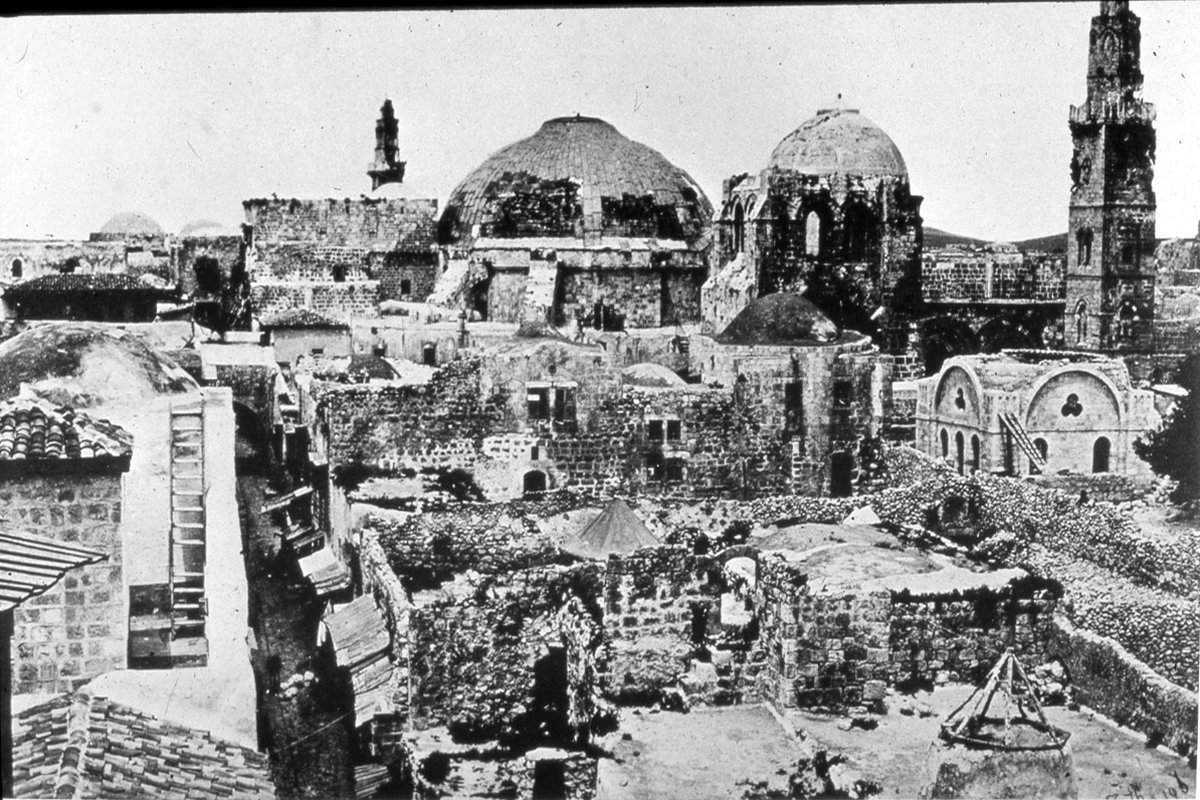
Francis Frith, Entrance of the Church of the Holy Sepulchre, Jerusalem, 1858 - public domain.
The identification of the site goes back to the fourth century, when Emperor Constantine ordered a basilica built there following excavations directed by Bishop Macarius of Jerusalem, which uncovered a rock-cut tomb identified with Christ's burial place. Constantine's mother, Helena, is credited by tradition with discovering relics of the True Cross during the same building campaign — an episode belonging, like much early Christian relic history, to devout tradition rather than a documented modern excavation record.
Destruction and rebuilding
The Constantinian church did not survive intact. In 1009, the Fatimid Caliph Al-Hakim bi-Amr Allah ordered the complete destruction of the site, one of the most severe blows the building has ever suffered. Byzantine emperors financed a rebuilding in the decades that followed, and when the Crusaders took control of Jerusalem, they undertook a major renovation and unification of the site's separate shrines into a single Romanesque church, consecrated in 1149. Much of the structure pilgrims walk through today still traces back to that Crusader-era building, even after later repairs, fires, and restorations across the centuries since.
The Status Quo — a peace kept by not touching anything
Few buildings on earth are shared quite the way the Holy Sepulchre is. Custody of the church is divided among several Christian communities under an arrangement known as the Status Quo — a body of customs governing precisely which community controls which altar, chapel, lamp, and hour of use, down to details that would seem trivial anywhere else. The arrangement was formalized under an Ottoman decree in 1757 and reaffirmed by a further decree in 1852-1853, after tensions between the communities had escalated to the point of contributing to wider international friction in the region.
The Greek Orthodox Church, the Roman Catholic Church (represented by the Franciscan Custody of the Holy Land), and the Armenian Apostolic Church hold the principal rights under the Status Quo, with the Coptic, Syriac, and Ethiopian churches holding smaller, long-recognized claims to specific spaces. The underlying rule is simple to state and strict in practice: nothing shared between communities may be altered, moved, or changed without agreement from all parties involved — which is precisely why a wooden ladder has sat, undisturbed, on a ledge beneath one of the church's facade windows since at least the mid-1700s. Documented in engravings from that century and visible in the earliest surviving photographs of the church from the 1850s, the so-called Immovable Ladder has simply never found a moment when every community agreed it could be taken down.
The keys of the church
One further custom softens the tension between the resident Christian communities: for centuries, the keys to the church's main door have been held not by any of them, but by two Muslim families. The Joudeh family keeps the key itself, and the Nuseibeh family carries out the daily ritual of unlocking and locking the doors — a custom tradition traces back as far as the era of Saladin, adopted precisely because a neutral custodian outside the rival Christian communities could be trusted not to favor one side over another.
The tomb inside the tomb
At the physical center of the building sits the Aedicule, a small stone shrine built directly over the site identified as Christ's tomb, standing beneath the church's great rotunda dome. The current Aedicule dates mostly to an 1810 rebuilding after fire damage, and for decades before 2016 it stood wrapped in an unsightly iron cage, installed by British authorities in 1947 after earthquake damage left the structure genuinely unsafe to approach without support. That cage came down only after a landmark 2016-2017 restoration project, the first major conservation of the shrine in centuries, carried out by a team from the National Technical University of Athens with the rare cooperation of all the major custodian communities — an unusual moment of practical agreement inside a building otherwise defined by its frozen disputes. During the work, researchers were able to open the burial shelf inside the Aedicule for the first time in centuries and confirmed that a marble slab, believed to date to the Crusader period or earlier, still covers the original limestone surface identified by the earliest Christian tradition.
Not far from the Aedicule lies the Stone of Anointing, a flat slab just inside the church's entrance where tradition holds Christ's body was prepared for burial after the crucifixion. Pilgrims commonly kneel to touch it, rub cloths or small objects against its surface, or pour oil over it as an act of devotion — the current stone dates only to a 1810 replacement rather than antiquity, but its meaning to visitors rests entirely on the event it commemorates rather than the age of the slab itself.
Why it still matters
The Holy Sepulchre remains one of the most visited sites in Christendom, and its layered, contested history is, in its own way, part of the point: a building that has survived destruction, rebuilding, and centuries of shared and disputed custody, while never losing its claim on the two events Christian faith holds as most central. For a related look at how sacred art and building history intersect elsewhere in the Holy Land and beyond, see St. Peter's Basilica on this blog.
Trivia
What does the Church of the Holy Sepulchre actually mark?
Who built the original church, and what happened to it?
What is the "Status Quo" at the Holy Sepulchre?
Why is there a ladder stuck on the church's facade?
Who holds the keys to the Church of the Holy Sepulchre?
Related Reading