Rila Monastery: Bulgaria's Mountain Fortress of Faith

A hermit's cave becomes a nation's refuge
High in the Rila mountains of southwestern Bulgaria, a monastery stands in a landscape so remote that reaching it even today requires a real journey — which is, in a sense, exactly the point. In the tenth century, a man named Ivan withdrew into these mountains seeking nothing but solitude, living first in a hollow tree trunk and later in a small cave, devoting himself entirely to prayer and ascetic discipline far from any settlement. Word of his holiness spread anyway, as it tends to for hermits determined to disappear, and disciples began seeking him out despite the difficulty of the terrain.
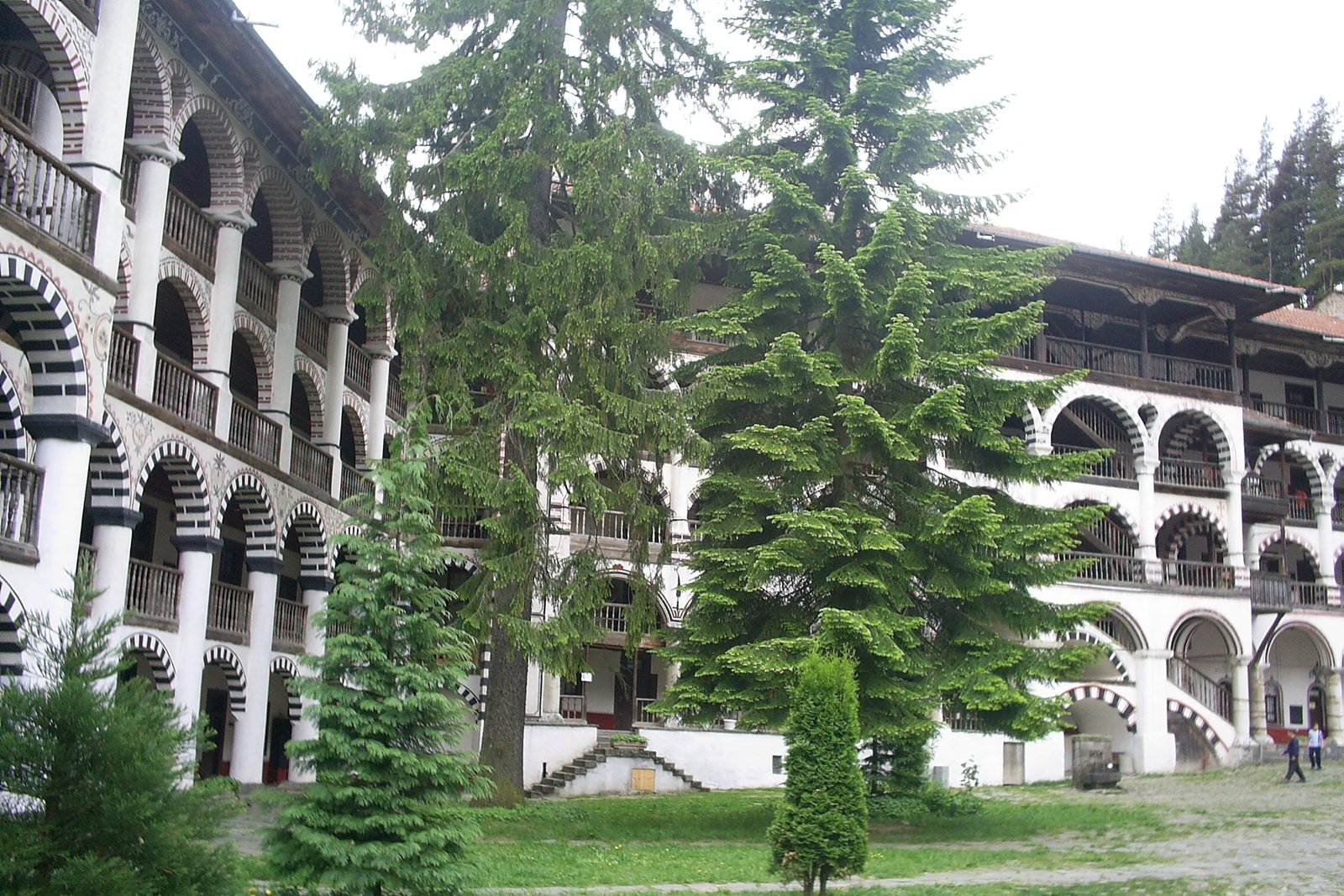
Photograph by Svik, Rila Monastery, Bulgaria, 2006 — CC BY-SA 3.0, Wikimedia Commons.
Ivan — later canonized as Saint Ivan of Rila, and revered today as Bulgaria's most beloved national saint — never sought to found an institution himself. It was his followers, gathering after his death around 946, who organized the community that would eventually grow into Rila Monastery, built not at his original cave but at a nearby, more accessible site along the Rilska River that could support a larger permanent community.
Surviving under Ottoman rule
The monastery's most consequential period came centuries later, following the Ottoman conquest of Bulgarian territory in the late fourteenth century. Ottoman rule brought heavy taxation, periodic destruction of religious buildings, and sustained pressure against Bulgarian Christian institutions that lasted, in various forms, for nearly five hundred years. Many churches and monasteries across Bulgaria didn't survive this period intact; a considerable number were destroyed, converted to other uses, or abandoned entirely.
Rila endured. Its remote mountain location offered some natural protection, but the monastery's survival owed just as much to the determination of the monks who remained there, continuing to copy manuscripts, teach Bulgarian language and literacy, and maintain Orthodox Christian worship largely uninterrupted through the centuries when Bulgaria had no independent political structures of its own to protect its culture. Historians of the period often describe Rila as functioning, in effect, as a kind of national library and school operating in the only form available under occupation — a role that gave the monastery a significance in Bulgarian national memory that extends well beyond its religious function alone.
Rebuilt in fire's aftermath
The buildings pilgrims and visitors see at Rila today are, ironically, almost entirely the product of the monastery's most difficult modern crisis rather than of its medieval founding. In 1833, a catastrophic fire swept through the complex, destroying most of the earlier structures that had stood, in various forms, since the medieval period. Rather than a moment of final loss, the fire became the occasion for the monastery's most ambitious building campaign — reconstruction began the following year and continued through 1862, funded substantially by donations from Bulgarian communities across the region, still living under Ottoman rule but determined to see their most important religious institution restored.
That reconstruction produced the monastery's now-iconic architecture: tiered wooden galleries wrapped around a stone courtyard, striped black-and-white arches, and richly colored frescoes covering nearly every available surface of the central church, painted by some of the leading Bulgarian artists of the period as part of a broader cultural revival movement that was gaining momentum across Bulgarian society in the decades leading up to independence.
A landmark of the Bulgarian National Revival
Rila's nineteenth-century rebuilding coincided closely with what historians call the Bulgarian National Revival, a period of growing cultural and eventually political awakening that would culminate in Bulgaria's independence from Ottoman rule in 1878. The monastery's reconstruction wasn't simply a religious project; it became, for many Bulgarians of the period, a tangible expression of national identity and continuity at a moment when that identity still lacked any independent state to embody it. The monastery's museum today houses one of the most striking artifacts of this era: the Cross of Rafail, a small wooden cross carved over twelve years by the monk Rafail Bobovski using only fine tools, containing 140 miniature biblical scenes and over 1,500 human figures, a work so intricate the monk reportedly lost most of his eyesight completing it.
A living monastery and a national symbol
Rila remains an active Bulgarian Orthodox monastery today, home to a small community of monks who continue the tradition of prayer and hospitality the site has offered pilgrims for over a thousand years. It was named a UNESCO World Heritage Site in 1983 in recognition of both its architectural and artistic significance and its unique historical role, and it continues to draw visitors from across Bulgaria and beyond — many coming specifically to see Saint Ivan's original hermit cave, still accessible near the monastery, where a solitary man's search for silence eventually grew into a refuge that helped carry an entire nation's culture through five centuries of foreign rule.
Trivia
Who founded Rila Monastery and when?
Why does Rila Monastery look so different from the medieval monastery Saint Ivan founded?
What role did Rila Monastery play during Ottoman rule?
What is the significance of Saint Ivan of Rila to Bulgarian Christianity?
Is Rila Monastery still an active monastery today?
Related Reading