Meteora: The Monasteries Built Atop Sheer Rock Towers

Monasteries that seem to grow out of stone
Approach the town of Kalambaka in central Greece and the landscape changes abruptly: flat farmland gives way, with almost no transition, to a forest of massive gray sandstone pillars rising hundreds of feet straight out of the plain, some of them capped with buildings that appear, from a distance, to be impossible — small monasteries perched directly on top of rock towers with no visible way up at all. This is Meteora, and the name itself, from Greek, means something like "suspended in the air" or "in the heavens above." It's not an exaggeration. It's a fairly literal description.
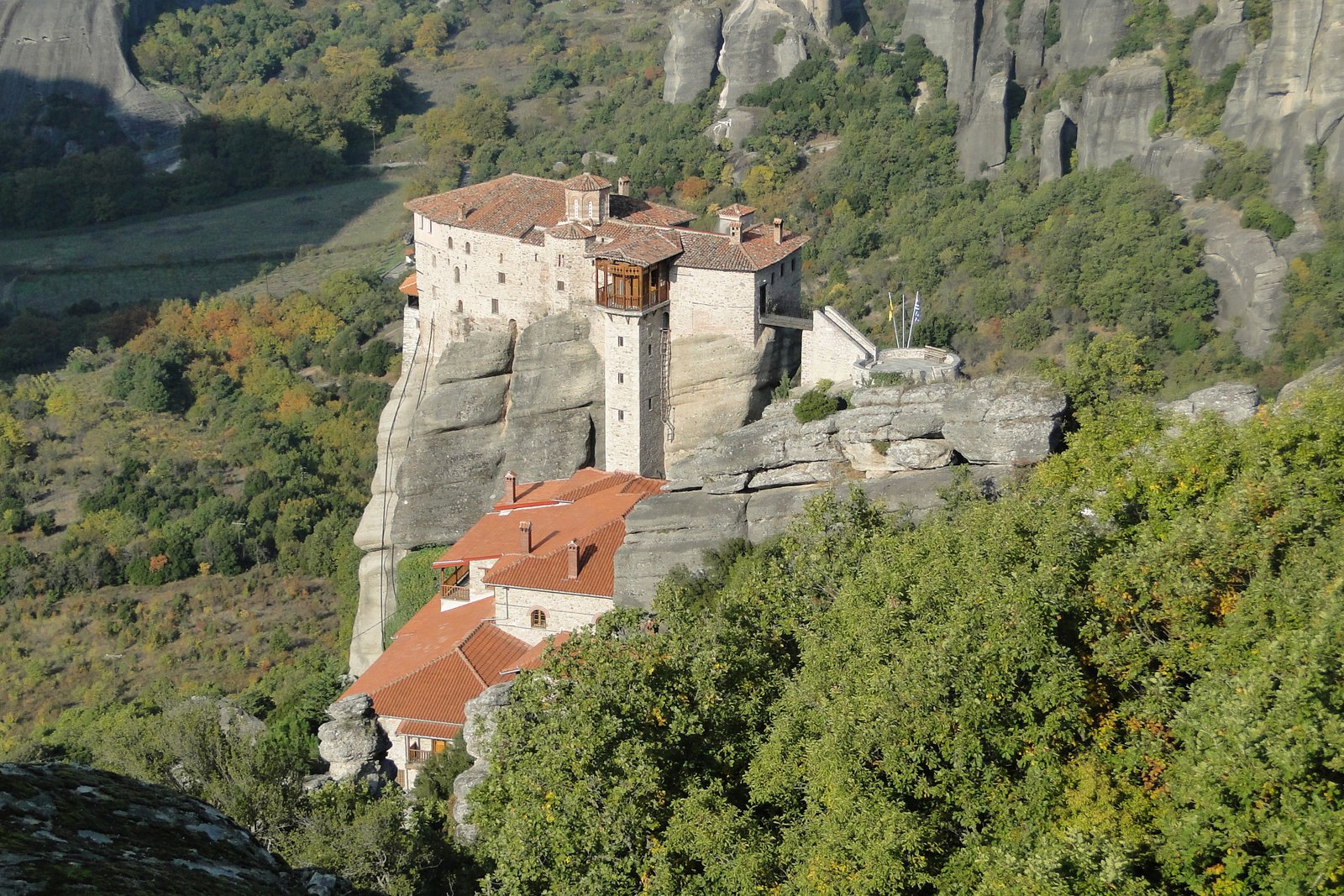
Photograph by Bernard Gagnon, Roussanou Monastery, Meteora, 2011 — CC BY-SA 4.0, Wikimedia Commons.
The rock formations themselves are the product of geological processes going back millions of years — ancient river sediment and erosion carving isolated pillars out of what was once a continuous plateau. Hermits recognized the potential of these formations for solitary religious life as early as the eleventh century, taking shelter in the caves and natural clefts scattered across the rock faces, drawn by exactly the qualities that made the site so forbidding: near-total inaccessibility, dramatic isolation, and a landscape that felt, to those who chose to live there, closer to heaven than to the ordinary world below.
From scattered hermits to a monastic community
Organized monastery-building at Meteora began in earnest in the 1340s, led by a monk named Athanasios, who had previously lived at Mount Athos — the great monastic peninsula that remains, to this day, the center of Eastern Orthodox monasticism — before relocating to the relative safety of central Greece as instability spread through the wider Byzantine world. Athanasios chose the tallest and most inaccessible of the Meteora pillars for his own monastery, later named the Great Meteoron, and the difficulty of the climb was, for him and the monks who joined him, entirely the point rather than an obstacle to overcome.
Over the following two centuries, other monastic communities followed his example, and at the height of Meteora's development in the sixteenth century, as many as twenty-four monasteries occupied the surrounding rock pillars, forming one of the largest and most significant concentrations of Orthodox monasticism anywhere outside of Mount Athos itself.
Reaching the unreachable, on purpose
For most of Meteora's history, getting to any of the monasteries required either climbing removable wooden ladders lashed together and lowered from above — which monks could pull up entirely to seal off the monastery from any unwanted visitor, including raiders or hostile soldiers during the region's frequent periods of conflict — or being hauled up bodily in a net or wooden basket, drawn by a rope-and-windlass system operated by monks at the top. Visitors and pilgrims of the period reportedly found the ascent terrifying, and it was meant to be: the difficulty of the climb functioned as both practical defense and a kind of spiritual threshold, a way of physically enacting the separation from worldly concerns that monastic life was meant to represent.
This system remained the primary means of access for centuries, and was only replaced with carved stone steps and, eventually, small footbridges in the 1920s, making the monasteries genuinely accessible to ordinary visitors for the first time in their history. Older monks at some of the communities reportedly still recalled, well into the twentieth century, having personally used the rope-and-net system in earlier decades.
Frescoes preserved by isolation
Much like Saint Catherine's Monastery at the foot of Mount Sinai, Meteora's extreme isolation had an unintended benefit: its remoteness protected the monasteries' interiors — and the extensive Byzantine and post-Byzantine fresco cycles covering their church walls — from much of the destruction, looting, and disruption that affected more accessible religious sites during centuries of regional conflict and, later, Ottoman rule over Greece. The frescoes at several of the monasteries, particularly the Great Meteoron and the Monastery of Varlaam, are today considered among the finest surviving examples of late Byzantine religious painting anywhere in Greece.
A living monastic tradition, still active today
Of the original twenty-four monasteries, six remain active today — four inhabited by communities of monks and two by communities of nuns — continuing a monastic tradition that has now persisted at this site for close to seven centuries. Meteora was recognized as a UNESCO World Heritage Site in 1988, cited for the exceptional combination of its natural geological formations and its architectural and artistic heritage, one of the relatively small number of sites worldwide honored for both natural and cultural significance simultaneously.
Modern visitors reach the monasteries by road and stone steps rather than rope net, and the surrounding pillars now draw rock climbers alongside pilgrims — a use the site's original monks, seeking maximum separation from the world below, likely never anticipated. But the monasteries that remain active continue much as they always have: small communities maintaining a rhythm of prayer, largely undisturbed, hundreds of feet above the ordinary noise of the valley floor.
Trivia
What does the name Meteora mean and why were the monasteries built there?
When were the Meteora monasteries built and by whom?
How did monks and supplies originally reach the monasteries?
How many monasteries remain active at Meteora today?
Is Meteora recognized as a UNESCO World Heritage Site?
Related Reading