St. Patrick's Cathedral, New York City

A cathedral built by immigrants, for immigrants
St. Patrick's Cathedral occupies a full city block on Fifth Avenue in midtown Manhattan, its white marble Gothic spires rising between the glass towers of Rockefeller Center and the surrounding commercial district. It is one of the most recognizable Catholic churches in the United States and the seat of the Archbishop of New York, but its origins lie not in institutional wealth or civic prestige — it was conceived and largely funded by a community of Irish and German Catholic immigrants who, in the mid-nineteenth century, had little of either.
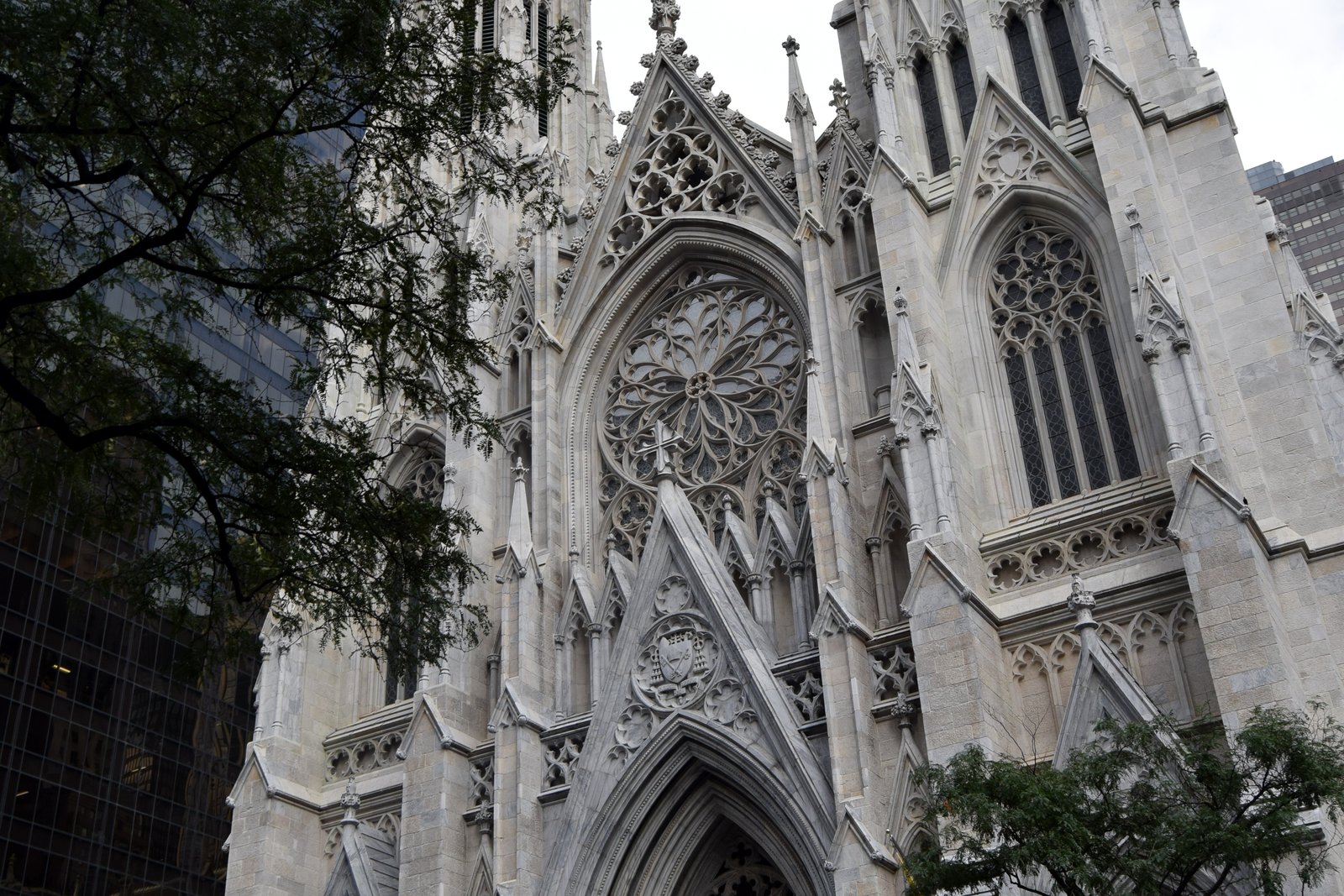
St. Patrick's Cathedral facade, Fifth Avenue, Manhattan (Jean-Christophe BENOIST, CC BY 3.0, Wikimedia Commons)
That community's driving figure was Archbishop John Hughes, himself an Irish immigrant who had risen to lead the Diocese of New York at a time when Catholics, and Irish Catholics especially, faced open hostility and discrimination in American civic life, including violent nativist riots targeting Catholic churches and institutions in several American cities during the 1840s. Hughes envisioned a cathedral that would answer that hostility not with confrontation but with visible, undeniable permanence — a building on the scale of Europe's great cathedrals, standing as proof that American Catholicism, however recently arrived and however poor its congregants, was here to stay.
Choosing a site far from the city's heart
When Hughes selected a plot of land on Fifth Avenue between 50th and 51st Streets for the new cathedral in 1850, the choice struck many contemporaries as bewildering. The site lay well north of Manhattan's developed downtown core, surrounded largely by open or sparsely built land, and skeptics questioned why the diocese would build its grandest church so far from where the city's Catholics actually lived and worshiped. Hughes, however, was betting on the city's inevitable northward expansion — a bet that within a few decades would prove entirely correct, as Manhattan's commercial and residential growth swept up past the cathedral site and eventually surrounded it with the dense urban fabric of midtown.
Ground was broken and the cornerstone laid in 1858, but construction proceeded slowly and was halted entirely during the Civil War years, when funds and labor were diverted elsewhere. Work resumed after the war's end, and the cathedral, designed by the prominent American architect James Renwick Jr. in the Gothic Revival style, was finally completed and formally dedicated in May 1879 — nearly three decades after Hughes had first proposed it, and after his own death in 1864 without seeing the finished building.
Gothic Revival on an American street grid
Renwick's design drew consciously on the great Gothic cathedrals of medieval Europe, incorporating pointed arches, ribbed vaulting, extensive stained glass, and a soaring nave meant to evoke the same sense of vertical grandeur found in the cathedrals of France and England — though built, notably, of white marble rather than the stone typical of its European models, giving it a distinctly bright, almost luminous appearance uncommon among Gothic Revival churches of its era. Its twin spires, among the tallest structures in New York City when completed, were not finished until 1888, rising to a height of 330 feet above the surrounding streets.
The interior houses an extensive collection of stained glass, much of it produced by celebrated European workshops including Chartres' own glassmakers, along with a great bronze baldachin over the high altar and numerous side chapels added over subsequent decades as the cathedral's decoration continued to develop well into the twentieth century. Notably, the cathedral's connection to Ireland's patron runs deeper than its dedication alone: the site sits at the heart of a city whose Irish Catholic community, shaped by devotion to figures like Saint Patrick himself, built much of the institutional infrastructure of American Catholicism in the nineteenth century, from parish schools to hospitals to, ultimately, this cathedral.
A landmark surrounded by skyscrapers
The most striking irony of St. Patrick's Cathedral's history is architectural rather than religious: the same Gothic verticality that made it an imposing presence on a mostly undeveloped Fifth Avenue in 1879 now reads, by comparison, as almost modest against the skyscrapers that eventually rose around it, including Rockefeller Center directly across the avenue. Rather than diminishing the cathedral, this juxtaposition has become part of its identity — a nineteenth-century Gothic silhouette persisting, deliberately unmodernized in scale, amid one of the densest concentrations of twentieth-century commercial architecture on earth.
The cathedral underwent a major restoration completed in 2015, addressing decades of accumulated wear from pollution and the sheer volume of visitor traffic, and it remains today an active parish church and the seat of the Archbishop of New York, hosting regular Masses, major civic and memorial events, and drawing millions of visitors annually as one of the most visited religious sites in the United States. It stands, more than a century and a half after Hughes first proposed it, as one of the clearest physical monuments to the role Catholic immigrants played in building the city around it.
Trivia
Why is St. Patrick's Cathedral in New York dedicated to Saint Patrick?
When was St. Patrick's Cathedral built?
Why was the cathedral's original location considered controversial?
What architectural style is St. Patrick's Cathedral built in?
Is St. Patrick's Cathedral still an active parish?
You May Also Like

Related Reading