Andrei Rublev's Trinity: The Icon That Defines Icons

An Old Testament story read as a hidden Trinity
Rublev's icon draws its subject from Genesis 18, where three mysterious visitors appear to Abraham at the oak of Mamre, and Abraham, recognizing something extraordinary in them, offers hospitality and a shared meal. Christian interpreters going back to the early Church, including Augustine, had long read this episode as more than a simple story of divine visitation — many saw in the three visitors, who are addressed at points in the text with singular verbs despite appearing as three distinct figures, a veiled Old Testament foreshadowing of the Trinity, three Persons in one God. Icons depicting this scene, often called the "Hospitality of Abraham" or simply the "Old Testament Trinity," existed well before Rublev, typically showing Abraham and Sarah actively serving their three guests at a fully laid table.
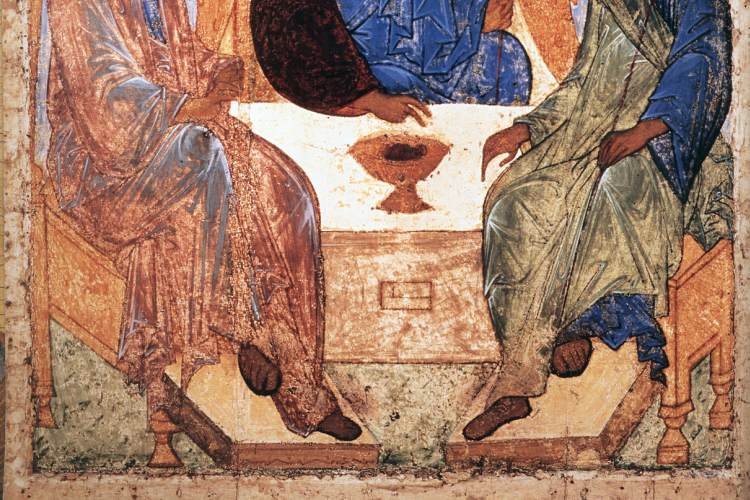
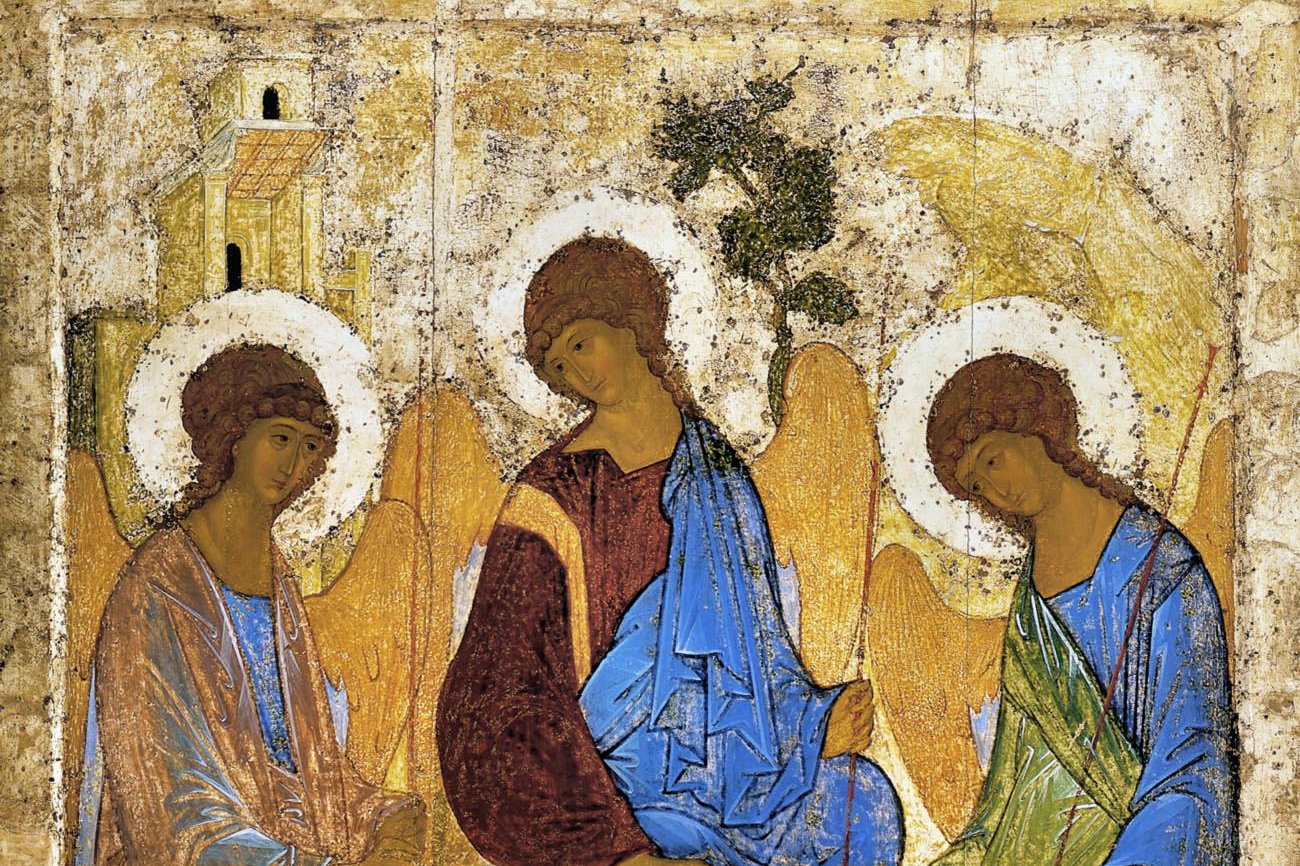
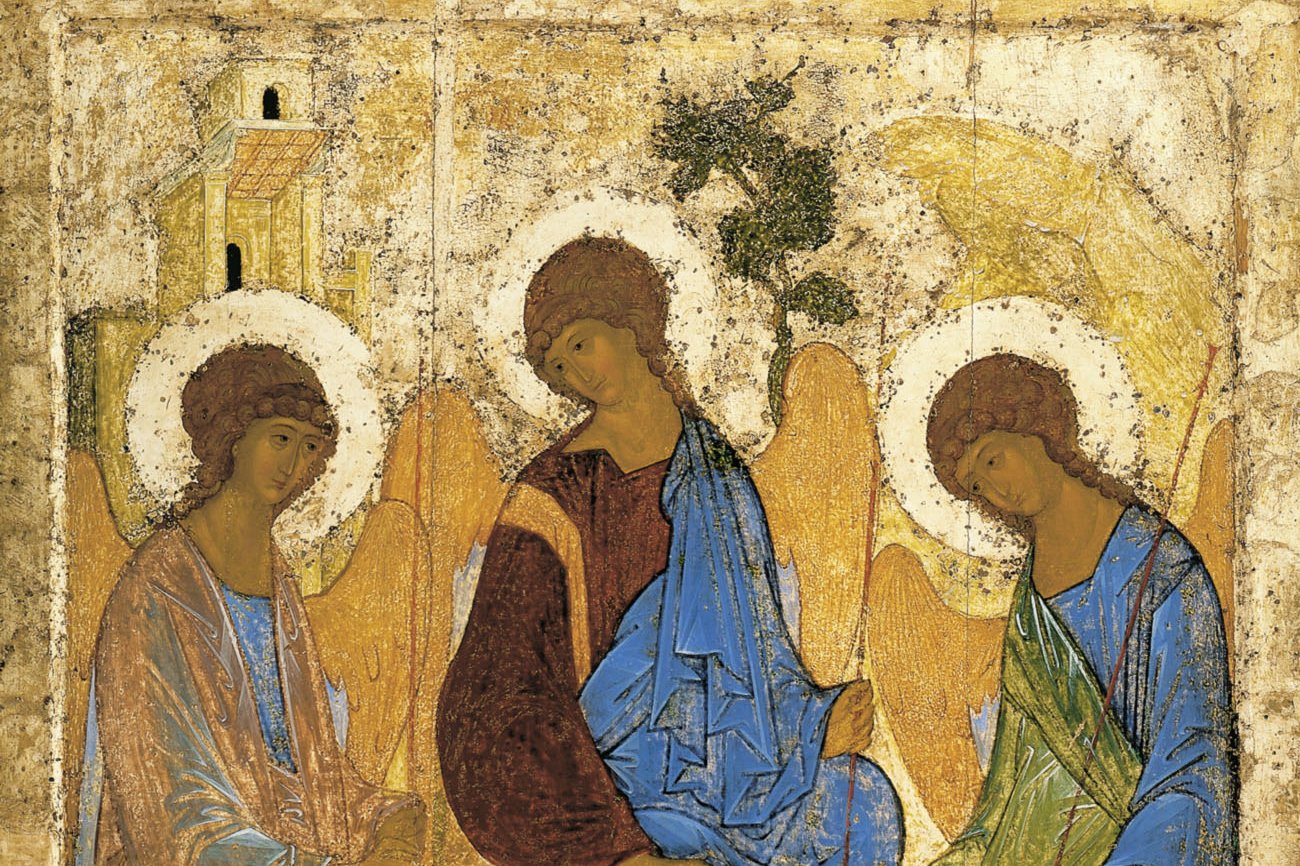
Andrei Rublev, "Trinity," c. 1411-1425, Tretyakov Gallery, Moscow — public domain.
What Rublev removed, and why it matters
What sets Rublev's version apart from earlier treatments of the same subject is what he took out. Abraham and Sarah, present in most earlier depictions of the Mamre visitation, disappear entirely from his composition. The elaborate table of food shrinks to a single chalice. What remains is just the three winged, haloed figures, seated in a gentle, unbroken circle, their heads inclined toward one another, their eyes and gestures forming a continuous visual rhythm that draws the viewer's eye around the composition and back again rather than settling on any one figure as dominant. That circular unity — no single figure positioned as clearly superior to the others, each gazing toward or gesturing toward the central cup — has been read for centuries as a visual argument for the equal, unified nature of the three divine Persons, expressed through composition rather than through narrative detail or written explanation.
Byzantine tradition, pushed toward something new
Rublev worked within the established conventions of Byzantine icon painting — flattened space, formalized gestures, gold backgrounds, a deliberate avoidance of the illusionistic depth developing at the same period in Western Renaissance art. Readers can find the broader rules governing Byzantine icon painting covered elsewhere on this site. Within that inherited formal language, though, Rublev achieved something that felt genuinely new to contemporaries and later commentators alike: a quietness and interior stillness among the three figures that many viewers, then and now, describe as feeling contemplative rather than static, an unusual accomplishment within a tradition that generally prized formal consistency over individual expressive innovation.
Painted for a specific monastery, in a specific moment
Rublev created the icon for the Trinity Monastery of Saint Sergius, founded by Saint Sergius of Radonezh, one of the most revered figures in Russian Orthodox monastic history. Tradition connects the commission to honoring Sergius's memory, and some historians read the icon's emphasis on unity and harmony as a deliberate response to the political fragmentation and internal conflict troubling Russian principalities during Rublev's lifetime — an image of perfect concord offered, whether consciously or not, against a background of real discord. Little is documented about Rublev's own life beyond a handful of surviving records, but the Trinity icon alone secured his lasting reputation as the greatest master of the medieval Russian icon-painting tradition.
Formally declared the standard, a century later
In 1551, more than a century after Rublev's death, the Council of the Hundred Chapters — a major gathering of the Russian Orthodox Church addressing questions of doctrine, discipline, and church practice — formally named Rublev's Trinity icon the model that all future icons of the same subject should follow. That kind of explicit, institutional endorsement of a single artist's specific composition was unusual within icon-painting tradition, which generally prized continuity with established type over individual innovation, and it cemented Rublev's version as something closer to a fixed theological reference point than simply one respected painting among many.
Technique: reverse perspective and color theology
Icon painters of Rublev's era worked in a system art historians call reverse perspective, where lines that would converge toward a vanishing point in Western Renaissance painting instead appear to widen as they recede, so the table and footstools in the Trinity seem to open outward toward the viewer rather than receding away. The effect draws the viewer into the scene rather than positioning them as a distant observer looking through a window, a formal choice well suited to an image meant for contemplative prayer rather than narrative illustration. Rublev's color choices carry theological weight as well: the deep blue traditionally associated with divinity, a warm gold recalling the uncreated light described in Orthodox theology, and a soft green robe on the central figure that some interpreters connect to the Holy Spirit's association with life and renewal. Restoration work in the twentieth century removed centuries of darkened varnish and later overpainting, revealing color relationships far brighter and more luminous than the icon had shown for generations, closer to what Rublev's own contemporaries would have seen.
Its place today
The icon now hangs in the Tretyakov Gallery in Moscow, having been removed from the Trinity-Sergius Lavra monastery during the Soviet era's suppression of religious institutions. It was briefly returned to the monastery for public veneration in 2023, a transfer that drew wide attention and later controversy over its conservation, before returning to museum care. Reproductions of Rublev's Trinity remain ubiquitous in Orthodox churches and homes across the world today, still functioning exactly as the 1551 council intended: not simply as a historical artwork to admire, but as the working visual definition of how the Trinity itself is imagined across Orthodox Christianity.
Trivia
Who was Andrei Rublev, and when did he paint the Trinity icon?
Why does the Trinity icon show three angels instead of God the Father, Son, and Holy Spirit directly?
What happened to the table setting from the original biblical story in Rublev's version?
Where is Rublev's Trinity icon located today?
Did the Russian Orthodox Church give any special recognition to Rublev's Trinity icon?
Related Reading