Fra Angelico's Annunciation: Prayer Painted on a Wall

A fresco meant to be walked into, not just looked at
Most Renaissance Annunciations were made for altars or private chapels, seen from a respectful distance by people dressed for the occasion. Fra Angelico's version at the Convent of San Marco in Florence was made for none of that. It sits directly on the plaster at the top of the dormitory staircase, at the exact height and angle a friar would meet it while climbing to bed after Compline or descending before dawn for Matins. There's no frame separating it from the wall, no gold ground signaling "this is a sacred object, handle with reverence" — just Gabriel and Mary under an arcaded loggia identical in style to the convent's own cloister, as if the angel had simply arrived at San Marco itself.
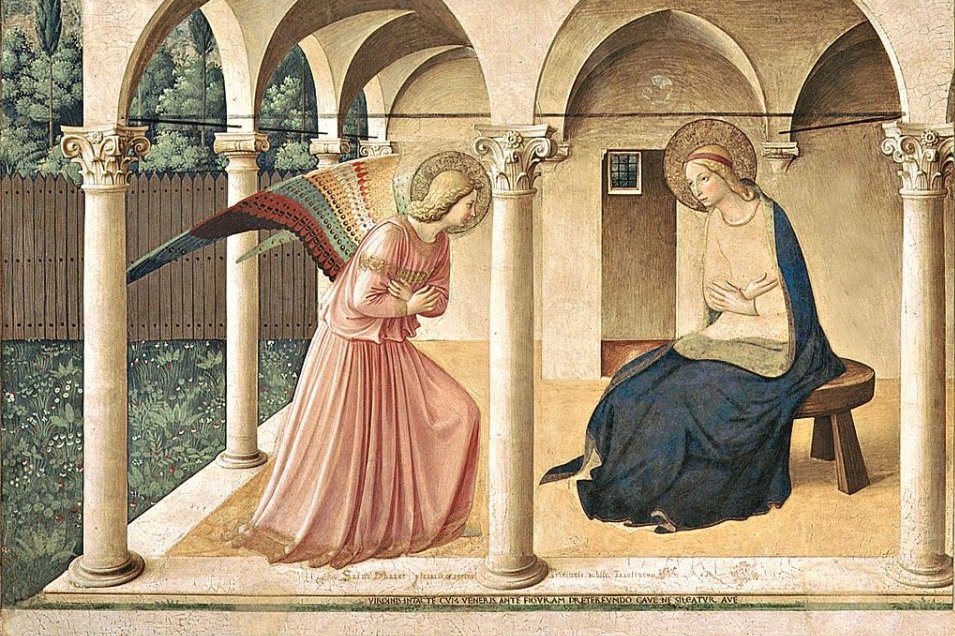
Fra Angelico, "The Annunciation," c. 1440-1445, Convent of San Marco, Florence — public domain.
The moment and the composition
The scene shows the instant recorded in the Gospel of Luke, when the angel Gabriel tells Mary she has been chosen to bear the Son of God. Fra Angelico strips the encounter down to essentials: Gabriel kneels on the left, wings still lifted as though he has just landed, hands crossed over his chest in a gesture of reverence rather than command. Mary sits opposite him on a plain wooden stool, her own hands crossed in an almost identical pose, her head bowed in a posture of humble acceptance rather than surprise. Between them lies a small enclosed garden glimpsed through the loggia's columns — a visual echo of the hortus conclusus, the "enclosed garden" long used in Christian art as a symbol of Mary's perpetual virginity, drawn from the Song of Songs.
Why the plainness is the point
Fra Angelico was a Dominican friar living at San Marco under the reforming prior (and future saint) Antoninus, and the fresco cycle he and his workshop painted throughout the convent — in the corridors, the chapter house, and individual friars' cells — was never intended for the public. It was built for men committed to silence, poverty, and constant prayer, and the Annunciation fresco matches that life precisely: no crowd of prophets, no elaborate architecture competing for attention, no gold leaf catching candle light to dazzle a visiting patron. Just clear, even daylight falling across two figures in a loggia that looks like it could be the convent's own. Below the image, a short Latin inscription instructs anyone passing not to forget to say a Hail Mary — confirming that this was never meant purely as decoration but as a trigger for an actual, repeated act of prayer, performed by the same friars dozens of times a week for the rest of their lives.
Fra Angelico's broader career
Born Guido di Pietro around 1395, he took the name Fra Giovanni upon joining the Dominican order and was known in his own lifetime simply as "Fra Angelico" — "the angelic friar" — a nickname that stuck because contemporaries saw an unusual sincerity in his devotional work. Vasari, writing biographies of Renaissance artists a century later, claimed Fra Angelico never picked up a brush without first praying and reportedly wept while painting scenes of the Crucifixion, though how literally to take Vasari's anecdotes is debated among historians. What isn't in dispute is the scale of his output: beyond San Marco, he painted major fresco cycles for the Vatican's Niccoline Chapel and worked extensively across Florence and Rome, training a workshop that carried his clear, luminous style forward after his death in 1455. Readers curious about how Fra Angelico approached painting as a vocation can find a fuller account of his life and working methods.
A second Annunciation, painted for one friar alone
San Marco holds a second, less famous Annunciation by Fra Angelico, painted inside one of the individual friars' cells rather than in a public corridor. That version adds a background scene of Adam and Eve being driven from Eden, a detail entirely absent from the stairwell fresco, linking Mary's "yes" to Gabriel with humanity's fall in Genesis — a theological pairing common in Christian art, since medieval theologians frequently framed Mary as the "new Eve" whose obedience reversed Eve's disobedience. That the two frescoes, painted for different purposes just steps apart, take such different approaches says something about how deliberately Fra Angelico calibrated each image to its specific viewer and setting, rather than repeating a single formula throughout the convent.
How the fresco is regarded and used today
The stairwell Annunciation is now one of the most reproduced images in Western religious art, appearing on everything from prayer cards to museum posters, yet it has never quite lost the hushed, private quality it was painted for. Visitors to the Museo di San Marco today still encounter it the way the friars did — at the top of a real staircase, unlit by spotlights, simply present. Its restrained composition has also made it a recurring touchstone for how the Annunciation itself is told and retold across Christian art, and for artists exploring the enclosed garden and Marian symbolism more broadly. Nearly six centuries after it was painted, it remains one of the clearest surviving examples of an artwork built not to impress an audience but to prompt a prayer — which, for the friar climbing those stairs at dusk, was always the entire point.
Trivia
Where is Fra Angelico's Annunciation fresco located, and can it still be seen there?
Why does Fra Angelico's Annunciation look so much simpler than other Renaissance versions of the same subject?
What is the small Latin inscription below the fresco, and what does it mean?
How many Annunciation scenes did Fra Angelico paint at San Marco?
Was Fra Angelico ever formally recognized by the Catholic Church for his art?
You May Also Like
Related Reading