Caravaggio's Conversion on the Way to Damascus

A conversion with almost no visible miracle
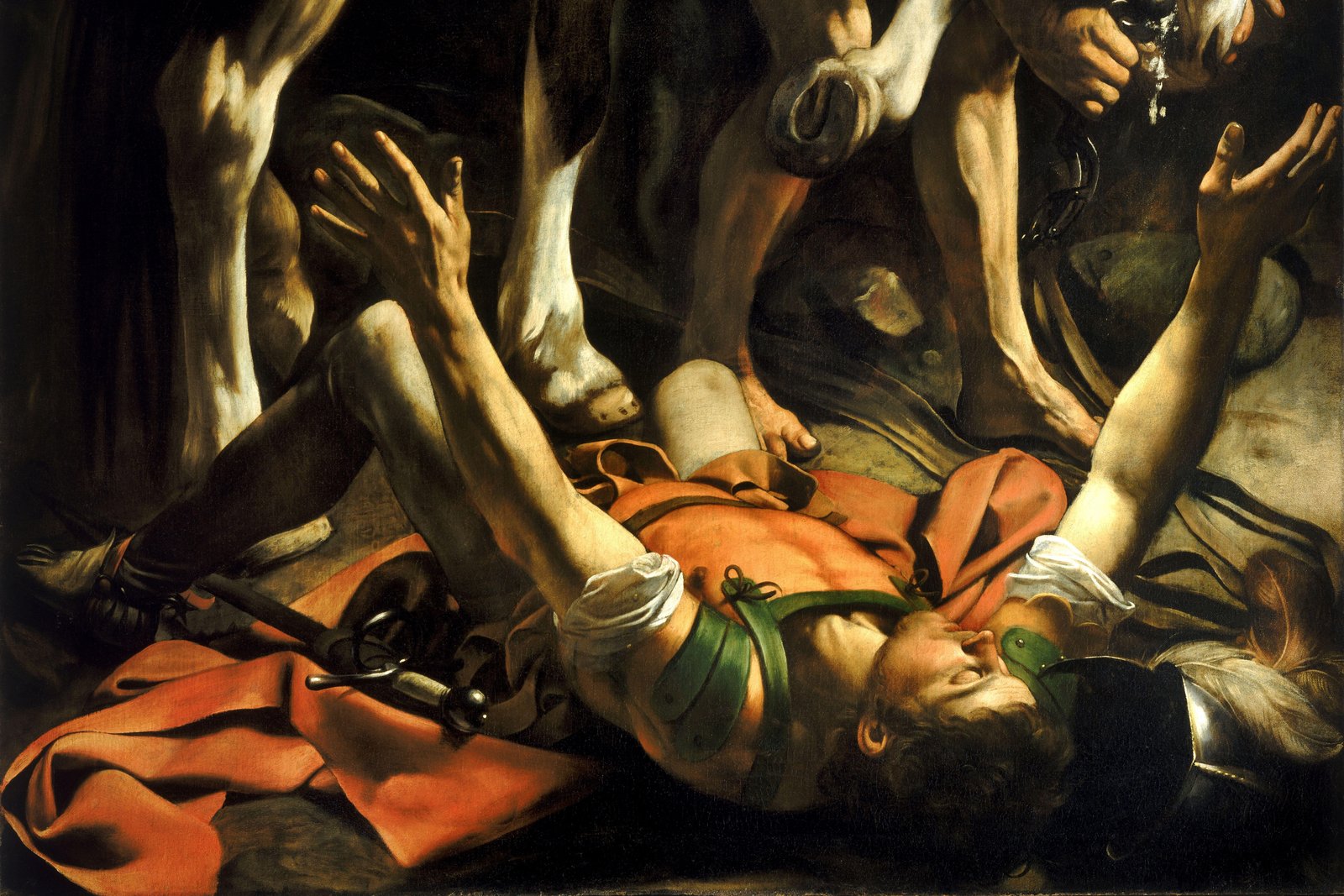
Every element a viewer might expect from a painting of Saint Paul's conversion — the opened heavens, a beam of divine light, an angelic messenger, a dramatic landscape witnessing the event — is either absent or pushed to the barest suggestion in Caravaggio's version. What remains is close, physical, and strangely quiet: a horse fills roughly half the canvas, its groom bent over adjusting a hoof or leading it forward, entirely absorbed in an ordinary task, while beneath them Saul of Tarsus lies flat on his back in full armor, eyes closed, arms thrown wide, reaching toward a light the viewer cannot fully locate. Nothing in the scene announces itself as sacred except Saul's own posture and the unexplained illumination striking his upturned face — and that restraint is exactly what makes the painting so unsettling and so effective.
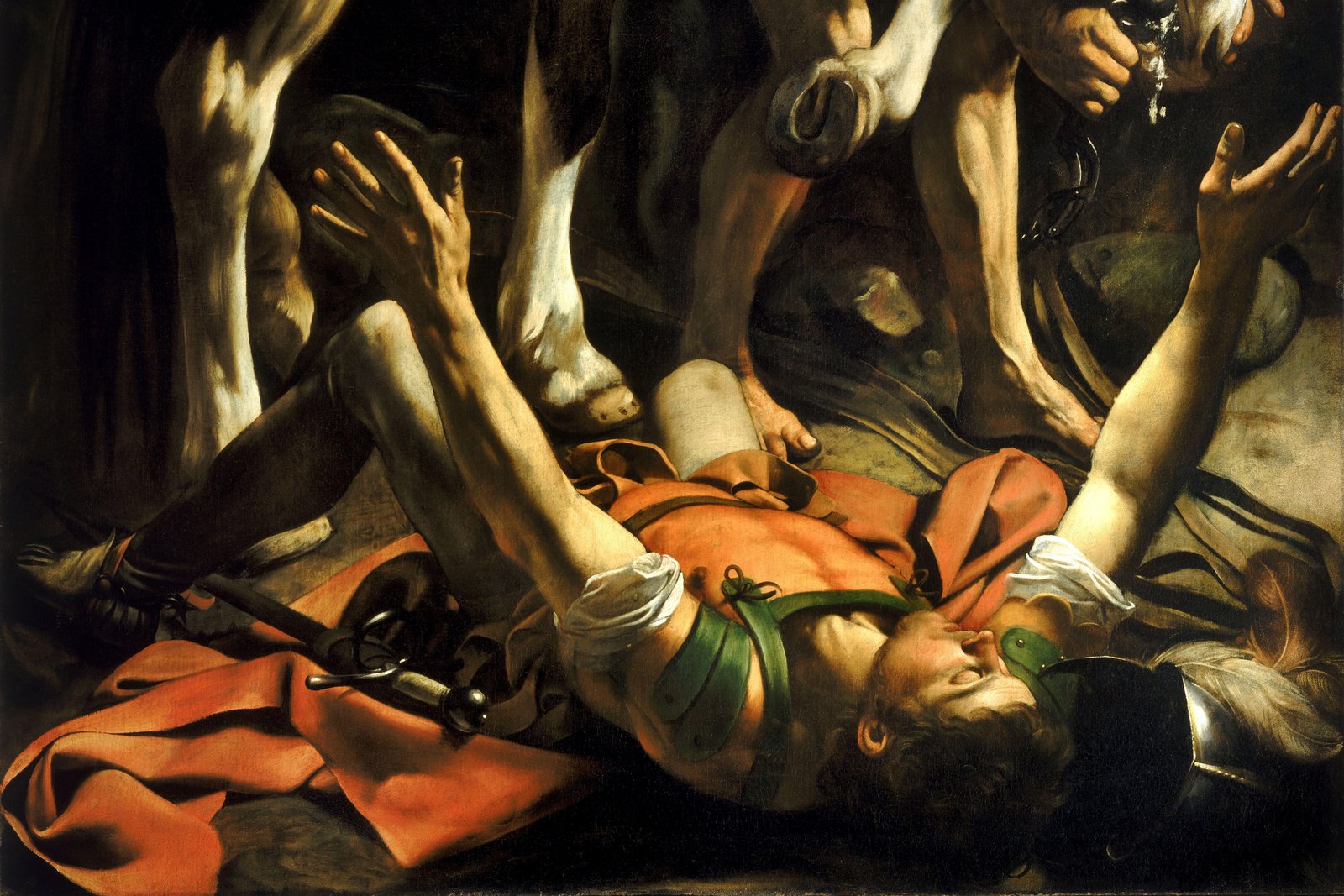
Caravaggio, "Conversion on the Way to Damascus," 1600-1601, Cerasi Chapel, Santa Maria del Popolo, Rome — public domain.
The biblical moment behind the image
The painting depicts the conversion recorded in the Acts of the Apostles: Saul, a zealous persecutor of the early Christian community, was traveling to Damascus with authority to arrest followers of Christ when a sudden light from heaven and a voice — "Saul, Saul, why do you persecute me?" — struck him to the ground and left him blinded for three days. That encounter marked the beginning of his transformation into Paul, who became one of Christianity's most consequential missionaries and letter-writers. Readers can find the fuller biblical account of Saint Paul's conversion covered elsewhere on this site. Caravaggio's choice to render this cosmic turning point through a fallen man, a placid horse, and an unremarkable groom rather than a heavenly spectacle reframes conversion as something that can happen in the middle of an entirely mundane moment, indistinguishable from outside observation.
Chiaroscuro as theology, not just technique
Caravaggio's signature use of chiaroscuro — a stark, often unexplained contrast between deep shadow and a sharp, directional light — does more here than create visual drama. The light falling on Saul's upturned face and open palms, with no clear origin within the painted space, functions as the entire visible evidence of the miracle: everyone and everything else in the scene, including the horse standing directly above him, seems untouched by it, as though the experience is happening to Saul alone, invisible to everyone around him. That interior, almost private quality of the light draws a sharp contrast with the loud, crowded conversion scenes common in earlier Italian religious painting, and it's part of why Caravaggio's Baroque naturalism proved so influential on painters who followed — a style explored further in how Baroque religious painting built drama.
A rejected first attempt
Caravaggio actually painted this subject twice for the same commission. His first version, now held in the Odescalchi Balbi collection in Rome, took a different, more crowded approach involving Christ appearing directly above Saul; it was set aside — whether rejected by the patron, Tiberio Cerasi, or by Caravaggio's own dissatisfaction remains debated among historians — and replaced with the stripped-down composition now installed in the chapel. That willingness to discard a finished, competent painting in favor of a far more radical solution says a great deal about how deliberately Caravaggio was pushing against convention, rather than arriving at his famous style by accident.
A chapel built around two martyrdoms
The Conversion hangs in the Cerasi Chapel facing Caravaggio's equally startling Crucifixion of Saint Peter, the two canvases commissioned together around 1600 for the same small space in Santa Maria del Popolo. Seen together, they form a deliberate pairing: Peter's death, rendered with the same unflinching physicality, and Paul's conversion, the moment that set his entire apostolic life in motion. Visitors standing in the chapel today are positioned exactly between the two events that, according to tradition, bookend the two greatest apostles' service to the early Church — Peter's end and Paul's beginning, facing each other across a few feet of Roman stone floor.
A composition built for a cramped, narrow space
Part of what makes the painting's design so unusual is the physical space it had to work within. The Cerasi Chapel is small and narrow, meaning viewers can never stand far enough back to take in the whole canvas from a comfortable distance the way they could with a large altarpiece in an open nave. Caravaggio responded by pushing his figures forward, cropping the horse's body at the edges of the frame so its bulk seems to press directly into the viewer's own space, and steepening the near-vertical foreshortening of Saul's fallen body so it reads clearly even from close range and a sharp angle. That solution turned the chapel's physical limitation into part of the painting's power: rather than a distant spectacle to be observed from across a nave, the conversion feels close enough to step into, the horse's raised hoof seeming to hover just above the floor a visitor is standing on.
Caravaggio's lasting influence
The painting's raw, unidealized realism — a Roman street groom's ordinary horse, worn armor, a fallen man rendered without heroic polish — became a hallmark of Caravaggio's mature style and influenced a whole generation of painters across Europe who came to be grouped under the label "Caravaggisti." Its refusal to spectacle-ize a miracle, choosing instead to locate the sacred inside an almost embarrassingly plain moment, remains one of the most studied and imitated compositional choices in Baroque religious art, still drawing visitors into that small Roman chapel more than four centuries later.
Trivia
Where can you see Caravaggio's Conversion on the Way to Damascus today?
Why is a horse the largest figure in Caravaggio's painting of Saint Paul's conversion?
What biblical event does the painting depict?
Did Caravaggio paint two different versions of this subject?
How does this painting use light differently from earlier Renaissance depictions of the same subject?
Related Reading