Early Christian Sarcophagi: Scripture Carved in Marble

From painted walls to carved marble
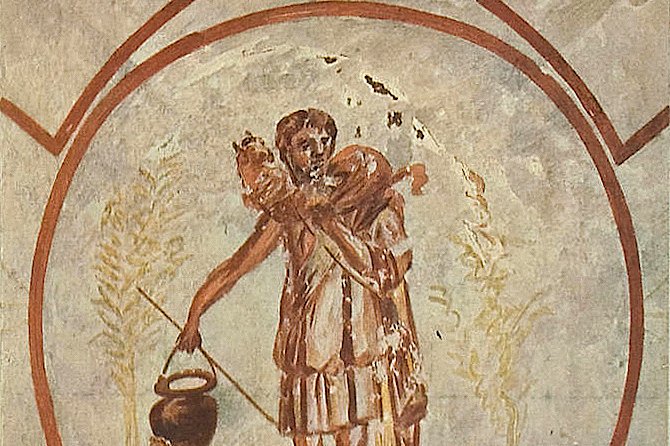
Catacomb paintings, discussed in our companion article on the catacomb paintings of Rome, represent Christian art produced under modest circumstances, painted relatively quickly on tomb walls by artisans working within tight budgets. Sarcophagi tell a different story. Commissioning a carved marble coffin required substantial wealth, and the objects that survive reflect patrons drawn from Rome's more prosperous Christian families, including, by the 4th century, members of the aristocracy and imperial administration. As Christianity moved from a persecuted minority faith toward, following the Edict of Milan in 313 and its eventual adoption as the empire's dominant religion later in the century, official and social pressures against open Christian expression eased considerably, and wealthy Christians increasingly commissioned funerary monuments that displayed their faith with the same confidence, and often the same craftsmen, previously employed for pagan mythological subjects.
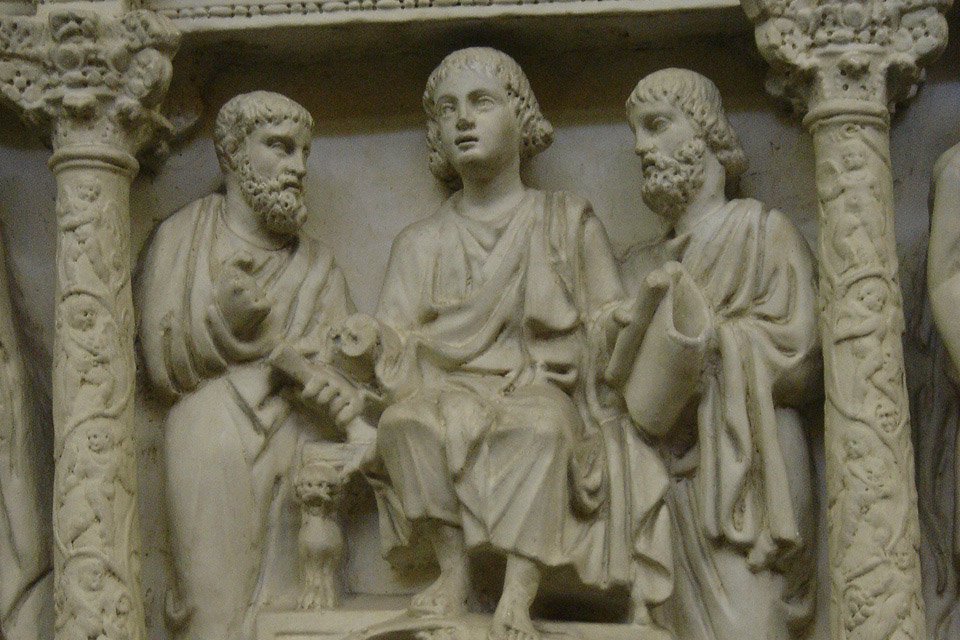
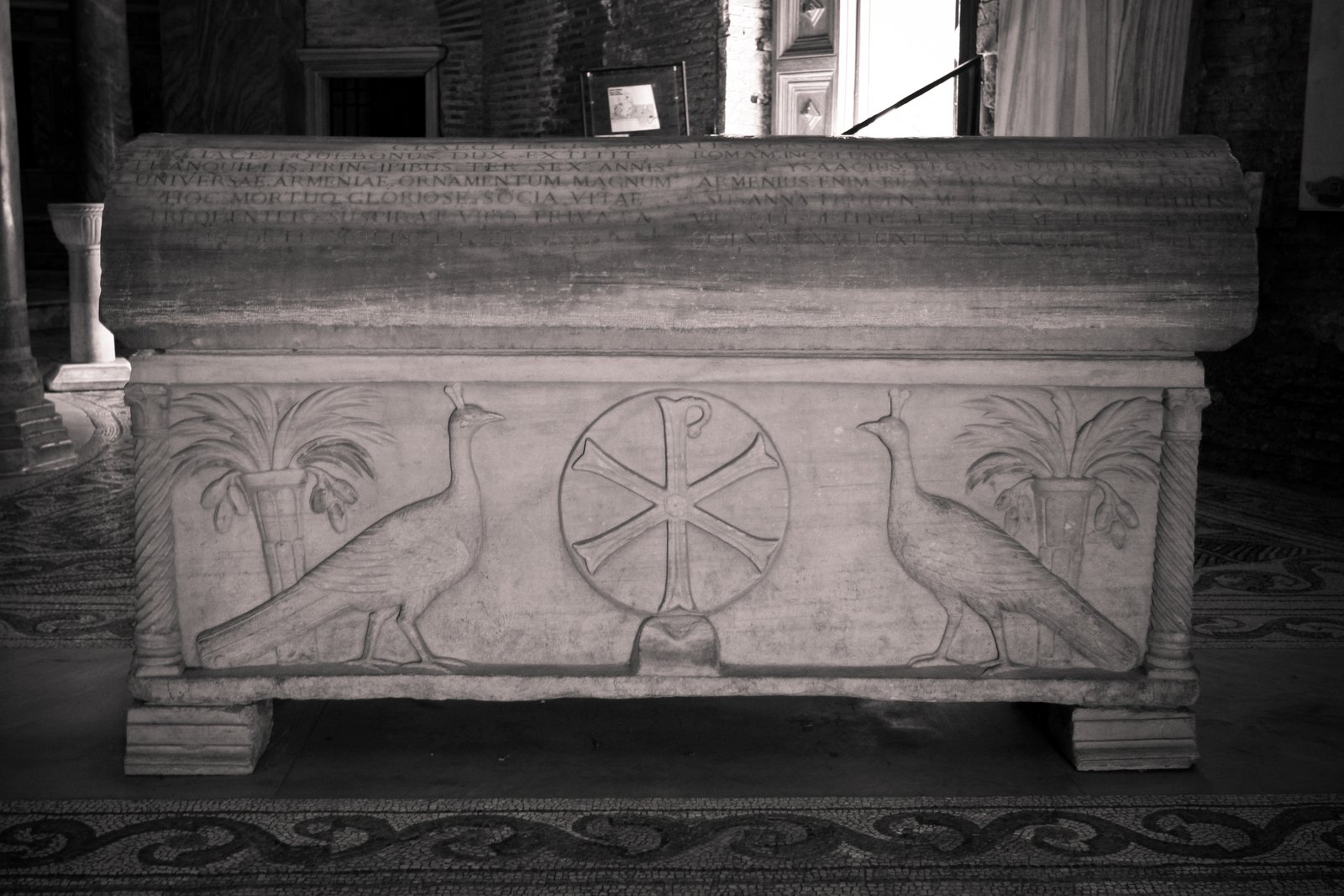
Sarcophagus of Junius Bassus (detail), c. 359 AD, Vatican Museums, Rome. Photo — public domain.
The Sarcophagus of Junius Bassus
No single object better illustrates the sophistication of 4th-century Christian sarcophagus carving than the Sarcophagus of Junius Bassus, now held at the Vatican Museums. An inscription on the sarcophagus records that Junius Bassus, a Roman prefect, died in 359 AD shortly after being baptized, and the coffin his family commissioned displays an extraordinarily dense narrative program: ten separate scenes arranged in two horizontal registers, each framed within its own classical architectural niche complete with miniature columns and shell-shaped canopies, a compositional format borrowed directly from earlier pagan sarcophagus design. The scenes combine Old and New Testament episodes — the sacrifice of Isaac, Daniel among the lions, Christ's arrest, his appearance before Pontius Pilate, and a central image of Christ enthroned handing a scroll representing the Law to Saint Peter — into a single, carefully organized theological program emphasizing themes of sacrifice, judgment, and triumph.
A visual theology carved in stone
The scene selection on sarcophagi like that of Junius Bassus was rarely arbitrary. Patrons and the workshops they commissioned typically arranged biblical episodes to build a coherent theological argument about death, judgment, and salvation, rather than simply illustrating a random assortment of favorite stories. Old Testament scenes of divine deliverance from mortal danger — Isaac saved from sacrifice, Daniel preserved among the lions, the three young men unharmed in the fiery furnace — sit alongside New Testament scenes emphasizing Christ's own authority and triumph over death, creating a visual argument that the same God who rescued the faithful of the Old Testament would likewise grant resurrection and eternal life to the Christian entombed within. This careful theological structuring places sarcophagus relief among the most sophisticated visual theology produced anywhere in the early Church, developed even before large-scale Christian mosaic and painting programs became common in newly built basilicas.
Borrowing from a pagan visual tradition
Christian sarcophagus carvers did not invent their craft from nothing. They inherited, and substantially reused, compositional formats, architectural framing devices, and even specific figural poses from the long-established Roman tradition of pagan mythological sarcophagus carving, which had for centuries depicted scenes from classical mythology in comparable relief formats. Christ himself, in earlier sarcophagi, is sometimes shown adopting poses closely modeled on depictions of pagan philosophers or classical youthful gods, a visual strategy that allowed emerging Christian iconography to draw on familiar, prestigious classical visual conventions even as its subject matter shifted entirely. This continuity underscores how gradually and organically Christian visual art emerged from within, rather than in sharp opposition to, the broader visual culture of the late Roman world.
Beyond Rome: sarcophagi across the Mediterranean
While Rome produced the largest surviving concentration of early Christian sarcophagi, workshops in other major centers of the late Roman world, including Arles in southern Gaul and cities across North Africa and the eastern Mediterranean, developed their own related but distinct sarcophagus traditions, sometimes exporting finished or partially finished pieces considerable distances by sea. Regional variations in scene selection, carving style, and compositional density allow art historians to trace connections between these workshops and to map how Christian iconographic conventions spread and adapted across different regions of the late Roman Empire during the crucial decades of the faith's transition from persecuted minority to the empire's established religion.
Enduring evidence of an emerging faith
Early Christian sarcophagi occupy a unique place in the history of sacred art: too costly and permanent to have been produced casually, they preserve, in exceptional physical durability, some of the clearest evidence available for how relatively wealthy 4th-century Christians understood and visually expressed their faith at a moment of profound historical transition. Standing before the Junius Bassus sarcophagus in the Vatican Museums today, a viewer sees not a simple decorative object but a carefully constructed theological statement, carved to reassure a grieving family and to proclaim, in permanent stone, a confident hope in resurrection.
That confidence marks a genuine historical turning point. Only a generation or two earlier, Christian imagery had to be encoded in symbols subtle enough to pass unnoticed by hostile outsiders; by the time Junius Bassus was laid to rest, his family could commission a public monument that named Christ, Peter, and the Church's central narrative openly, in one of the most durable and prestigious materials available in the ancient world. Few single categories of surviving artifact chart that shift, from cautious symbol to confident proclamation, as clearly or as richly as the carved marble sarcophagi of 4th-century Rome.
Trivia
What is an early Christian sarcophagus?
What is the Sarcophagus of Junius Bassus?
Where did the workshops that carved Christian sarcophagi come from?
Why do so many sarcophagi show scenes of miraculous deliverance?
Where can early Christian sarcophagi be seen today?
Related Reading