The Catacomb Paintings of Rome: Christianity's First Visual Language

Burial grounds, not hideouts
A persistent popular image casts the Roman catacombs as secret refuges where terrified Christians hid from imperial persecutors in the dark. The historical reality is less dramatic but arguably more interesting: Roman law generally protected burial sites regardless of the religion of those interred, and the catacombs functioned as legitimate, if modest, underground cemeteries, dug into Rome's soft volcanic tufa rock because it was relatively easy to excavate and land at the surface was expensive. Christian communities, along with separate Jewish communities that maintained their own catacombs nearby, used these spaces for burial and for annual commemorative gatherings held at the tombs of martyrs and other honored dead, not as permanent shelters from Roman authorities. It was within this context of ordinary, if religiously distinct, burial practice that the earliest substantial body of Christian visual art was created.
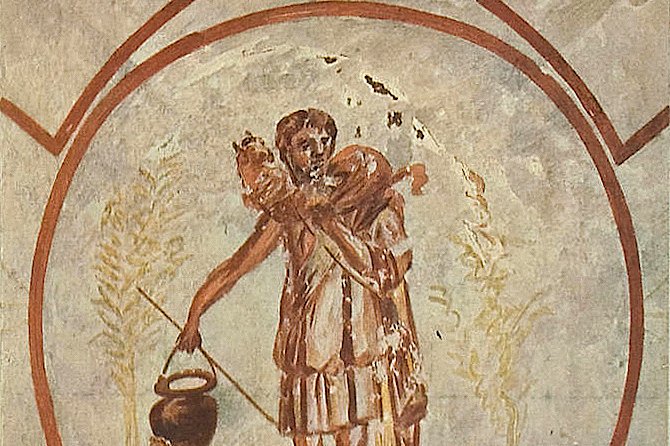
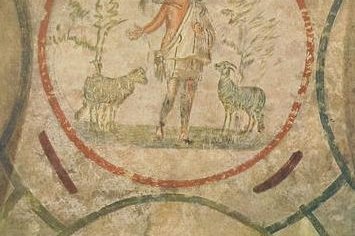
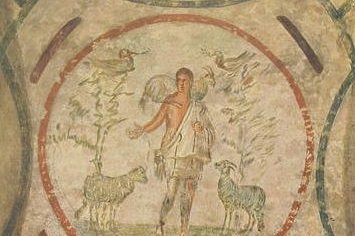
The Good Shepherd, fresco, Catacomb of Priscilla, Rome, c. 3rd century AD. From "Die Malereien der Katakomben Roms" by Joseph Wilpert, 1903 — public domain.
A visual language built for two audiences
What makes catacomb painting historically fascinating is the particular visual problem early Christian artists faced: how to create imagery meaningful to fellow believers while remaining unthreatening, or simply illegible as specifically Christian, to outsiders during periods when official attitudes toward the faith ranged from indifference to active hostility. The solution was a visual vocabulary built largely from symbols already familiar within broader Greco-Roman visual culture, but reinterpreted with specifically Christian meaning. A shepherd carrying a lamb, a common pastoral image in Roman art generally, became a representation of Christ as the Good Shepherd. A fish, whose Greek letters spelled out an acronym for "Jesus Christ, Son of God, Savior," served as compact theological shorthand recognizable to believers and largely opaque to anyone else. Readers interested in how this particular symbol developed further may enjoy our piece on the fish as a symbol in Christian art.
The Good Shepherd's enduring popularity
Among all catacomb images, the Good Shepherd appears with particular frequency, painted on ceilings and walls across multiple catacomb systems throughout the city. The image draws directly on Gospel language describing Christ as a shepherd who knows his sheep and lays down his life for them, and its visual form — a young, often beardless figure in simple dress, carrying a lamb across his shoulders — closely echoed a stock pastoral figure already common in Roman funerary and decorative art more broadly. That overlap was likely deliberate: early Christian communities could commission or paint an image that read, to unfamiliar eyes, as conventional Roman pastoral decoration, while carrying clear theological meaning for those who understood its Christian context. The theme's popularity persisted long after persecution ended, eventually evolving into the more elaborate Good Shepherd imagery found in later Christian mosaics and sculpture.
Scenes of deliverance from the Old Testament
Alongside symbolic imagery, catacomb painters frequently depicted narrative scenes from the Hebrew Scriptures chosen specifically for their themes of divine rescue and deliverance from mortal danger — Jonah being cast from and later delivered from the great fish, Noah surviving the flood in the ark, and Daniel preserved unharmed in the lions' den. These stories carried an obvious resonance in a funerary context: each depicted God intervening to save a faithful individual from what appeared to be certain death, offering a visual expression of hope in resurrection and eternal life appropriate to the tombs surrounding these paintings. The consistent selection of these particular narratives across multiple, geographically separate catacombs suggests an early, shared visual and theological tradition circulating among Christian communities in Rome well before any centralized institutional authority could have standardized it.
The Catacomb of Priscilla and its treasures
Among Rome's catacomb systems, the Catacomb of Priscilla on the ancient Via Salaria holds particular importance for art historians, containing one of the earliest known painted depictions of the Good Shepherd, dated by scholars to as early as the mid-3rd century, along with other significant frescoes including a scene sometimes discussed in relation to the earliest surviving Christian images associated with the Virgin Mary. The catacomb's paintings, though faded and in places damaged by nearly two millennia underground, remain remarkably legible, offering modern visitors and scholars alike a direct visual connection to the devotional life of Rome's earliest Christian generations.
A foundation for everything that followed
The catacomb paintings represent something art historians rarely get to study elsewhere: the visible beginning of an entire tradition, captured at the moment before it had settled into fixed conventions. The symbols and scenes worked out in these dim underground chambers — the Good Shepherd, the fish, the praying figure, the stories of deliverance — would go on to shape Christian iconography for centuries, surfacing again in mosaics, sculpture, and painting long after Christianity moved from persecuted minority faith to the dominant religion of the empire above. Walking through the catacombs today, past painted ceilings dimmed by centuries of darkness, is as close as it is possible to come to witnessing Christian art at its very origin.
Trivia
What are the catacombs of Rome?
Were Christians hiding from persecution in the catacombs?
What is the Good Shepherd image found in the catacombs?
What other symbols appear frequently in catacomb paintings?
Which Roman catacomb is especially significant for its paintings?
Related Reading