The Peacock: An Ancient Bird of Immortality

A bird that Rome loved before the Church did
Long before Christians adopted the peacock as a religious symbol, it was already a prized and expensive bird across the Roman world, imported from farther east and associated with luxury, royal display, and — through its connection to the goddess Juno in Roman mythology — a kind of exalted, almost otherworldly status. Its brilliant, iridescent tail, which molts completely and regrows even more vividly each year, made it a natural subject for artists across the ancient Mediterranean world well before any specifically Christian meaning attached to it. When Christian art began developing its own visual vocabulary in the first centuries after Christ, the peacock was already available as a rich, recognizable image — it just needed a new layer of meaning laid over the old one.
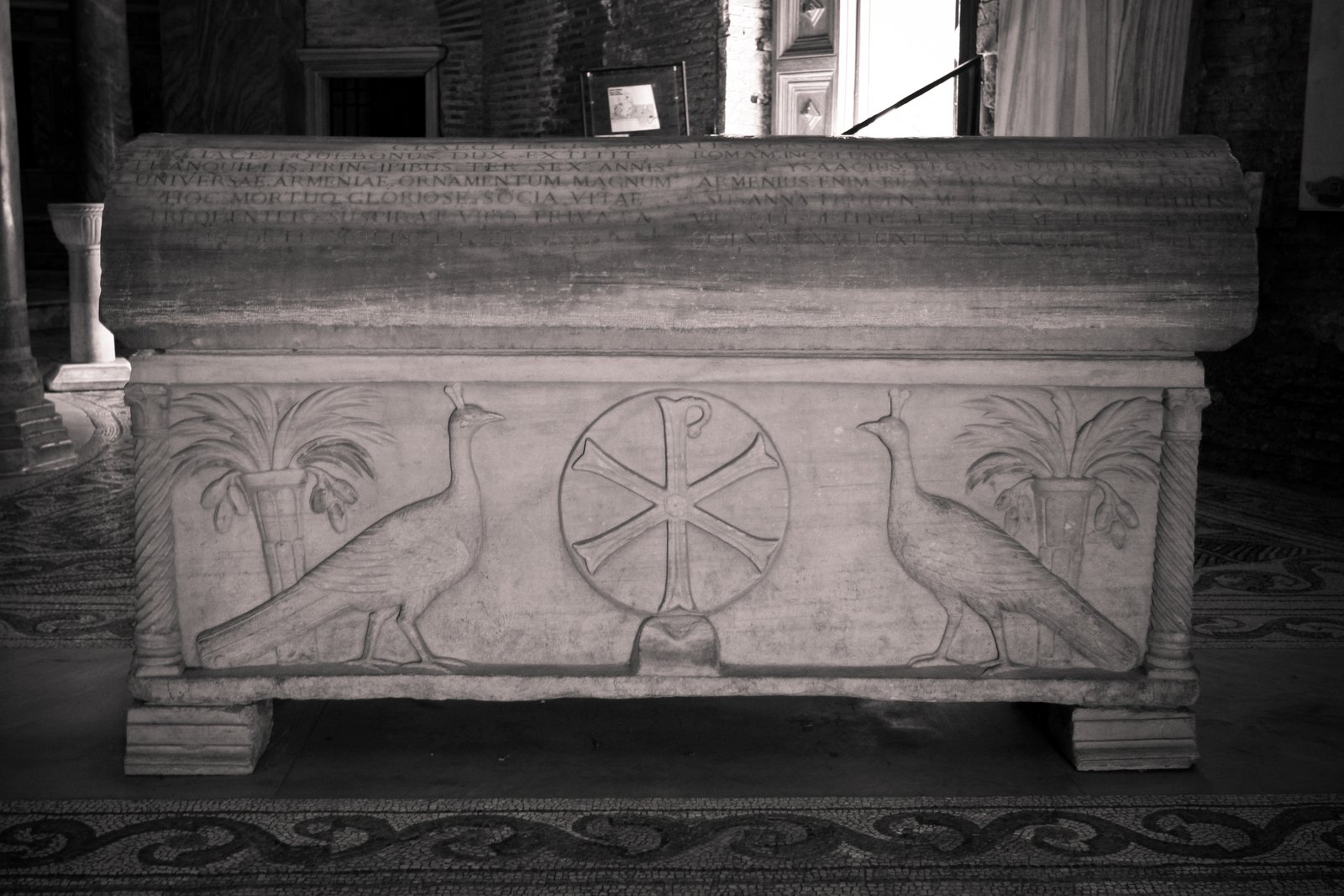
Peacock sarcophagus, Basilica of San Vitale, Ravenna, 5th-6th century AD. Photo by Sharon Mollerus — CC BY 2.0.
The belief that changed everything: incorruptible flesh
The specific claim that gave the peacock its Christian significance comes from natural history rather than theology. The Roman writer Pliny the Elder, in his first-century Natural History, recorded a belief that peacock flesh resisted decay after death, an unusual property compared to other meat. Centuries later, Saint Augustine picked up this same claim in his major work The City of God, describing how he had personally tested cooked peacock meat and found it remained unspoiled far longer than expected, offering the observation as a small, concrete piece of evidence supporting belief in the resurrection of the body. That's a documented passage from Augustine's own writing, not a later legend invented about him — and it shows a genuinely influential Christian theologian treating an ordinary natural-history claim as worth citing in a serious argument about resurrection.
Why the symbolism stuck
Once that connection was made, the peacock's other qualities reinforced it naturally. Its yearly molt and regrowth of even more vivid tail feathers offered a visual parallel to renewal and rebirth, while its already established association with immortality in classical mythology gave Christian artists a symbol that didn't need to be invented from nothing — only reinterpreted. By the time Christian art was developing its distinctive iconography for funerary contexts, the peacock had become a natural fit alongside other resurrection symbols such as the phoenix, discussed further in the phoenix as a Christian symbol, each drawing on ancient natural-history beliefs to illustrate a distinctly Christian hope.
Where the symbol appears in early Christian art
Peacocks show up extensively across early Christian and Byzantine visual culture: carved onto sarcophagi as a sign of the hoped-for resurrection of the deceased, painted in catacomb frescoes, and worked into elaborate floor and wall mosaics across churches from Rome to Ravenna. A particularly common composition shows two peacocks facing each other symmetrically on either side of a chalice, cross, or the Tree of Life, a pairing that turns the birds into flanking guardians of a central symbol of eternal life. The mosaics of Ravenna, Italy — among the best-preserved examples of early Byzantine art anywhere in the world — include several notable peacock images from the fifth and sixth centuries, giving modern viewers direct access to exactly the kind of imagery Augustine and his contemporaries would have recognized.
A meaning that later softened and shifted
Not every later use of the peacock in Christian-influenced art carries the same positive weight. By the medieval period, secular moral literature had also begun associating the peacock's showy tail display with vanity and pride, a meaning largely separate from, and later than, its earlier resurrection symbolism. Both meanings have coexisted since, depending on context — a peacock in an early Christian mosaic reads very differently from a peacock in a later moralizing illustration of the deadly sins — which is worth keeping in mind when interpreting the bird's appearance in any specific artwork rather than assuming a single fixed meaning across all of Christian art history.
The "hundred eyes" and a second layer of meaning
Beyond incorruptibility, the peacock's tail carries a second image that Christian writers also drew on: the pattern of eye-like spots covering each feather. In earlier Greco-Roman mythology, those "eyes" were explained as the hundred eyes of the giant Argus, placed on the peacock's tail by Juno after Argus's death — a story with no Christian content at all, but one that left behind a visual motif Christian interpreters found useful in its own right. Watchfulness, vigilance, and the idea of an all-seeing presence were read into the same feathers that already carried the resurrection association, giving the bird a double symbolic charge: a creature whose flesh does not decay and whose plumage seems, quite literally, to watch. In some later church decoration the peacock's tail is stylized specifically to emphasize this eyed pattern, layering the watchfulness motif on top of the older incorruptibility symbolism inherited from Pliny and Augustine.
Its lasting devotional presence
Though far less common today than the cross, dove, or fish, the peacock retains its resurrection symbolism in some devotional and liturgical art, particularly in contexts drawing directly on early Christian and Byzantine visual traditions. Its persistence across nearly two thousand years, rooted in a piece of Roman natural history that turned out to be scientifically mistaken, is a reminder of how early Christian symbolism often worked: not by inventing entirely new images, but by finding a fresh, hopeful meaning inside whatever the surrounding culture already believed.
Trivia
Why did early Christians associate the peacock with the resurrection?
Did Saint Augustine actually write about peacock flesh not decaying?
What does it mean when a peacock is shown with its tail fully displayed in Christian art?
Where can early Christian peacock imagery still be seen today?
Is the peacock symbol connected to vanity or pride in Christian art, as it sometimes is in other traditions?
Related Reading