The Phoenix: A Pagan Myth Reborn as a Christian Symbol

A myth that predates Christianity by centuries
Long before any Christian writer picked it up, the phoenix was already a well-known figure in classical mythology, described by the Greek historian Herodotus and later by the Roman naturalist Pliny the Elder as an extraordinary bird, often connected to Egyptian tradition, that lived for hundreds of years before dying in flame and rising again from its own ashes, renewed and youthful. Different ancient authors disagreed on details — the exact lifespan, the precise mechanics of its rebirth, even its physical appearance — but the core pattern remained consistent across versions: death, consumption by fire, and a genuine return to life from the remains. That pattern, entirely independent of any Christian source, is exactly what made the phoenix so useful once Christian writers began looking for ways to illustrate their own central claim about resurrection.

Phoenix mosaic, Archaeological Museum of Aquileia — CC BY-SA 4.0 (photo: G41rn8).
Pope Clement's surprising citation
The clearest and earliest documented Christian use of the phoenix comes from Clement of Rome, traditionally regarded as an early bishop of Rome, in his letter to the church at Corinth, generally dated to around the end of the first century. Clement cites the phoenix directly, describing its reported cycle of death and rebirth as an example drawn from the natural world that should make resurrection seem less implausible to skeptical readers — reasoning that if God had already built such a pattern into ordinary creation, raising the dead was consistent with, rather than contrary to, the order of nature. This is a documented passage from an actual, surviving early Christian letter, not a later legend attributed to Clement, and it shows how directly and confidently an influential early Christian leader was willing to draw on pagan natural history to make a theological point.
Later writers who kept the tradition alive
Clement wasn't alone in finding the phoenix useful. Later Christian writers, including the early apologist Lactantius, who wrote an entire Latin poem on the phoenix, and figures like Ambrose of Milan, continued to reference the bird as an illustration of resurrection and immortality well into the fourth century. The image proved durable enough to migrate from theological writing into visual art, appearing in mosaics and manuscript illumination across the late Roman and early Byzantine world, often rendered surrounded by rays of light or nested among flames, unmistakably tied to its mythological death-and-rebirth cycle.
A natural companion to the peacock
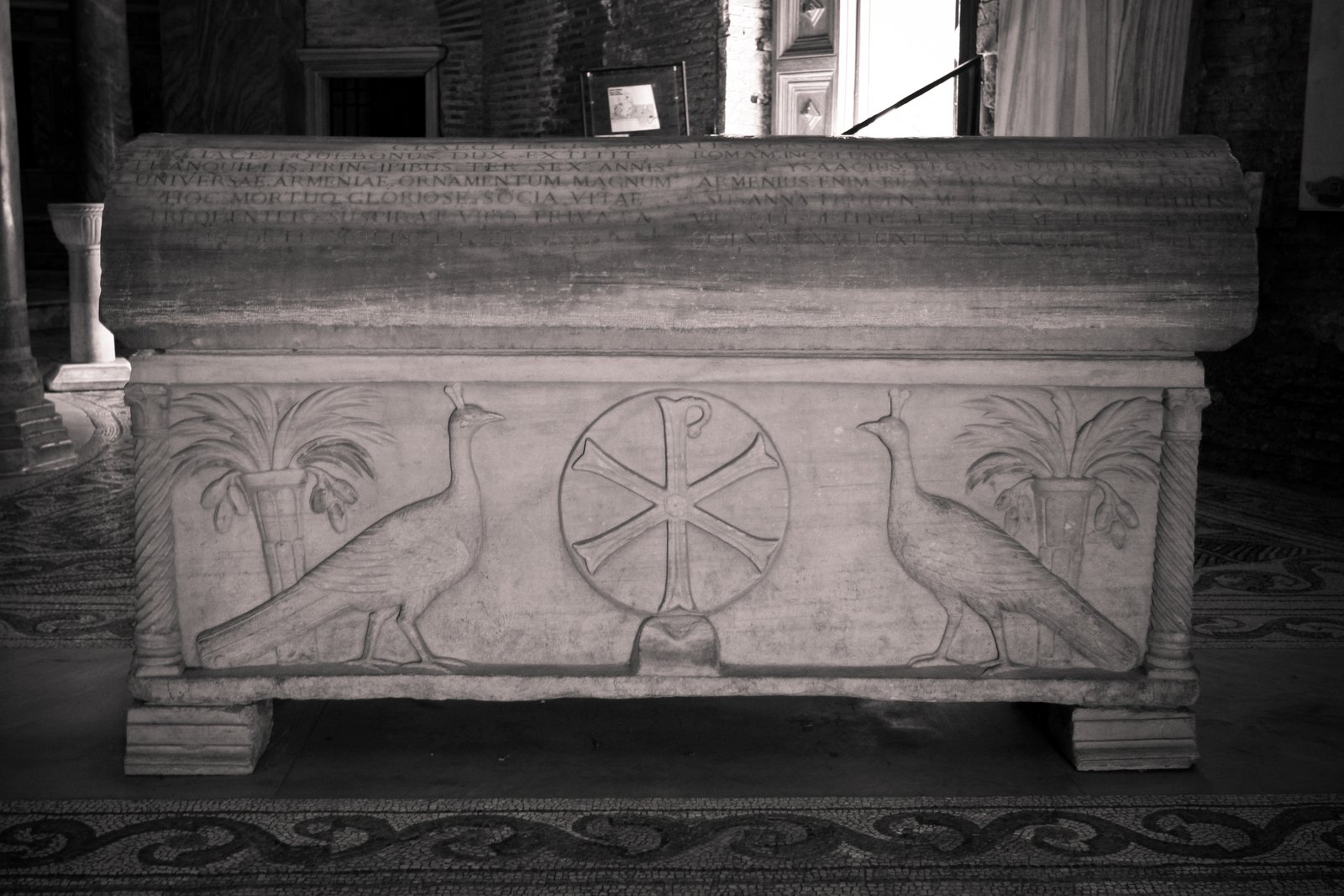
The phoenix rarely appears in isolation within early Christian resurrection imagery — it's frequently found alongside, or in a similar visual role to, the peacock, whose incorruptible flesh made it a parallel symbol of resurrection drawn from an entirely separate strand of ancient natural history. Both symbols share the same underlying strategy: taking an already-circulating classical belief about an animal's unusual relationship to death and repurposing it as a vivid, memorable illustration of specifically Christian hope, at a time when Christian visual and theological vocabulary was still actively being formed.
Why borrowing a pagan myth wasn't seen as a problem
Modern readers might expect early Christian writers to have been wary of citing pagan mythology to support Christian doctrine, but that wasn't generally how they approached it. Clement, Lactantius, and others treated the phoenix explicitly as a natural-world illustration or analogy — evidence drawn from the created order that God had supposedly built resurrection- like patterns into nature itself — rather than as a competing source of religious authority or truth. The distinction mattered to them: the phoenix illustrated a point that Scripture and apostolic teaching had already established, it didn't establish that point on its own. That careful framing let the symbol travel freely into Christian art and preaching without being treated as doctrinally suspect.
The phoenix and the Tudor jewel
The phoenix's symbolic afterlife extended well past the early Christian and Byzantine periods, resurfacing centuries later in an entirely different context: Elizabethan England, where it became a favored emblem of Queen Elizabeth I herself. Portraits and jewels from her reign, including the gold and enamel Phoenix Jewel now held by the British Museum, depict the bird rising from flame as a symbol of the queen's own singular, unbroken reign — a monarch without heir presenting herself as unique and self-renewing in the way the mythical bird was said to be. That later, largely secular use borrowed the phoenix's visual drama without its specifically Christian resurrection meaning, illustrating how thoroughly the image had traveled by the sixteenth century: from a pagan natural-history legend, to a proof-text for Christian resurrection in Clement of Rome's letter, to a piece of royal propaganda more than a thousand years later, all resting on the same core image of death and renewal by fire.
Where it appears in art and how it's understood today
Surviving examples of Christian phoenix imagery are less common than peacock or fish symbolism, but they appear in several notable early Christian and Byzantine mosaics and manuscripts from the fourth through sixth centuries, generally in funerary or resurrection-themed contexts. Today the phoenix is more often recognized as a general cultural symbol of renewal and rebirth than as a specifically Christian one, its explicitly theological use having faded compared to the cross or the dove — but its early presence in Christian writing, running from a first-century pope's letter through centuries of later commentary, remains a distinctive example of how confidently the early Church was willing to reach outside its own tradition to explain what it believed about life after death.
Trivia
What is the phoenix, and where does the myth originate?
Who was the first Christian writer to use the phoenix as an argument for the resurrection?
Does the phoenix appear in the Bible itself?
Why would early Christians use a pagan myth to explain a core Christian belief?
Where can early Christian phoenix imagery still be seen today?
Related Reading