The Good Shepherd: Christianity's First Image of Christ

An image built for hiding in plain sight
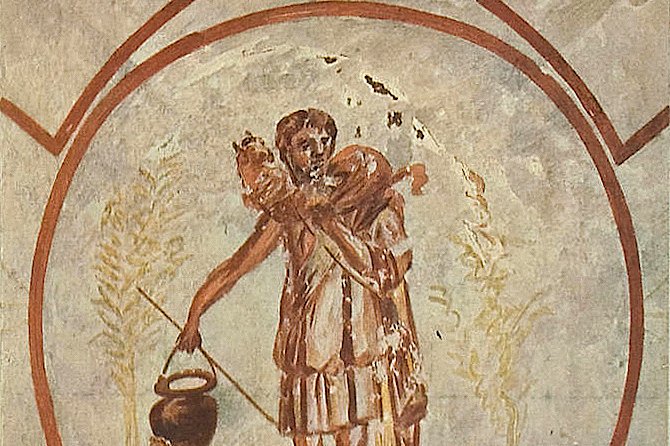
Christianity in its first three centuries was, for long stretches, a persecuted and often illegal faith within the Roman Empire, and its earliest surviving art reflects that reality. Christians buried their dead in catacombs — underground networks of tunnels and burial niches outside Rome's walls — and decorated those spaces with images that could carry deep Christian meaning while still looking, to an outsider, like unremarkable pastoral scenes. The Good Shepherd was perfectly suited to that double life. A young man carrying a sheep or lamb across his shoulders was already a familiar sight in Roman art and literature, evoking simple rural contentment. To a Christian, though, it meant something specific and personal: Christ himself, described in John's Gospel in his own words as "the good shepherd" who "lays down his life for the sheep" (John 10:11).
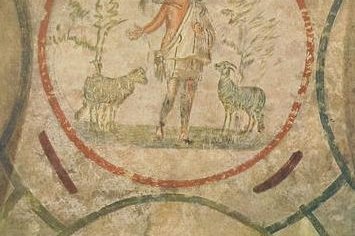
Good Shepherd fresco, 3rd century, Catacomb of Priscilla, Rome — public domain.
Scripture behind the image
The image draws on more than one biblical source. Beyond Jesus' direct self-identification in John 10, the parable of the lost sheep in Luke 15:3-7 describes a shepherd who leaves ninety-nine sheep to search for the one that wandered off, then carries it home rejoicing on his shoulders once he finds it — a detail that maps almost exactly onto the pose artists chose again and again: a lamb draped across the shepherd's neck, its legs held in his hands. Psalm 23, with its opening declaration "The Lord is my shepherd," lent the image still more resonance, tying an ancient Hebrew tradition of God as shepherd of his people directly into the new Christian image of Christ.
Where the image came from visually
Early Christian artists were not inventing their visual vocabulary from nothing. The specific pose of a young man carrying an animal on his shoulders had circulated in Greco-Roman art for centuries before Christianity, most notably in the figure of the kriophoros, or "ram-bearer," associated with the god Hermes in his role as a protector of flocks. Roman funerary art also used generic pastoral shepherd figures simply to evoke peace and the countryside, without any specific religious meaning attached. Early Christians took this ready-made, culturally legible visual formula and filled it with new content — a move typical of how the earliest Christian art developed generally, adapting familiar Roman forms rather than inventing a wholly separate artistic language from the outset. For more on how this pattern shaped the wider visual tradition of the Church, see our guide to Catholic sacred art.
Youthful, beardless, and not yet standardized
Modern viewers accustomed to the bearded, long-haired image of Christ that became standard from roughly the 4th and 5th centuries onward are often surprised by how different the earliest Good Shepherd figures look. They are almost always young, beardless, and dressed in a simple short tunic — following classical Greco-Roman conventions for depicting an idealized young man, rather than making any specific claim about what the historical Jesus actually looked like. Christian art in this period had not yet settled on a single, agreed-upon appearance for Christ at all; different communities and regions experimented with different visual types before conventions gradually solidified. The Good Shepherd type represents one of the earliest and most consistent of these experiments, appearing with remarkably similar features across catacomb paintings, carved sarcophagi, and small free-standing sculptures found throughout the Roman world.
Surviving examples
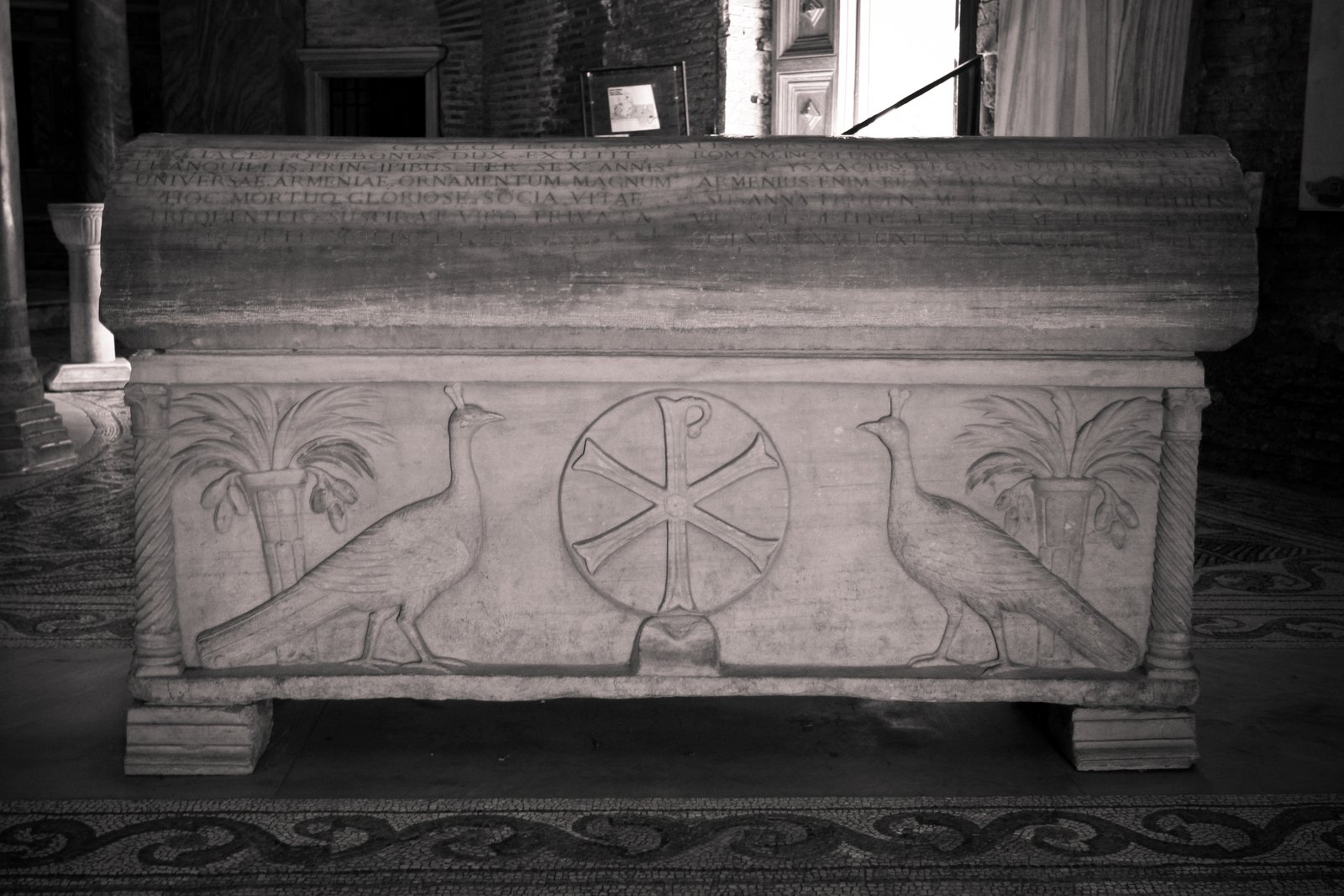
The richest surviving collection of Good Shepherd imagery comes from the Roman catacombs, particularly the Catacomb of Priscilla and the Catacomb of Callixtus, where frescoes dating to the 3rd century still decorate burial chamber ceilings and walls, their pigments remarkably preserved by the stable underground environment. Beyond painting, sculptors carved the same figure in the round as small marble statuettes — several fine examples survive in the Vatican Museums and other major collections, including the Cleveland Museum of Art — and the motif appears carved in relief on early Christian sarcophagi, where a shepherd is sometimes shown flanked by sheep on either side, evoking the shepherd's care over an entire flock rather than a single rescued lamb.
Why the image faded from prominence
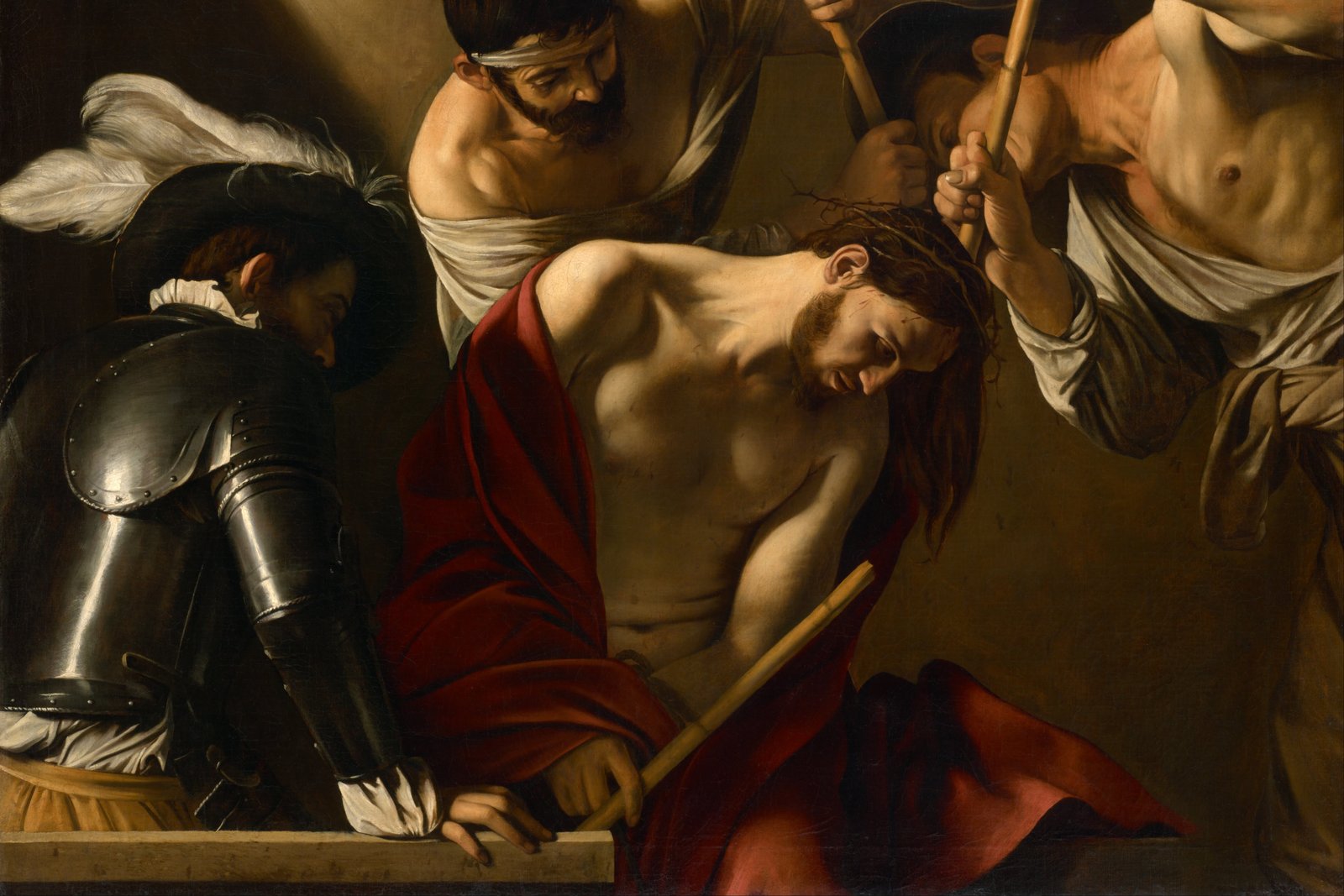
The Good Shepherd's dominance did not last indefinitely. After the Roman Emperor Constantine legalized Christianity in 313 with the Edict of Milan, and the faith moved from persecuted minority to eventually the Empire's official religion by the century's end, Christian art changed to match its new public and institutional standing. Grand new church buildings called for grand new imagery — Christ increasingly appeared enthroned in majesty, robed like a Roman emperor, flanked by apostles or saints in formal, hierarchical compositions meant to convey authority and cosmic kingship. The intimate, pastoral Good Shepherd, suited to a small private burial chamber and a persecuted community's need for a hidden, personal image of Christ's care, gradually gave way to imagery built for public monumental spaces and official theological statement.
A quietly radical starting point
It's worth sitting with what it means that this — a humble figure carrying a single rescued animal — was Christianity's visual starting point, rather than the cross, the crown, or the enthroned judge that would come to dominate later centuries. The choice reflects something about how the earliest Christians understood their faith at its core: not primarily as power or triumph, but as a personal, searching care extended toward whoever had wandered off and needed to be carried home. Nearly two thousand years later, the image still appears in stained glass, devotional art, and church decoration precisely because that core meaning never really went out of date, even as the surrounding visual language of Christian art changed dramatically around it.
Trivia
Why did early Christians choose the Good Shepherd as an image of Christ?
Where can the earliest Good Shepherd images be found?
Did the Good Shepherd image come from pagan art?
Why is the Good Shepherd usually shown as young and beardless?
When did the Good Shepherd stop being the dominant image of Christ?
Related Reading