El Greco's Saint Martin and the Beggar

A painter who made Spain his own
El Greco — born Domenikos Theotokopoulos on the Greek island of Crete, then part of the Venetian-controlled Mediterranean world — trained first in the Byzantine icon-painting tradition before traveling to Venice and Rome, absorbing the influence of Titian and Michelangelo along the way. By the 1570s he had settled permanently in Toledo, Spain, then a major religious and intellectual center, where he would remain for the rest of his life and develop the distinctive, elongated, almost otherworldly style that has made his work instantly recognizable ever since. His nickname, simply "the Greek" in Spanish, stuck for good reason: he never fully abandoned the artistic vocabulary of his Byzantine training even as he absorbed Italian Renaissance and Mannerist influences, producing a hybrid style that looked like nothing else being painted in Spain at the time.
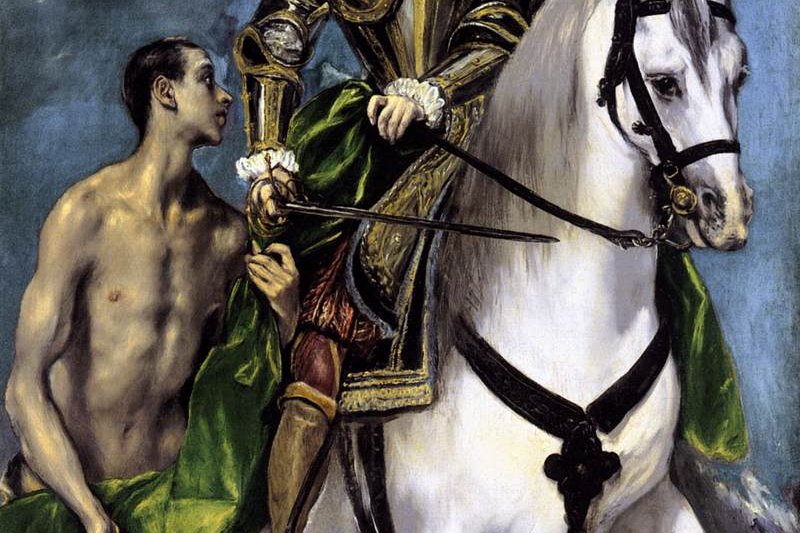
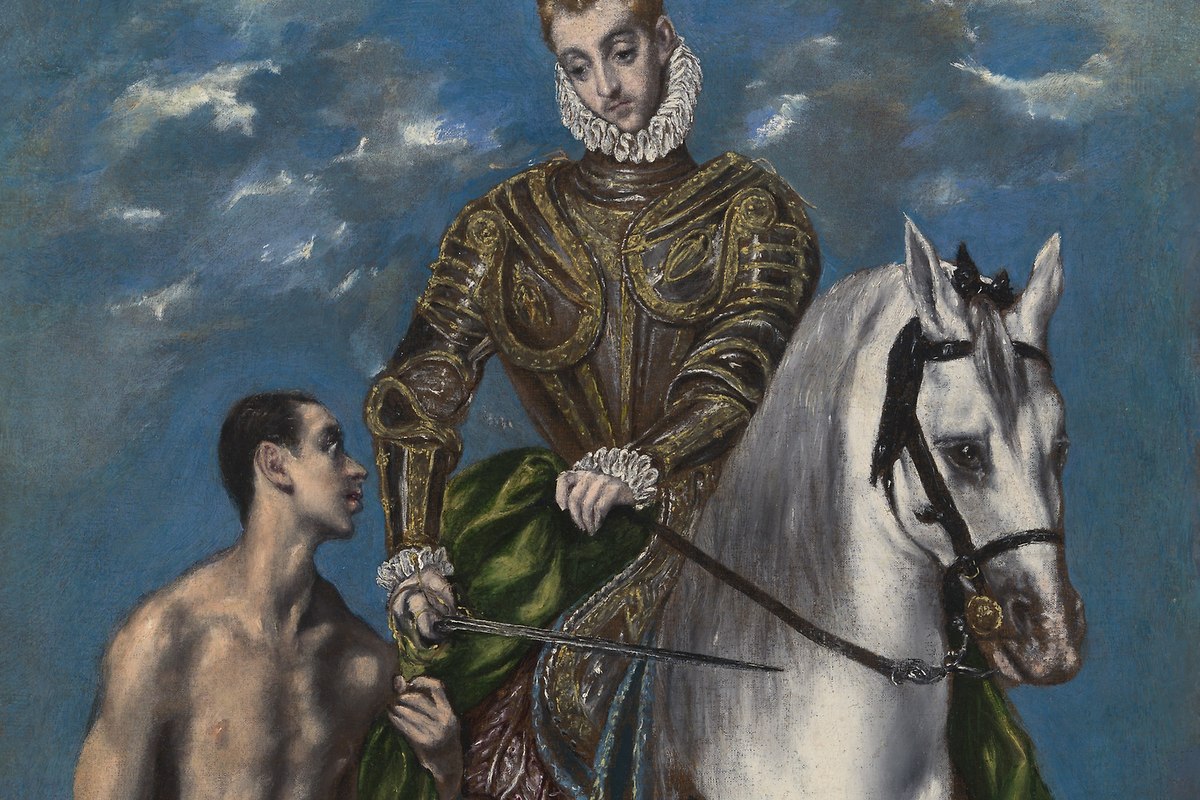
El Greco (Domenikos Theotokopoulos), Saint Martin and the Beggar, 1597-1599, National Gallery of Art, Washington — public domain / CC0.
Saint Martin and the Beggar, painted between roughly 1597 and 1599, was created as part of an altarpiece commission for a private chapel in Toledo dedicated to Saint Martin of Tours, and it stands among El Greco's most beloved and frequently reproduced religious works, precisely because its subject — an act of simple, direct human charity — translates so clearly even to viewers unfamiliar with the specific saint's biography.
The story behind the image
The episode El Greco depicts comes from the traditional biography of Martin of Tours, a fourth-century Roman soldier stationed at Amiens, in what is now northern France, before his later fame as a bishop and one of the most widely venerated saints of the early medieval Western Church. According to the account that became central to his cult, Martin, still a young cavalry officer and not yet baptized, encountered a beggar shivering at the city gate on a bitterly cold day. Having nothing else to give, he drew his sword, cut his own military cloak in half, and gave one half to the beggar. That night, tradition holds, Christ appeared to him in a dream wearing the half-cloak he had given away, telling the surrounding angels, "Martin, still a catechumen, has clothed me with this garment" — an experience credited with deepening his conversion and setting him on the path toward baptism and, eventually, the religious life that would define the rest of his biography.
El Greco's composition captures the moment of the act itself rather than the vision that followed: Martin, mounted on a pale, almost luminous horse, twists in the saddle to complete the cut, his cloak already drawn taut between sword and shoulder. The beggar below, rendered nearly nude and physically vulnerable in a way that emphasizes his need, looks upward with an expression that reads as more curious than desperate — a compositional choice that keeps the scene's emotional register calm and dignified rather than pitiable.
Toledo standing in for Amiens
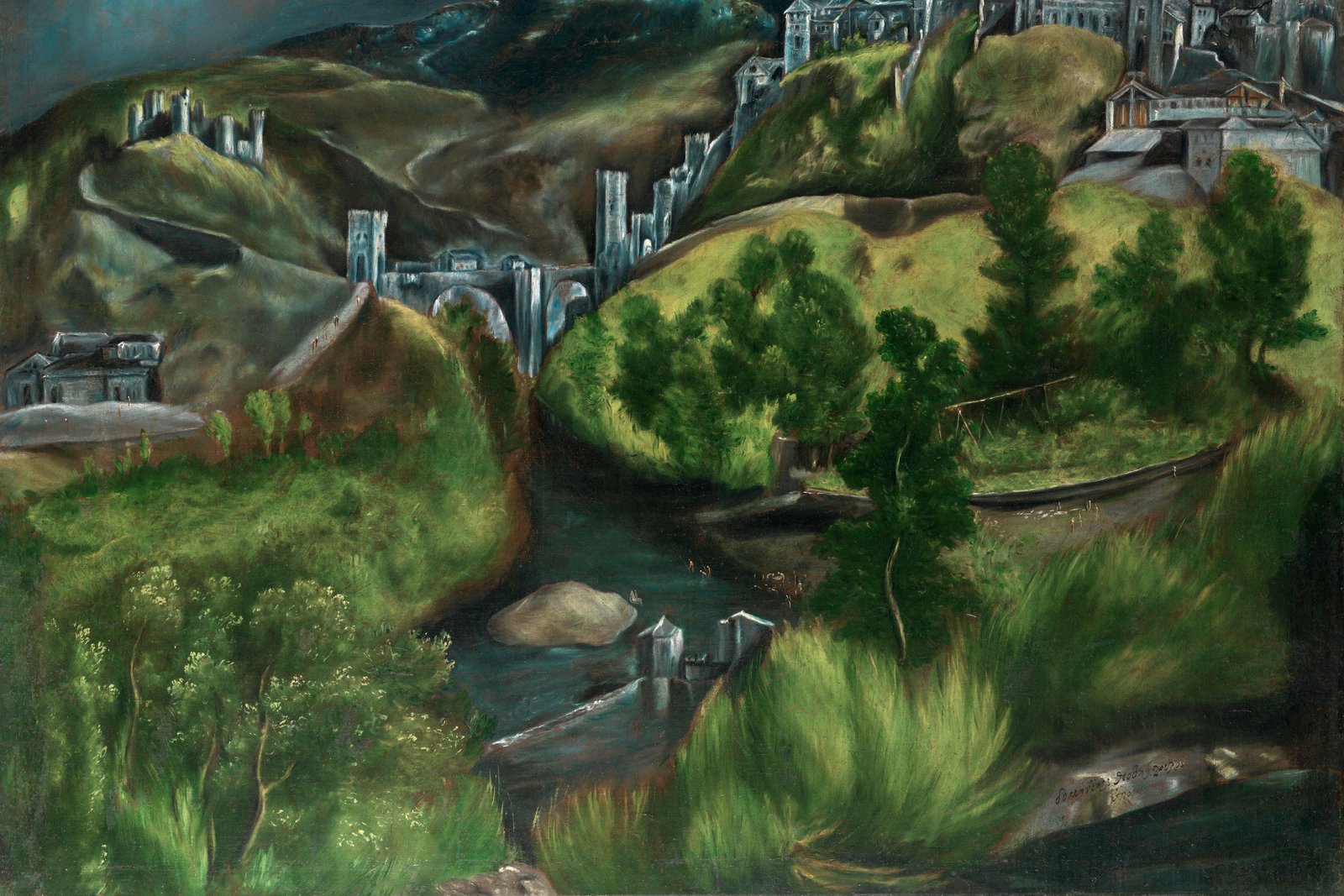
One of the painting's most striking features has nothing directly to do with Martin's biography at all: the hilltop city rising behind the two figures, rendered under the same dramatic, stormy, silver-grey sky that appears in several of El Greco's most famous Toledo landscapes, including his celebrated View of Toledo. Historically, the episode being depicted took place at Amiens in Roman Gaul, a city El Greco had certainly never visited and had no particular reason to research or reconstruct accurately. Instead, following a common convention among artists of his era, he set the scene against the city he actually knew — his adopted home of Toledo, whose skyline he had studied and painted repeatedly enough that it appears, in one form or another, across a significant portion of his religious output.
This wasn't a mistake or an oversight; it reflects how devotional painting of this period generally worked. Viewers in sixteenth-century Toledo encountering this altarpiece would have understood the scene not as a literal historical reconstruction of fourth-century Gaul but as a timeless act of Christian charity, made immediate and present by being set in a landscape the congregation recognized as their own.
A composition popular enough to multiply
The demand for this particular image proved strong enough during and after El Greco's own lifetime that his workshop produced several additional versions and copies, a common practice for successful compositions in this period, when a well-received altarpiece design might be requested again by other patrons or churches. Several of these versions survive today in different collections, though the version most closely associated with El Greco's own hand and now held at the National Gallery of Art in Washington remains the one most widely reproduced and studied — a painting that has, in its own way, done for Martin's story of shared charity something not unlike what the story itself describes: taken something whole and, through reproduction and circulation, made it available to far more people than could ever have seen the original altarpiece in its Toledo chapel alone.
Trivia
What story does El Greco's Saint Martin and the Beggar depict?
Why is the city of Toledo visible in the painting's background?
What is distinctive about El Greco's painting style in this work?
Where is this painting held today?
Was this painting made for a specific chapel?
Related Reading