El Greco's View of Toledo and Its Religious Symbolism

A landscape unlike almost anything else in his career
El Greco spent nearly his entire working life painting altarpieces, saints, and devotional scenes for churches and religious orders in Toledo, Spain, where he settled after training in Venice and Rome. The View of Toledo, painted late in his career, stands apart from that body of work simply by subject: it has no biblical figures, no saints, no narrative moment at all — just the walled hill-city of Toledo itself, seen from the north under a sky heavy with storm light. Pure landscape painting, made as an independent subject rather than background scenery, was still unusual in European art around 1600, and El Greco's decision to attempt it at all sets the painting apart from nearly everything else he produced.
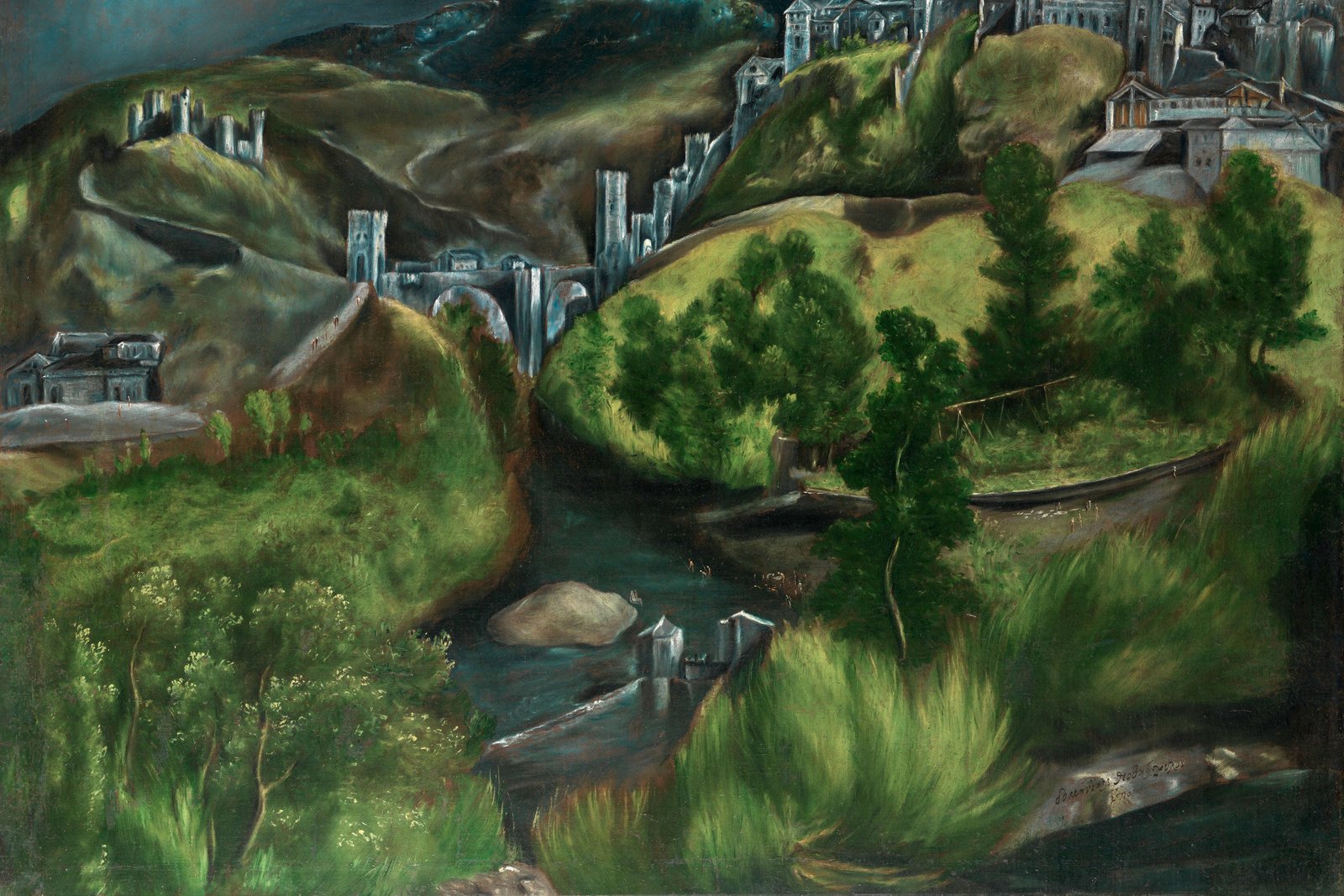
El Greco, "View of Toledo," c. 1596-1600, Metropolitan Museum of Art, New York — public domain.
A city rearranged for effect, not accuracy
Anyone comparing El Greco's Toledo to the real city quickly notices the liberties he took. He shifted the position of the Alcazar, the fortress palace, and moved the cathedral to a location it doesn't actually occupy relative to the rest of the skyline, and he exaggerated the height of the hills surrounding the city well beyond their real proportions. These weren't errors — El Greco was a technically skilled draftsman capable of precise topographical work, as his companion piece, View and Plan of Toledo, demonstrates. The distortions in the View of Toledo were deliberate, reshaping the city into a composition governed by emotional and visual rhythm rather than by what a surveyor standing on that hillside would actually have seen.
Why the sky carries so much of the meaning
The storm dominating the upper half of the canvas is rendered in the same cold, otherworldly palette of greens, grays, and flashes of pale light that El Greco used throughout his religious paintings to signal visionary or supernatural moments — the kind of sky that, in his altarpieces, often accompanies a saint's ecstatic vision or a scene of divine intervention. That visual continuity is the main reason art historians so consistently read the View of Toledo as carrying more than topographical interest: the same artist who painted saints and Marian visions under skies like this one turned that same dramatic, spiritually charged light onto an ordinary city, suggesting he saw Toledo itself — a center of Spanish Catholic religious life — as a fitting subject for that visionary treatment. It's worth being careful here: El Greco left no known written statement explaining the painting's meaning, so readings of the storm as apocalyptic or prophetic remain scholarly interpretation rather than documented artistic intent.
El Greco's arrival in Toledo and his religious commissions
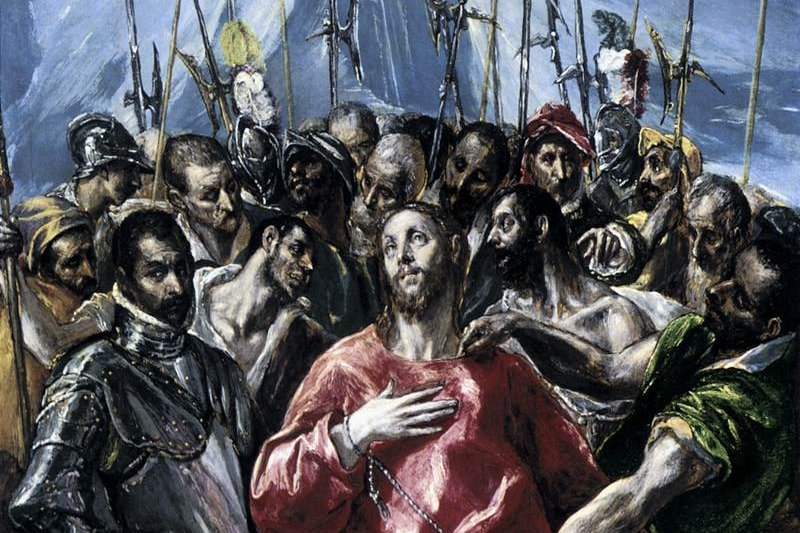
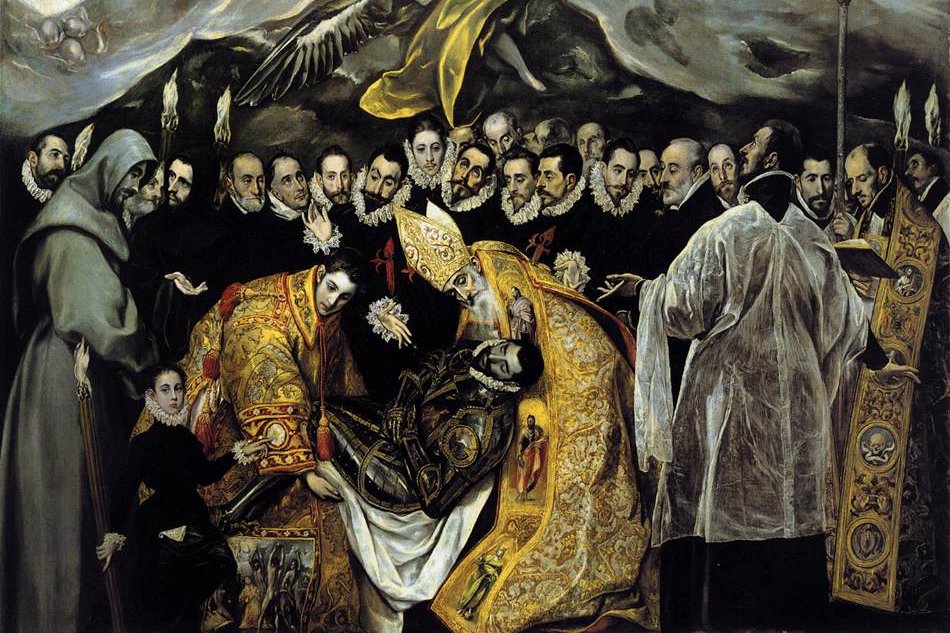
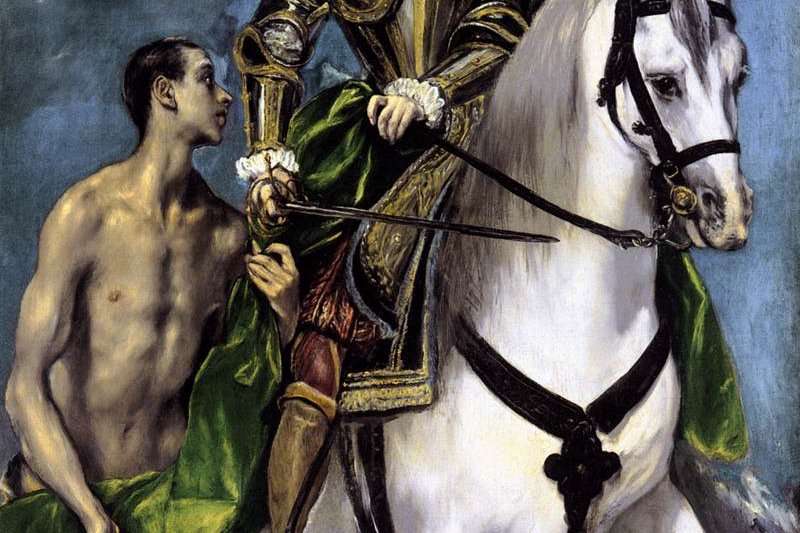
Born Domenikos Theotokopoulos on the island of Crete around 1541, El Greco trained first as an icon painter in the Byzantine tradition before moving to Venice and Rome to study under masters of the Italian Renaissance. He settled in Toledo around 1577, reportedly hoping to find favor with King Philip II in nearby Madrid, an ambition that never fully paid off — but Toledo itself, then the seat of the Spanish primate archbishop and a major center of Counter-Reformation religious life, gave him a steady stream of commissions from churches, convents, and religious confraternities that sustained his career for the rest of his life. His altarpieces and portraits of saints in ecstatic prayer, painted with elongated figures and restless, flame-like brushwork, made him one of the most distinctive religious painters of the Counter-Reformation period, and that same visual language — tension between the earthly and the visionary — carries directly into his one great landscape.
A companion work with an actual map
El Greco's other Toledo landscape, View and Plan of Toledo, pairs a wider panoramic view of the city with an allegorical figure holding an actual architectural plan of the city, alongside a floating image of the Virgin Mary above the skyline. That painting makes explicit what the View of Toledo leaves implicit: a city treated simultaneously as a real, mappable place and as a subject worthy of devotional, almost sacred attention. Seen together, the two works suggest El Greco viewed Toledo not merely as home but as a landscape charged with the same religious seriousness he brought to his altarpieces.
Its lasting reputation
The View of Toledo has gone on to become one of the most recognized landscape paintings in Western art history, admired by later artists including several twentieth-century Expressionists who saw in its distorted forms and charged atmosphere an early ancestor of their own emotionally driven approach to landscape. It remains at the Metropolitan Museum of Art in New York, still doing what it did for viewers four centuries ago: making an ordinary hillside city feel like the setting for something far larger than itself.
The painting's road to that museum wall was itself unusually long. El Greco's reputation faded sharply after his death in 1614, and for roughly two and a half centuries his work was largely dismissed or ignored outside Spain, sometimes disparaged as the product of astigmatism or outright madness by critics unable to account for his elongated, restless figures any other way. Serious critical reappraisal only began in the late nineteenth century, championed by French and Spanish critics who saw in his distortions not a defect but a deliberate, expressive choice — a reevaluation that directly paved the way for the Metropolitan Museum's 1929 acquisition of the View of Toledo and for the painting's rise to the status it holds today, arguably higher now than at any point since El Greco's own lifetime.
Trivia
Where can you see El Greco's View of Toledo today?
Is El Greco's View of Toledo geographically accurate?
Why do art historians read religious meaning into a landscape with no biblical figures in it?
Did El Greco paint any other landscapes of Toledo?
Why did El Greco settle in Toledo rather than staying in Italy or returning to his native Crete?
Related Reading