El Greco's The Disrobing of Christ

A Cretan painter's first major Spanish commission
Domenikos Theotokopoulos — known to history by the nickname El Greco, "the Greek," a reference to his birth on the island of Crete — arrived in Toledo, Spain, around 1577 after training in Venice and Rome, where he had absorbed the color sense of Titian and the dramatic figure compositions of Michelangelo's followers. Almost immediately upon settling in Toledo, he received a major commission from the cathedral chapter: an altarpiece for the sacristy depicting the moment just before the Crucifixion, when Roman soldiers stripped Christ of his garments in preparation for nailing him to the cross — an episode only briefly implied in the Gospel of John's account of the soldiers dividing "his garments" among themselves (John 19:23-24, RSV-CE) rather than narrated as a standalone scene. The painting, known in Spanish as El Expolio ("the despoiling" or "the stripping"), was completed by 1579 and remains in the same sacristy today, over four centuries later.
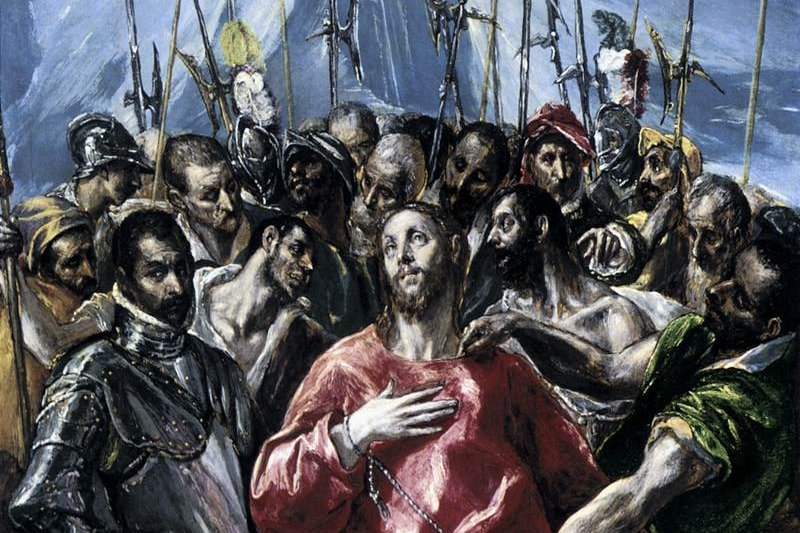
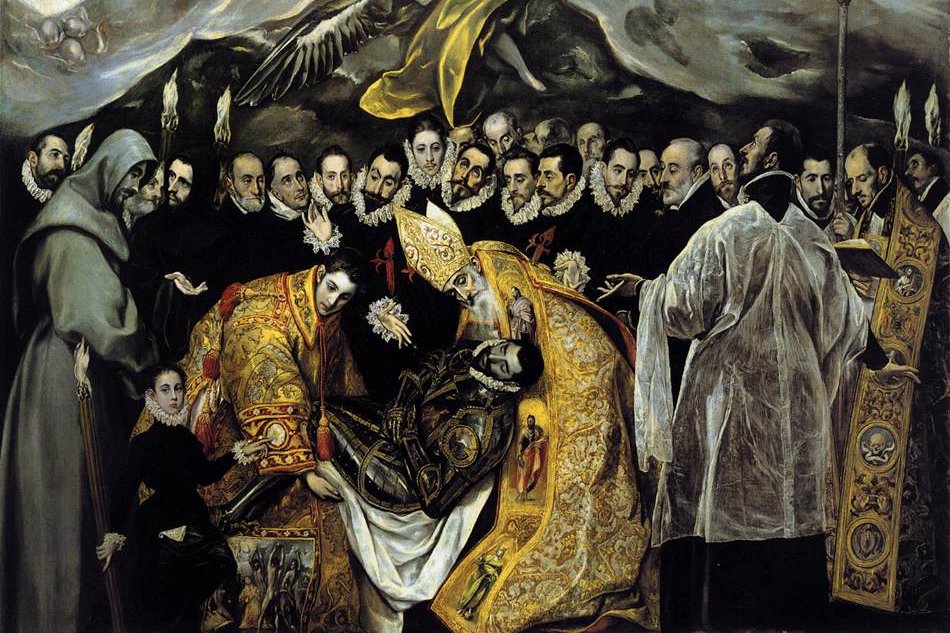
El Greco, "The Disrobing of Christ" (El Expolio), 1577-79, Toledo Cathedral, Spain — public domain.
This was a bold subject choice for a major altarpiece — most Passion cycles moved directly from Christ carrying the cross to the Crucifixion itself, treating the disrobing as a minor transitional detail rather than a scene worth monumental treatment in its own right. El Greco's decision to give it a full altarpiece elevated a normally overlooked moment into a study of Christ's composure amid a crowd bent on humiliating him.
A composition built on pressure and color
The painting crowds its canvas with figures — soldiers in period-inconsistent armor, onlookers, and the men preparing the cross in the lower right corner — pressed close around Christ, creating a sense of claustrophobic tension rather than the open, balanced staging typical of earlier Renaissance treatments of the Passion. Christ himself, dressed in a brilliant red robe that dominates the canvas' color scheme, stands with his hands already clasped as if in prayer, his face turned upward with an expression of serene resignation that contrasts sharply with the agitated crowd pressing in around him. A soldier in gleaming armor reaches toward the robe, his gesture the visual trigger for the scene's central action, while another figure gestures accusingly nearby.
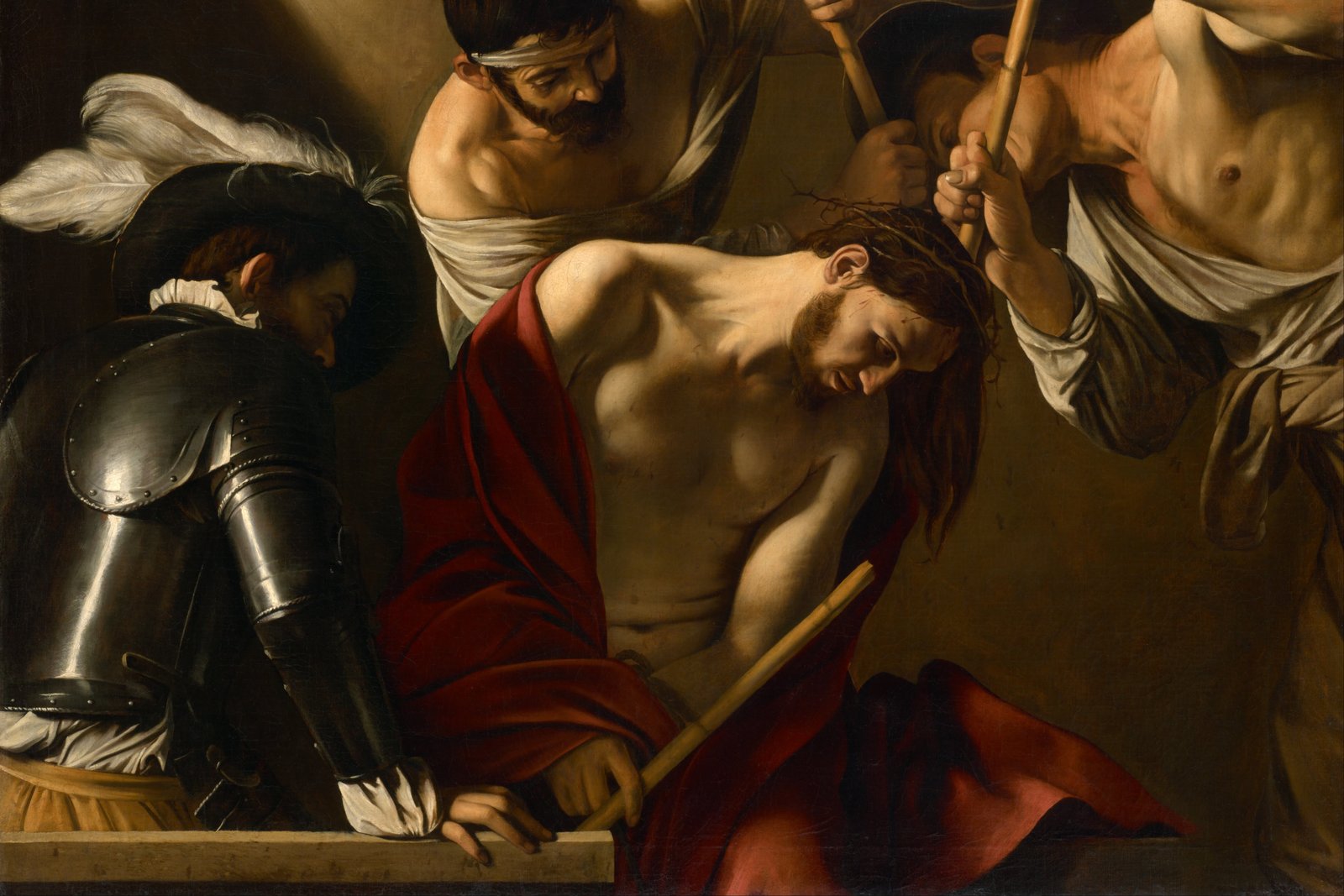
El Greco's characteristic elongation of the human figure — a hallmark of the style later called Mannerism, which favored dramatic, sometimes exaggerated proportions over strict naturalism — is already fully present here, years before his most famous mature works. Figures stretch upward with unnatural length, the crowded space compresses depth almost to the point of flatness, and the overall effect is less a literal narrative illustration than an intense, almost visionary meditation on Christ's suffering. This emphasis on inner spiritual intensity over naturalistic accuracy set El Greco apart from more classically balanced contemporaries, and it foreshadows the emotional charge later Baroque painters like Caravaggio would bring to religious scenes, including his own treatment of a calling and conversion moment in The Calling of Saint Matthew, though the two artists arrived at emotional intensity through very different technical means.
The dispute over the three Marys
Beneath the crowded main action, at the bottom of the canvas, El Greco placed the Virgin Mary and two other women traditionally identified as Mary Salome and Mary Cleophas — quiet witnesses to the events above, based loosely on Gospel references to women who followed Christ to Golgotha. The cathedral's appraisal committee objected specifically to their placement at a level that put their heads roughly at the same height as Christ's, arguing this improperly elevated the Marys' visual importance relative to Christ himself. Combined with a broader dispute over the painting's monetary value — appraisers, some of whom had professional rivalries with El Greco, valued the work at a fraction of his requested price — the disagreement led to a formal legal proceeding. The final settlement paid El Greco less than he had asked but still a respectable sum, and the painting was allowed to remain in place essentially unaltered, women and all.
An altarpiece that stayed exactly where it was painted for
Unlike many major altarpieces that were later relocated to museums or sold to private collectors during periods of political upheaval, The Disrobing of Christ has remained in Toledo Cathedral's sacristy continuously since its completion in 1579 — a rare case of a Renaissance-era masterpiece never leaving its original intended setting. El Greco and his workshop did produce several smaller replica and variant versions over subsequent years, some of which are now held in museum collections outside Spain, but the original altarpiece itself has stayed in place for well over four centuries, still viewed by visitors in essentially the same architectural context for which it was designed.
A singular vision within the Counter-Reformation
El Greco painted The Disrobing of Christ during a period when the Catholic Church, responding to the Protestant Reformation through the Council of Trent, was actively encouraging religious art that moved viewers toward devotion through emotional intensity and clarity of subject. While El Greco's unconventional style drew criticism from more conservative contemporaries, later generations came to recognize the painting as one of the earliest and most striking examples of his mature approach — an artist willing to sacrifice naturalistic proportion and spatial logic in favor of conveying spiritual intensity directly, a choice that would define his work for the remaining decades of his career in Toledo.
Trivia
What does El Expolio mean and why is the painting called that in Spanish?
Why did the cathedral clergy in Toledo dispute payment for the painting?
What is unusual about the composition of The Disrobing of Christ?
Where can you see The Disrobing of Christ today?
Who is the man in armor reaching toward Christ in the painting?
Related Reading