Marc Chagall's Stained Glass Windows

A late-career turn to glass
By the time Marc Chagall began working seriously in stained glass, he had already lived through most of the twentieth century's upheavals and built a reputation as one of its most distinctive painters — known for canvases full of floating lovers, fiddling goats, and inverted village rooftops, rendered in a style that drew on his Hasidic Jewish upbringing in Vitebsk, in what is now Belarus, and on decades spent among the avant-garde circles of Paris. Glass wasn't a medium he came to lightly or early. He was past seventy when he undertook his first major commission, windows for the synagogue at the Hadassah Medical Center in Jerusalem, completed in 1962, depicting the Twelve Tribes of Israel in blazing, jewel-toned color.
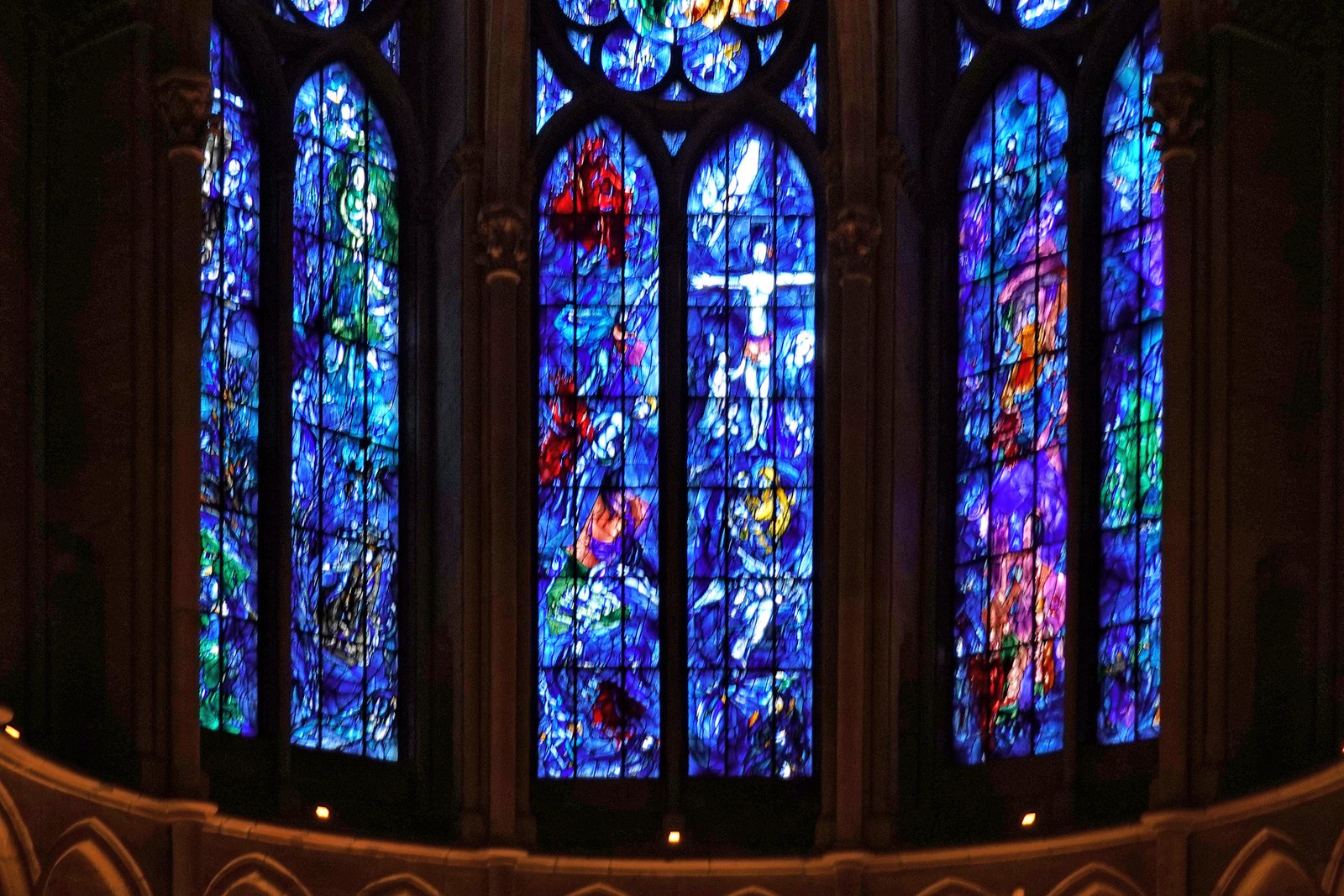
Photograph by Stefan Oemisch, Chagall windows, Reims Cathedral, 2026 — CC BY-SA 4.0, Wikimedia Commons.
What followed was one of the more surprising second acts in modern art. Working closely with master glassmaker Charles Marq at the historic Simon Marq workshop in Reims, France, Chagall developed techniques for layering and texturing colored glass that let him translate his painterly, dreamlike style into a medium traditionally associated with far more rigid, geometric design. He would go on to create windows for religious buildings across three continents, in Jewish, Catholic, and Protestant contexts alike, continuing major commissions well into his nineties.
Reims, Zurich, and a small English parish
Among Chagall's most significant Christian commissions are the windows he designed for the ambulatory of Reims Cathedral in France, installed in 1974. The cathedral, historically the site of French royal coronations and heavily damaged during the First World War, had already undergone extensive twentieth-century restoration by the time Chagall was invited to contribute new windows for its eastern chapels — a commission understood partly as a gesture of postwar reconciliation, bringing an internationally celebrated Jewish artist into one of French Catholicism's most historically resonant spaces. His windows there combine scenes from Genesis, including the sacrifice of Isaac and Jacob's dream of a ladder to heaven, with New Testament subjects such as the crucifixion and the tree of Jesse, rendered in the intense blues and reds that became something of a Chagall signature in glass.
He completed similarly significant work for the Fraumünster church in Zurich, Switzerland, where his five choir windows, installed between 1967 and 1970, remain among the most visited sights in the city, and for All Saints' Church in the small English village of Tudeley — the only church anywhere in the world where every single window, all twelve, was designed by Chagall. The Tudeley commission began after the church's patron, Sir Henry d'Avigdor-Goldsmid, asked Chagall to design a memorial window for his daughter, who died in a sailing accident; Chagall was reportedly so moved by the setting that he offered, unprompted, to design windows for the entire building.
Painting with light
Chagall himself described stained glass in terms that reveal how seriously he took the medium's particular demands and possibilities. Unlike a painting, which reflects light off its surface, a stained glass window transmits light directly through it — meaning the same design changes constantly with the hour, the season, and the weather outside, in a way no painted canvas ever could. He spoke of the medium as something closer to a living, breathing collaboration with daylight itself, and his technical partnership with Charles Marq was central to achieving this: Marq developed methods of layering multiple sheets of colored glass and applying enamel washes that let Chagall's designs achieve gradations of color and light far beyond what traditional leaded glass techniques typically allowed.
This technical ambition is part of why his religious windows read so differently from most stained glass that came before them. Traditional church windows, from the Gothic period onward, tended toward clear narrative sequence — a saint's life told scene by scene, meant to be read like a picture book by an often illiterate medieval congregation. Chagall's windows work more associatively, blending figures and biblical episodes across a single composition in a way that mirrors the floating, dreamlike logic of his paintings, inviting contemplation rather than sequential reading.
A body of work still expanding its reach
Chagall's final major stained glass commission, the America Windows at the Art Institute of Chicago, was completed in 1977 as a gift to the city and the United States, marking the country's bicentennial and Chagall's own gratitude for the refuge America had offered him during the Second World War. Unlike his church commissions, this work was designed for a secular museum setting, though it retains the same luminous religious and mythological imagery that characterizes his glass work more broadly.
Taken together, Chagall's stained glass commissions represent an unusual body of religious art: made by an artist rooted in one faith tradition, installed in the sacred spaces of others, and unified less by doctrine than by Chagall's own conviction that color and light, handled with enough sincerity, could speak to something shared across traditions rather than confined to any single one of them.
Trivia
Was Marc Chagall a Christian artist?
What are Chagall's most famous stained glass commissions?
How old was Chagall when he began designing stained glass?
What subjects did Chagall depict in his church windows?
Why did a cathedral choose a Jewish artist to design its windows?
Related Reading