The Tree of Jesse in Art

One line of prophecy, unfolded
The whole image traces back to a single, compact verse in the Book of Isaiah: "But a shoot shall sprout from the stump of Jesse, and from his roots a bud shall blossom" (NABRE, Isaiah 11:1). Jesse, in the Old Testament narrative, was the father of King David — meaning the prophecy promises a future ruler emerging from David's family line, at a moment centuries after David when that royal line had been cut down, politically and dynastically, much like a felled tree reduced to a stump. Christian readers, from the earliest centuries of the Church, understood this prophecy as pointing forward to Christ, whose genealogy both Matthew's and Luke's Gospels trace back through David and, in Matthew's case, explicitly through Jesse himself (Matthew 1:1-17). Turning that reading into an actual visual family tree, however, was a distinctly medieval artistic invention — nothing in Isaiah describes branches, leaves, or a literal tree diagram, and the earliest known Tree of Jesse images don't appear until around the eleventh century.
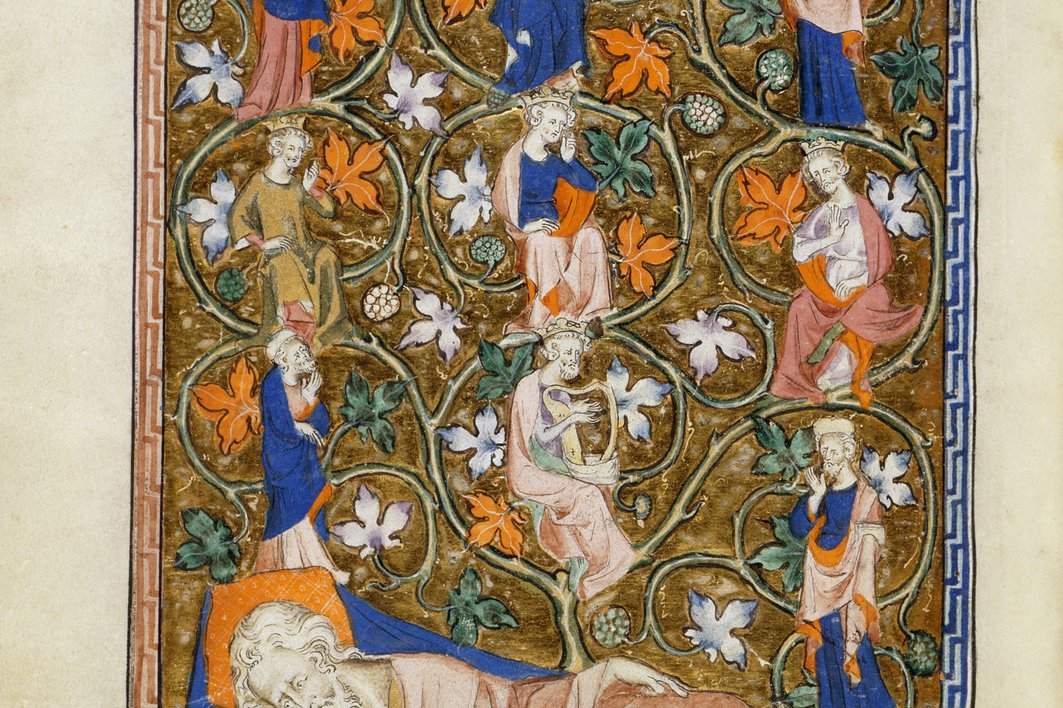
Tree of Jesse, from the Queen Mary Psalter, c. 1310-1320, British Library Royal MS 2 B VII, f.67v — public domain (CC0).
Jesse, asleep at the root
The composition's most distinctive and recognizable feature is its bottom figure: Jesse himself, almost always shown reclining or asleep, often on his side, with the tree's trunk rising directly out of his body — from his chest, his side, or occasionally his navel, depending on the artist. This visual choice draws directly from Isaiah's own language of a "stump" and "roots," literalizing the metaphor in a way medieval artists were fond of doing: if the prophecy speaks of Jesse as a stump from which new growth emerges, Jesse's own sleeping, reclining body becomes that stump, and the tree grows out of him almost like a dream taking physical shape above the dreamer. The device gives the whole composition a strong vertical anchor and an immediately legible starting point, however elaborate the branching genealogy above him becomes.
Climbing through kings and prophets to Christ
Above Jesse, the tree branches upward through a sequence of figures drawn from the royal line of Judah — kings such as David and Solomon typically appear, crowned and enthroned within roundels formed by the tree's curling branches, sometimes accompanied by Old Testament prophets holding scrolls inscribed with the specific prophecies Christian tradition read as foretelling Christ's coming. The sequence climbs toward a near-universal culmination: the Virgin Mary, usually seated just below the very top, often shown enthroned herself in a smaller echo of Jesse's original pose, and finally Christ crowning the entire composition, sometimes surrounded by seven doves representing the seven gifts of the Holy Spirit named in Isaiah's continuation of the same prophecy just two verses later (Isaiah 11:2) — a detail that ties the whole composition back to its originating text even at its topmost point.
Why stained glass artists loved this subject
The Tree of Jesse found an especially natural home in Gothic cathedral windows, and the fit wasn't accidental. A tall, narrow lancet window shares the same basic proportions as a tree's trunk reaching skyward, and the motif's branching structure gave glaziers a built-in system for organizing dozens of individual figures into roundels connected by flowing, continuous vine-work, filling an entire window with a single unified image rather than a disconnected sequence of separate scenes. Chartres Cathedral's twelfth-century Tree of Jesse window is among the most celebrated surviving examples, its deep blues and reds glowing with an intensity later glass rarely matched, and similar windows survive at cathedrals across France, England, and Germany, frequently positioned prominently — sometimes directly above a main entrance or behind the high altar — precisely because the subject's genealogical sweep made such a fitting visual introduction to the story of salvation a cathedral's entire program of art was built to tell.
Manuscripts, ivories, and beyond
Stained glass wasn't the motif's only medium. Illuminated manuscripts, particularly psalters and other devotional books intended for private prayer, frequently opened with a full-page Tree of Jesse miniature, painted in egg tempera and gold leaf at a scale glass could never achieve, allowing for extraordinarily fine detail in individual faces and drapery. The Tree of Jesse also appears carved into ivory diptychs, embroidered onto vestments, and painted onto church walls in fresco, demonstrating how thoroughly the image had embedded itself across nearly every visual medium available to medieval Christian art by the twelfth and thirteenth centuries.
A family tree built to make a theological point
Unlike an ordinary genealogical chart, the Tree of Jesse was never really about establishing precise historical lineage for its own sake — medieval viewers weren't expected to memorize the exact sequence of kings depicted. Its real purpose was theological: to make visually undeniable the claim that Christ's arrival had been prepared for centuries in advance, promised through a specific prophecy to a specific family line, so that anyone standing beneath a Jesse window or turning to one in a psalter would see, in a single glance upward from Jesse's sleeping body to Christ enthroned at the top, the whole arc of that promise fulfilled.
Trivia
Where does the Tree of Jesse image come from in Scripture?
Why is Jesse usually shown asleep or reclining at the bottom of the image?
Who typically appears in the branches of a Tree of Jesse?
Why did the Tree of Jesse become especially popular in stained glass?
Does the Tree of Jesse appear in the two Gospel genealogies of Christ?
You May Also Like
Related Reading