How Gothic Stained Glass Told Bible Stories

Light theology and the birth of the Gothic window
Gothic architecture didn't simply happen to include large stained glass windows as decoration — the windows were, in a real sense, the point. The style's origins are closely tied to Abbot Suger, who oversaw the twelfth-century rebuilding of the choir at the Basilica of Saint-Denis outside Paris, widely regarded as the first fully Gothic structure. Suger wrote about his renovation in terms drawn from Neoplatonic light theology, in which physical light was understood as a reflection of the divine, immaterial light of God — meaning a church filled with colored light wasn't just beautiful, it was theologically meaningful, drawing the mind of anyone standing inside toward contemplation of God himself.
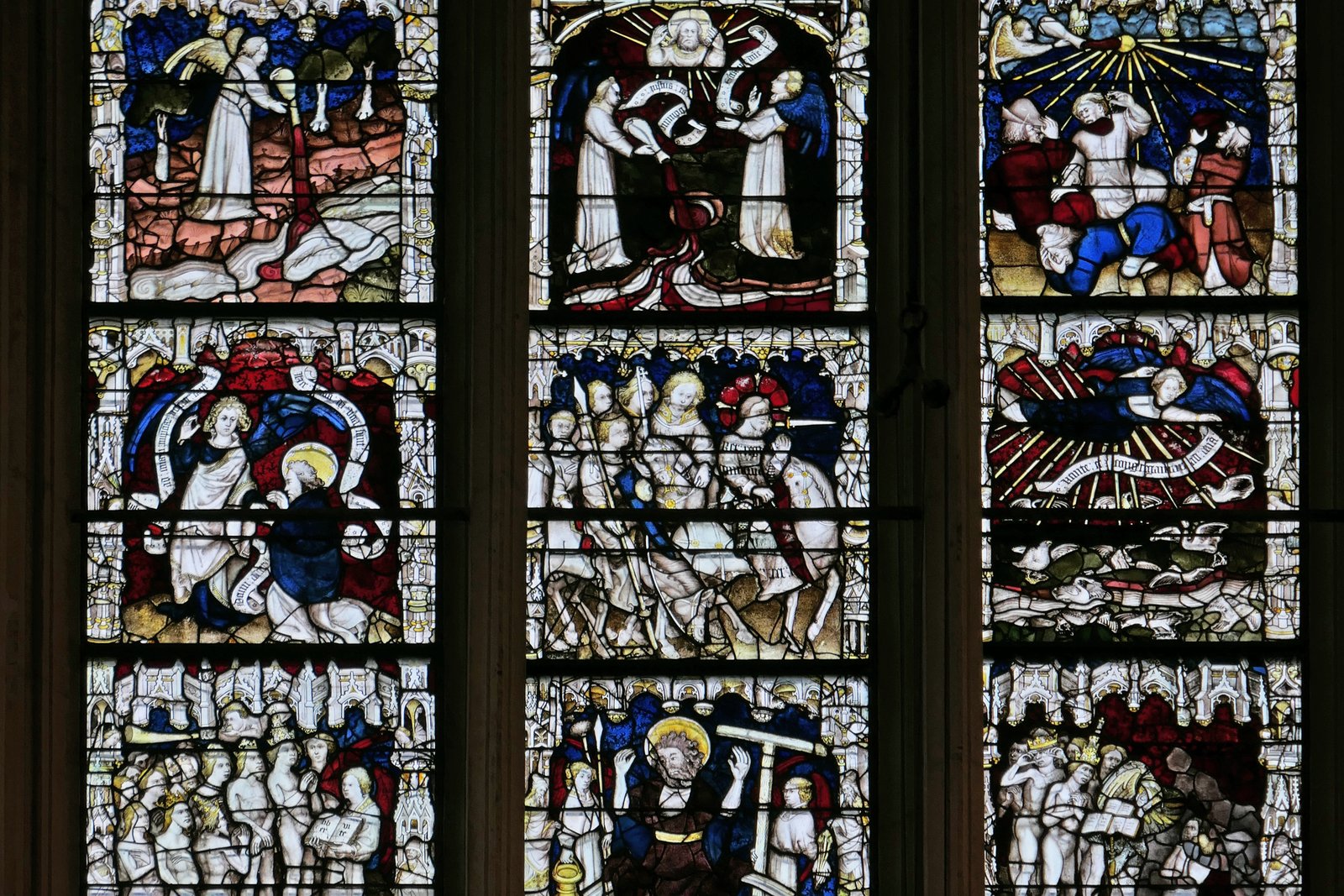
The Great East Window, York Minster, England, early 15th century — photo by Amanda Slater, CC BY-SA 2.0.
That idea reshaped what a church building could be. Earlier Romanesque architecture relied on thick walls and small windows to support heavy stone roofing, producing dim, cave-like interiors. Gothic engineering innovations — pointed arches, ribbed vaulting, and flying buttresses that transferred structural weight outward rather than relying on solid walls — freed builders to open enormous expanses of wall space to glass. The result was a new kind of interior, flooded with colored light, and an enormous new canvas for storytelling.
A Bible for people who couldn't read one
Literacy in medieval Europe was low, and even among those who could read, Latin — the language of the Vulgate Bible and the Mass — was understood by relatively few outside the clergy and educated elite. Stained glass, alongside sculpture, wall painting, and religious drama, became one of the primary ways ordinary Christians encountered biblical narrative directly, without needing to read a word. Windows depicting the life of Christ, Old Testament prefigurations believed to foreshadow the New Testament, and the lives of local or universal saints turned the cathedral itself into an enormous, walkable illustrated Bible.
This function is sometimes compared to the medieval genre known as the Biblia Pauperum, or "Bible of the Poor" — illustrated manuscripts pairing New Testament scenes with Old Testament episodes believed to prefigure them. Stained glass windows frequently used the same typological pairings, placing an Old Testament scene, such as Jonah emerging from the great fish, directly alongside a New Testament parallel, the Resurrection of Christ, teaching complex theological connections through visual juxtaposition rather than written commentary.
Panel by panel, like frames in a story
Most narrative stained glass windows aren't a single large image but a grid of many small individual panels, often called quarries or lights, each showing one distinct episode. A window devoted to the life of a saint might include a dozen or more separate scenes — birth, calling, miracles, martyrdom — arranged in a set reading order, commonly bottom to top, so that a viewer's eye moves upward through the narrative much as it would move across a page of illustrated panels today.
This structure required careful planning by the glaziers and the patrons who commissioned a window, since the story had to remain legible despite the physical challenge of viewing detailed imagery set high overhead, sometimes forty or fifty feet above the cathedral floor. Figures were often simplified and given bold, exaggerated gestures and strong color contrasts specifically to remain readable from a distance — a design necessity, not simply a stylistic preference of the period.
The rose window: a different kind of storytelling
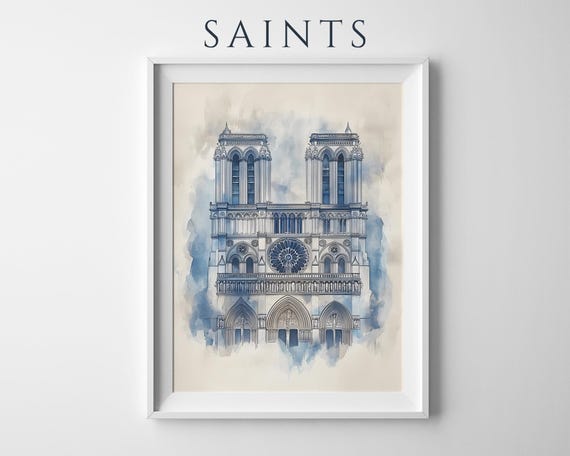
Not every window told a strictly sequential story. Large circular rose windows, such as the famous examples at Chartres Cathedral and Notre-Dame de Paris, often organized their imagery symbolically rather than narratively — a central figure of Christ or the Virgin Mary surrounded by radiating rings of prophets, kings, apostles, or scenes arranged more like a theological diagram than a linear plot. These windows worked less like a comic strip and more like an illuminated mandala of Christian cosmology, meant to be absorbed as a whole image of order and divine kingship rather than read scene by scene.
Chartres alone preserves an extraordinary 176 stained glass windows, most dating from the early thirteenth century, together forming one of the most complete surviving programs of medieval glass anywhere in the world — a testament to how central this visual teaching method was to the cathedral's original purpose.
Color as content, not just decoration
Medieval stained glass makers also used color symbolically, following conventions that would have carried meaning for period viewers even beyond specific narrative content. Blue, especially the deep cobalt associated with Chartres, became closely linked with the Virgin Mary and with heaven itself. Red frequently signaled Christ's Passion and blood, or royal and divine authority. Gold or yellow glass often marked halos, divine light, or figures of particular holiness. A viewer who couldn't read the specific narrative detail in a distant panel could still often grasp something of its meaning simply from its dominant color, another layer of the windows' function as a visual teaching system rather than pure ornament.
A technique that outlasted its original purpose
Stained glass windows continued to be produced long after literacy rates rose and printed Bibles became widely available, but their storytelling function never entirely disappeared from Christian architecture. Just as Byzantine icon painters preserved rigid conventions to keep sacred images theologically legible across centuries, Gothic glaziers developed their own durable visual grammar — sequence, color, gesture — built specifically to carry Scripture to a congregation that needed to see the story, not read it. Many of the greatest surviving windows, including much of Chartres's original glass, have endured for nearly eight centuries, still doing precisely the job they were built for.
Trivia
Why did medieval cathedrals use stained glass to tell Bible stories?
What is a rose window?
How were medieval stained glass windows organized to tell a story?
Who is credited with linking Gothic architecture and stained glass to Christian light theology?
Did ordinary medieval Christians actually understand what the windows depicted?
Related Reading