Rogier van der Weyden's Descent from the Cross: Grief in a Golden Box

A shallow box built for grief
The single strangest and most effective decision in Rogier van der Weyden's Descent from the Cross is spatial. Rather than setting the scene on Golgotha with sky, landscape, and distance behind it, van der Weyden crowded all ten figures into a narrow, boxlike space barely deeper than the figures themselves, set against a flat, gilded background that recalls a carved wooden altarpiece niche rather than an open outdoor setting. Art historians generally believe this was a deliberate echo of contemporary sculpture — the painting was likely commissioned to complement or evoke sculpted deposition groups that Netherlandish churches and confraternities favored at the time. Whatever the precise inspiration, the effect on a viewer is immediate and almost physical: there is nowhere else to look. Every mourner's face, every strained hand, every fold of cloth is pushed right up against the picture's surface, with no landscape or middle distance to offer the eye any relief.
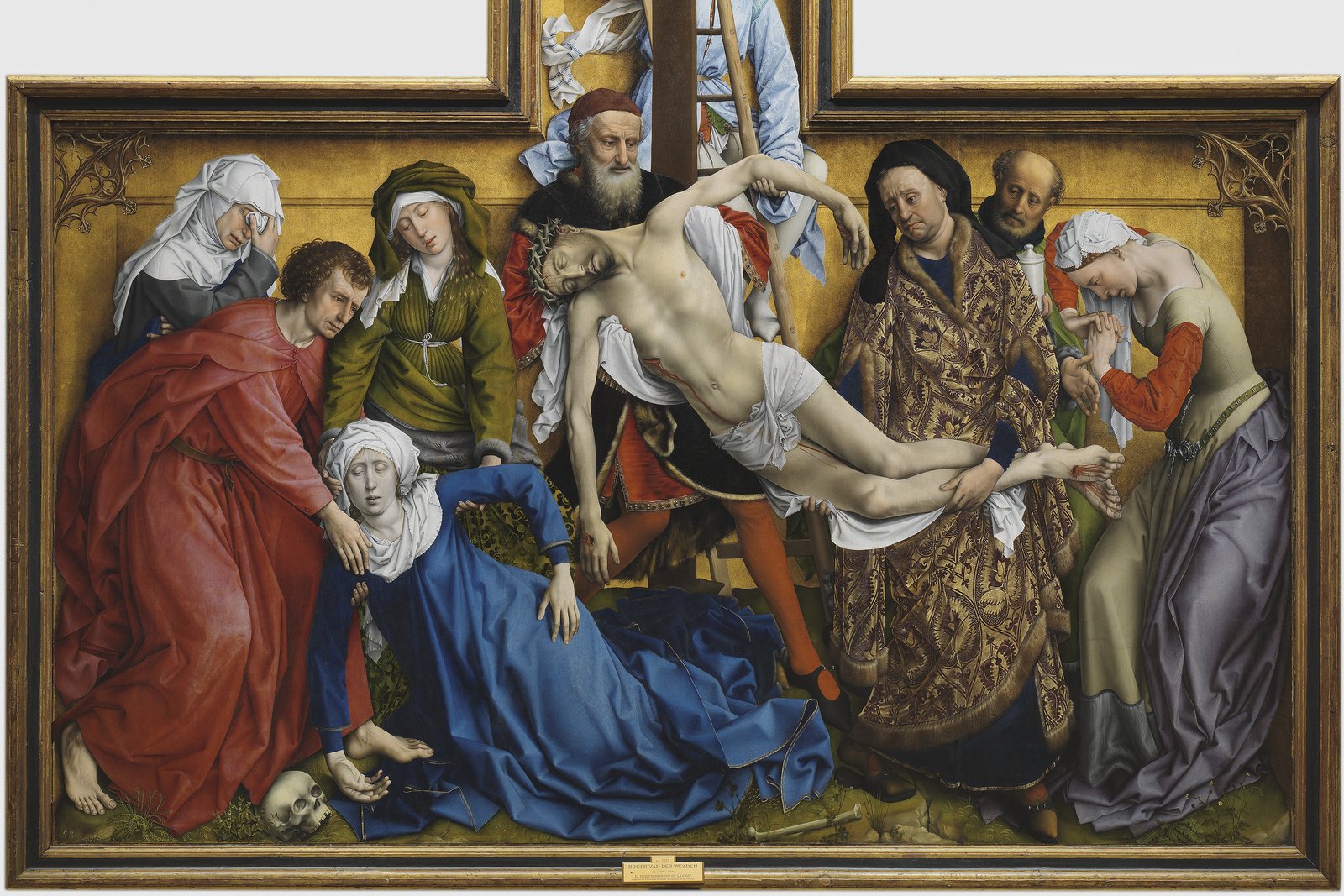
Rogier van der Weyden, "The Descent from the Cross," c. 1435, Museo del Prado, Madrid — public domain.
Ten figures, one unbroken chain of sorrow
Van der Weyden populated this compressed stage with ten figures, each doing real emotional work rather than standing as generic background presence. Joseph of Arimathea and Nicodemus, the two men traditionally credited with requesting Christ's body from Pilate and providing burial arrangements, carefully lower him from the cross at the composition's center. Saint John the Evangelist supports the collapsing Virgin Mary on the left side of the panel, while Mary Magdalene, recognizable by her long flowing hair and richly detailed robe, bends almost double with visible physical anguish on the right. Additional holy women fill out the remaining space, each with her own individualized posture and expression of grief — nothing here reads as a repeated or reused figure type. The overall effect is less a single scene than an interlocking chain of sorrow, every figure's pose responding to and amplifying the ones beside it.
The Virgin's collapse and Christ's body
One of the painting's most studied details is the visual rhyme between Christ's dead body, arcing downward from the cross, and the Virgin Mary's own collapsed form directly beneath him, her body curving in an almost identical line as she faints into John's arms. This is not coincidental composition. Medieval devotional writing had long developed the theme of Mary's compassio — her spiritual and physical participation in her son's suffering — and van der Weyden's doubled curve gives that theological idea a striking visual form: mother and son, echoing each other's suffering in nearly the same shape, occupying nearly the same visual space. It is the kind of quiet, deliberate formal choice that separates a truly great religious painter from a merely competent one, and it rewards viewers who take the time to look closely rather than simply registering the scene's general emotional temperature. For readers curious how other painters handled the same challenge of depicting grief and physical weight in sacred art, our guide to Catholic sacred art offers a broader starting point.
A painter shaped by Flanders' new realism
Rogier van der Weyden worked in the tradition of early Netherlandish painting pioneered by artists like Jan van Eyck, a movement defined by an almost obsessive attention to observed physical detail — the exact texture of velvet, the specific way tears well and catch light, the precise weight and drape of fabric under gravity. Where Italian Renaissance painters of the same period were often working out problems of mathematical perspective and idealized classical form, van der Weyden and his Netherlandish contemporaries pursued a different kind of realism, rooted in surface detail and psychological intensity rather than geometric system. The Descent from the Cross shows that tradition at its most emotionally focused: every tear, every strained tendon in Nicodemus's supporting arm, every crease in the Virgin's fainting face is rendered with the same careful precision Netherlandish painters usually reserved for jewels or fabric, redirected here entirely toward conveying grief.
From Leuven to the Spanish royal collection
The painting was originally created for the Chapel of Our Lady Without the Walls in Leuven, associated with the crossbowmen's guild of that city — a detail preserved in the small crossbow shapes worked subtly into the corners of the gilded frame-like background. It remained in the Netherlands for roughly a century before entering the Spanish royal collection in the 1500s, reportedly after King Philip II acquired it for his own collection, drawn to Netherlandish religious painting the way many Spanish royal and aristocratic collectors of the period were. It has remained in Spain ever since, and today hangs in the Museo del Prado in Madrid, one of the museum's most consistently singled-out masterpieces of early Netherlandish art.
An enduring template
Few paintings of the deposition were copied and adapted as extensively in the following decades as van der Weyden's. Painters across the Low Countries and beyond produced their own versions of the composition, borrowing its compressed staging, its interlocking figures, or specific individual poses, testament to how completely van der Weyden had solved the compositional and emotional problem of the subject. Nearly six centuries later, the painting still functions exactly as intended: a viewer standing in front of it in Madrid finds there is genuinely nowhere else to look, no distance to retreat into, only ten figures and one shared, inescapable grief pressed right up against the surface of the panel.
Trivia
Where is Rogier van der Weyden's Descent from the Cross housed today?
Why does the composition look almost like a sculpture rather than a painting?
Who are the figures shown in the painting?
What is significant about the pose of the Virgin Mary in this painting?
How did this painting influence later Netherlandish art?
Related Reading