Rubens' Descent from the Cross: Grief Made Monumental

A body that behaves like a real body
What immediately sets Rubens' Descent from the Cross apart from earlier treatments of the same subject is how convincingly heavy Christ's body looks. His head has fallen back, his limbs hang at angles that suggest real dead weight, and the group of figures lowering him — Nicodemus and Joseph of Arimathea near the top, John the Evangelist steadying the body's midsection, Mary Magdalene supporting a foot — visibly strain under the effort, one man even gripping a corner of the shroud in his teeth to free a hand. Earlier depositions in Christian art often posed Christ's body with a kind of residual grace or lightness, even in death. Rubens instead painted the mechanics of grief: the actual physical difficulty of moving a limp adult body down and across a cross, using a diagonal composition that pulls the eye — and seemingly gravity itself — from the upper right corner down to the lower left.
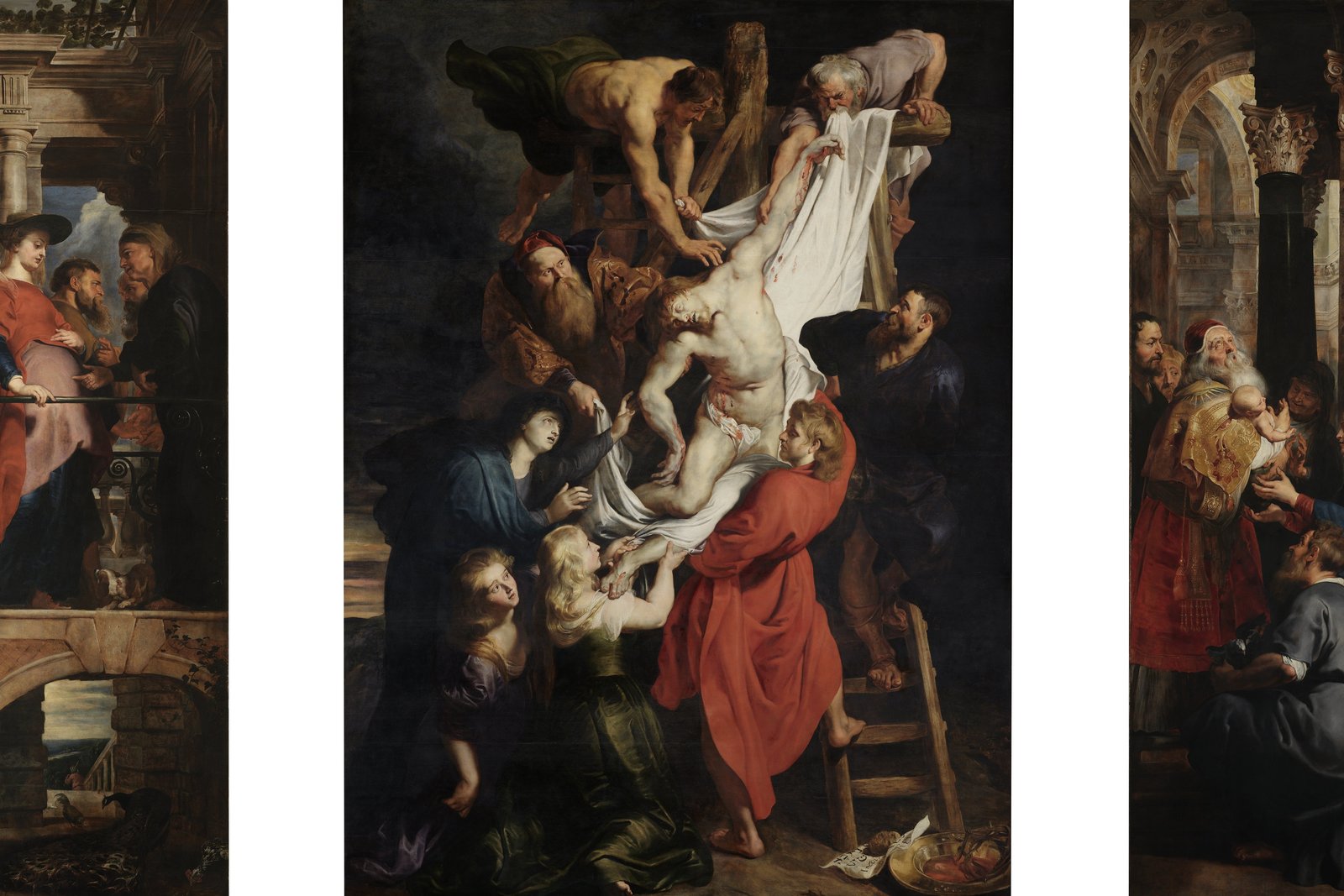
Peter Paul Rubens, "The Descent from the Cross," 1612-1614, Cathedral of Our Lady, Antwerp — public domain.
Why the diagonal matters
That downward diagonal isn't just a technical flourish. It organizes the entire emotional register of the painting, giving the viewer's eye nowhere to rest except along the same path the body itself is traveling — down, inexorably, toward the waiting arms below. The pale, luminous flesh of Christ's body, lit almost like the focal point of a stage set, cuts against the darker reds and deep shadow of the surrounding figures, making the descent read almost like a single continuous motion frozen at its midpoint. It's a deliberately different approach from the balanced, more static compositions typical of earlier Flemish and Italian religious painting, and it reflects the broader Baroque instinct — explored further in how Baroque religious painting builds drama — for pulling the viewer physically and emotionally into the middle of a sacred event rather than presenting it as a calm, distanced tableau.
A triptych built around one guild's patron saint
The altarpiece was commissioned by the Confraternity of the Arquebusiers, a civic militia and marksmen's guild in Antwerp, whose patron saint was Christopher — whose name means, literally, "Christ-bearer." Rubens structured all three interior scenes of the triptych around that theme of bearing or carrying Christ: the central Descent shows Christ's body being carried down from the cross, the left panel shows the pregnant Mary "carrying" the unborn Christ to visit her cousin Elizabeth, and the right panel shows the infant Christ being presented and physically held up in the Temple. Even the closed exterior panels, visible when the triptych was shut outside of feast days, depict Saint Christopher himself carrying the Christ Child across a river — meaning a viewer moving from the closed to the open triptych would see essentially the same theme of "Christ-bearing" repeated across every possible configuration of the altarpiece.
Rubens' return to Antwerp and rising reputation
Rubens had spent eight formative years in Italy studying the great masters of the Renaissance and Baroque before returning to Antwerp in 1608, where he quickly became court painter to the Habsburg governors of the Spanish Netherlands and the most sought-after religious painter in the region. The Descent from the Cross followed closely on the heels of his Raising of the Cross, an equally monumental triptych painted for the same cathedral just a few years earlier, and together the two works announced a distinctly new, physically forceful style of religious painting in the Southern Netherlands — one that combined Italian compositional sophistication with a Flemish attentiveness to material, tactile detail.
Echoes in later art
Rubens' handling of the deposed body did not stay confined to Antwerp. Nineteenth-century Romantic painters, most famously Eugène Delacroix, studied and copied passages from the Descent directly, drawn to how Rubens let color and diagonal movement carry emotional weight rather than relying on careful, static outline. Delacroix is recorded admiring Rubens precisely for this willingness to sacrifice classical restraint for visceral, physical truth — a lineage that runs from Rubens' Antwerp altarpiece through French Romanticism and on into the more expressive currents of nineteenth-century religious painting. The painting has also long served as a touchstone in art academies for how to compose a multi-figure scene around a single unifying movement instead of scattering incident across the canvas, a lesson that shows up in later depositions and pietàs well beyond Flanders.
Restoration and survival
The triptych has needed real intervention to survive intact. It suffered damage and was dispersed during the turbulence of the French Revolutionary period, when Napoleon's forces removed numerous artworks from Antwerp and other occupied cities, and the panels were only returned to the cathedral after 1815. A major conservation campaign in the 1990s cleaned centuries of accumulated grime and discolored varnish from the central panel, revealing color relationships — the cold, almost bluish pallor of Christ's skin against the warm reds of the surrounding drapery — that had been muted for generations. That restoration is part of why visitors today can still see so clearly the contrast Rubens built between the lit body at the center and the darker figures straining around it, a contrast that is central to how the whole composition reads.
Its place in Antwerp Cathedral today
The triptych remains installed in the Cathedral of Our Lady in Antwerp, the same building for which it was painted over four hundred years ago, and it continues to draw visitors specifically to study its handling of weight, light, and grief. Its influence rippled outward through generations of Baroque and later painters who studied Rubens' handling of a fully convincing human body in a moment of extreme physical strain, and it remains one of the clearest surviving examples of how the Counter- Reformation's demand for emotionally direct, physically immediate religious art found its fullest expression not in Italy, but in a cathedral in the Low Countries.
Trivia
Where is Rubens' Descent from the Cross displayed?
What is the diagonal composition in Rubens' Descent from the Cross meant to convey?
Why does the triptych show a scene of Saint Christopher on its outer panels rather than the Crucifixion?
Is the Descent from the Cross a single painting or made up of multiple panels?
How did this painting affect Rubens' reputation in Antwerp?
Related Reading