The Pelican as a Symbol of Christ

A legend, not a lesson in ornithology
Christian sacred art is full of symbols drawn from the natural world, but few are stranger, on inspection, than the "pelican in her piety" — a pelican shown piercing or wounding her own breast with her beak so that her chicks can feed on the blood, sometimes reviving chicks the legend claimed she had killed herself in a fit of anger three days earlier. None of this reflects how pelicans actually behave. The image is a medieval legend, not a natural observation, and understanding it means understanding how differently medieval Christians related to animal symbolism than a modern reader might expect — the point was never zoological accuracy, but a vivid picture worth building an entire visual theology around.
Pelican in her piety, illuminated manuscript initial, late 13th century — public domain (Google Art Project).
Where the legend came from
The pelican legend most likely traces back to a real, if far less dramatic, piece of pelican behavior: adult pelicans regurgitate stored fish from a pouch beneath their bill to feed their young, pressing that pouch against their chest in the process. From a distance, or filtered through secondhand description, that motion could plausibly be misread as the bird wounding itself, especially if the pouch skin showed a reddish tinge. Whatever its origin, the legend was well established by the time it entered the Physiologus, an early Christian text compiled in the second or third century that paired descriptions of real and fantastical animals with moral and spiritual lessons. The Physiologus became one of the most copied and translated texts of the medieval period, feeding directly into the illustrated bestiaries that circulated across medieval Europe, where the pelican's self-sacrifice was explicitly read as a figure for Christ.
From bestiary page to altarpiece
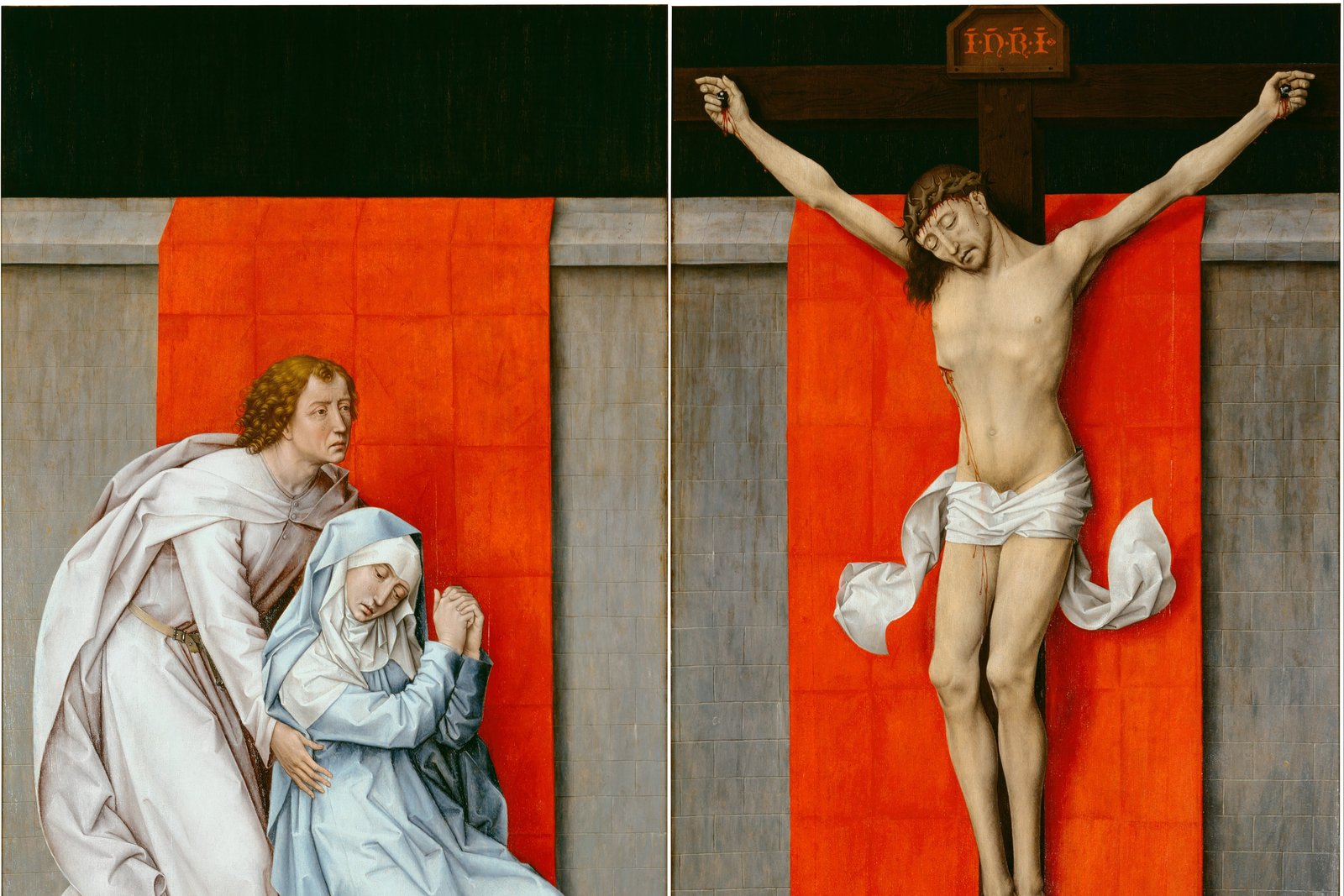
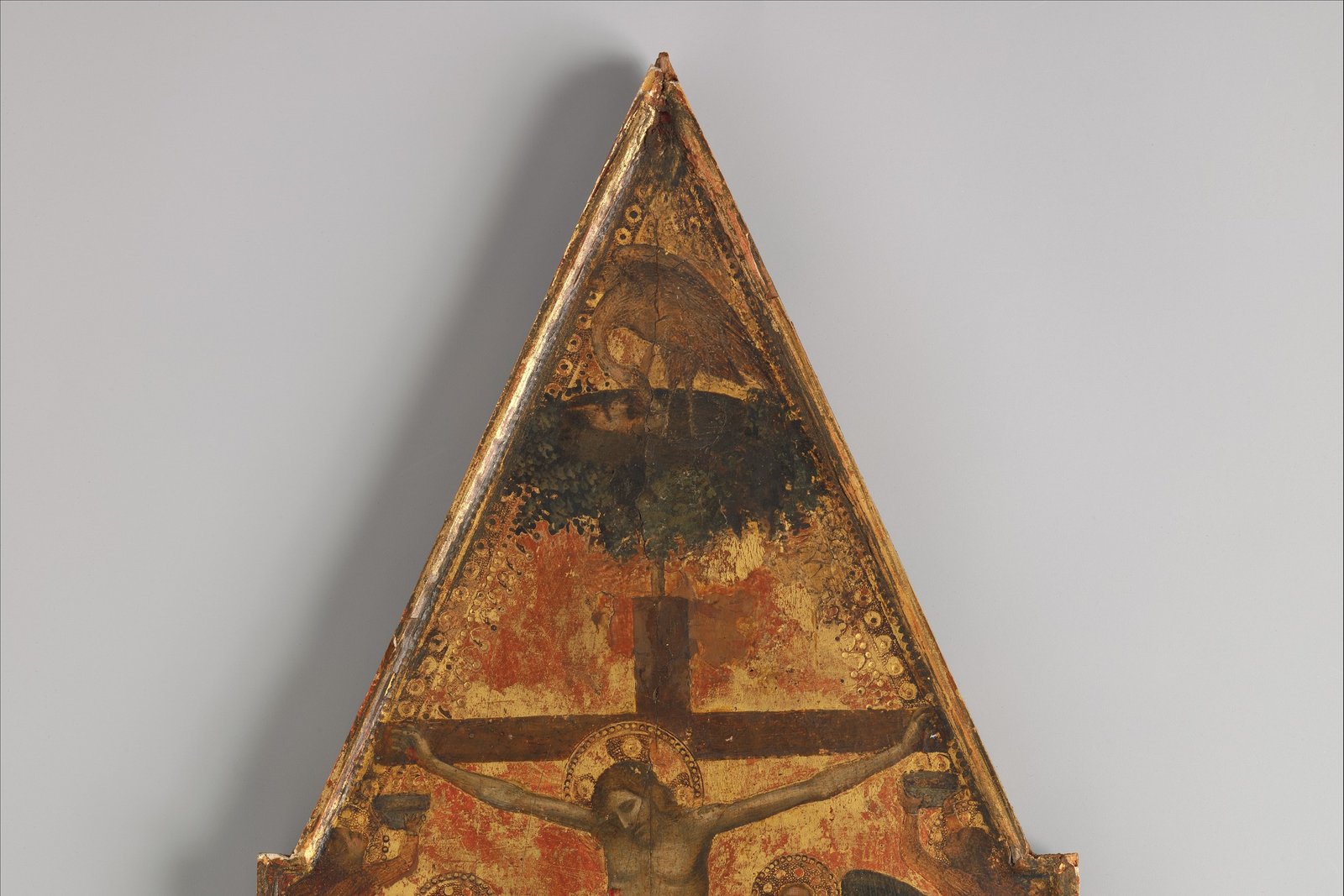
Once established in bestiary tradition, the pelican migrated naturally into painted and carved Christian art, almost always in the same context: positioned directly above or near a crucifixion, functioning as a kind of symbolic footnote to the scene below. Allegretto Nuzi's fourteenth-century altarpiece panel, shown above, places the bird at the very peak of the triangular gable, perched above a tree just over Christ's crucified body — small in scale compared to the crucifixion itself, but deliberately positioned so a viewer's eye moves naturally from the literal sacrifice below to its symbolic gloss above. The pairing repeats constantly across medieval and early Renaissance art: stained glass windows, illuminated manuscripts, carved misericords in choir stalls, and church ceilings all use the same compact visual formula, a wounded mother bird standing in for the wounded Christ.
A sacrifice that feeds
What made the pelican such a durable symbol wasn't just self-sacrifice in the abstract — it was specifically a sacrifice that feeds someone else, which gave the image an unusually direct connection to the Eucharist. Christ's own words frame the crucifixion in exactly this pattern of self-giving: "No one has greater love than this, to lay down one's life for one's friends" (John 15:13, NABRE), a sentiment echoed in the First Letter of John: "The way we came to know love was that he laid down his life for us" (1 John 3:16, NABRE). The pelican's blood nourishing her chicks maps naturally onto Christ's blood, received by the faithful at Communion, which is why the pelican symbol appears so often on altar frontals, tabernacle doors, and other objects directly connected to the Eucharist rather than only in general crucifixion scenes — the bird wasn't just illustrating sacrifice, but sacrifice that becomes food.
A quieter cousin of the lamb
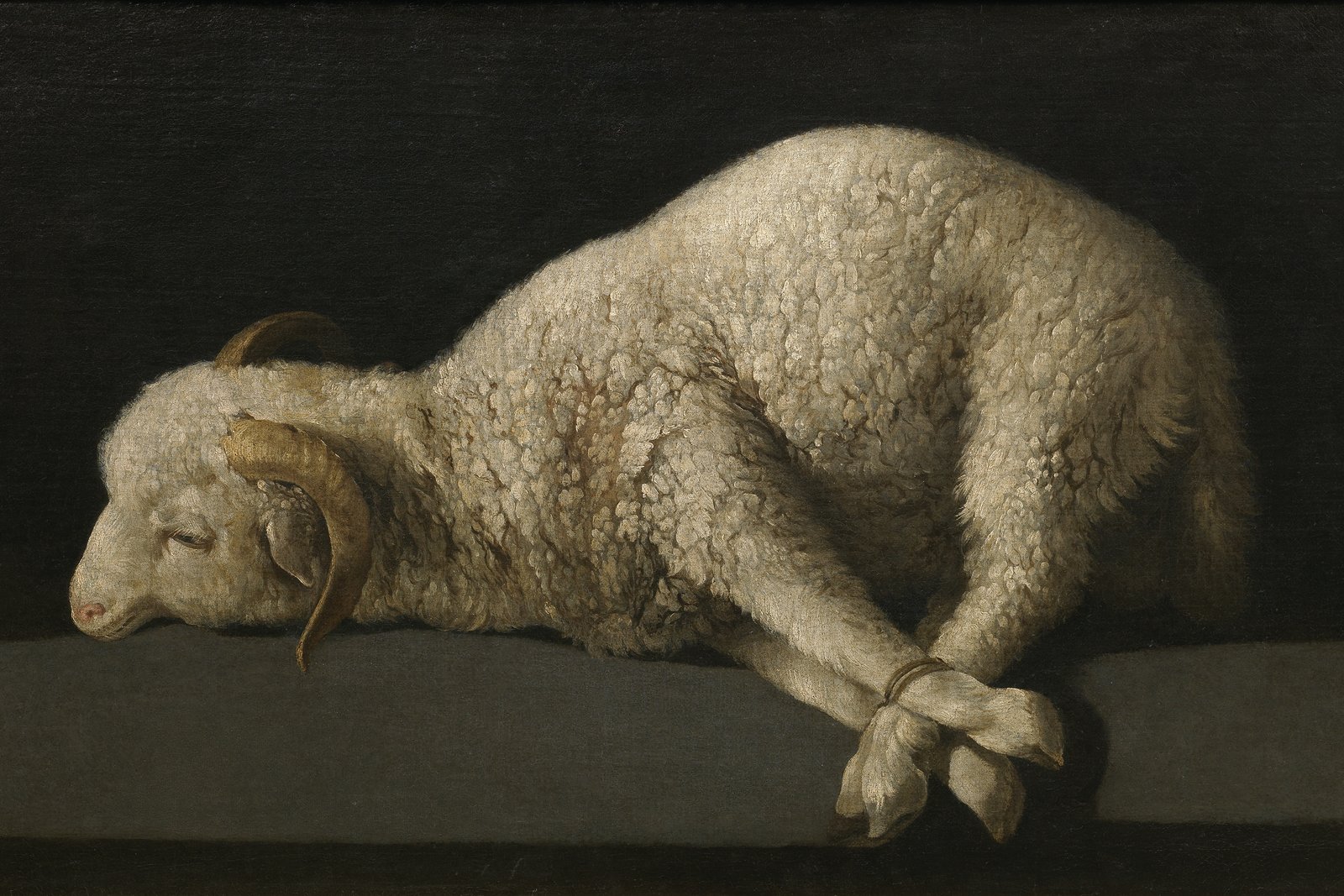
The pelican and the Lamb of God do overlapping work in Christian symbolism — both stand in for Christ's self-sacrifice — but they arrived by very different paths. The lamb comes directly from scripture, spoken by John the Baptist and pictured in Revelation; the pelican comes from a piece of folk zoology filtered through centuries of bestiary tradition and applied to Christ only after the fact. That distinction is worth keeping in mind precisely because it's easy to blur: the pelican's meaning is genuine and was taken seriously for centuries, but its authority rests on legend and long-accumulated symbolism rather than scripture itself, a difference worth naming plainly rather than letting the two blend into a single category of "biblical animal symbols."
Still perched, centuries later
Real pelicans, of course, do none of what the legend describes, and modern viewers sometimes discover this and wonder why medieval artists got their ornithology so wrong. But the symbol was never really about the bird. It survived for centuries, and still turns up in church architecture and Catholic heraldry today, because it gave believers an image compact enough to hold at a glance: a parent giving everything, including blood itself, to keep her young alive — exactly the claim medieval Christians wanted the crucifixion, painted just below it, to make.
Trivia
What does the pelican symbolize in Christian art?
Is the pelican legend based on real bird behavior?
Where does the pelican legend first appear in Christian writing?
Why is the pelican often placed at the very top of a crucifixion painting?
Related Reading