Types of Crosses Explained

One symbol, many shapes
Every cross traces back to the same historical fact: a Roman method of execution repurposed by early Christians into the central symbol of their faith. But by the time the cross moved from a shameful instrument of death to the most recognizable emblem in the world, different regions, religious orders, and eras had reshaped its basic form to say something specific. Learning to read those shapes is a small but genuine key to understanding centuries of Christian art and devotion.
Muiredach's High Cross, Monasterboice, Ireland, 9th–10th century — CC BY-SA 3.0 (photo: Kiss Tamás).
The Latin cross
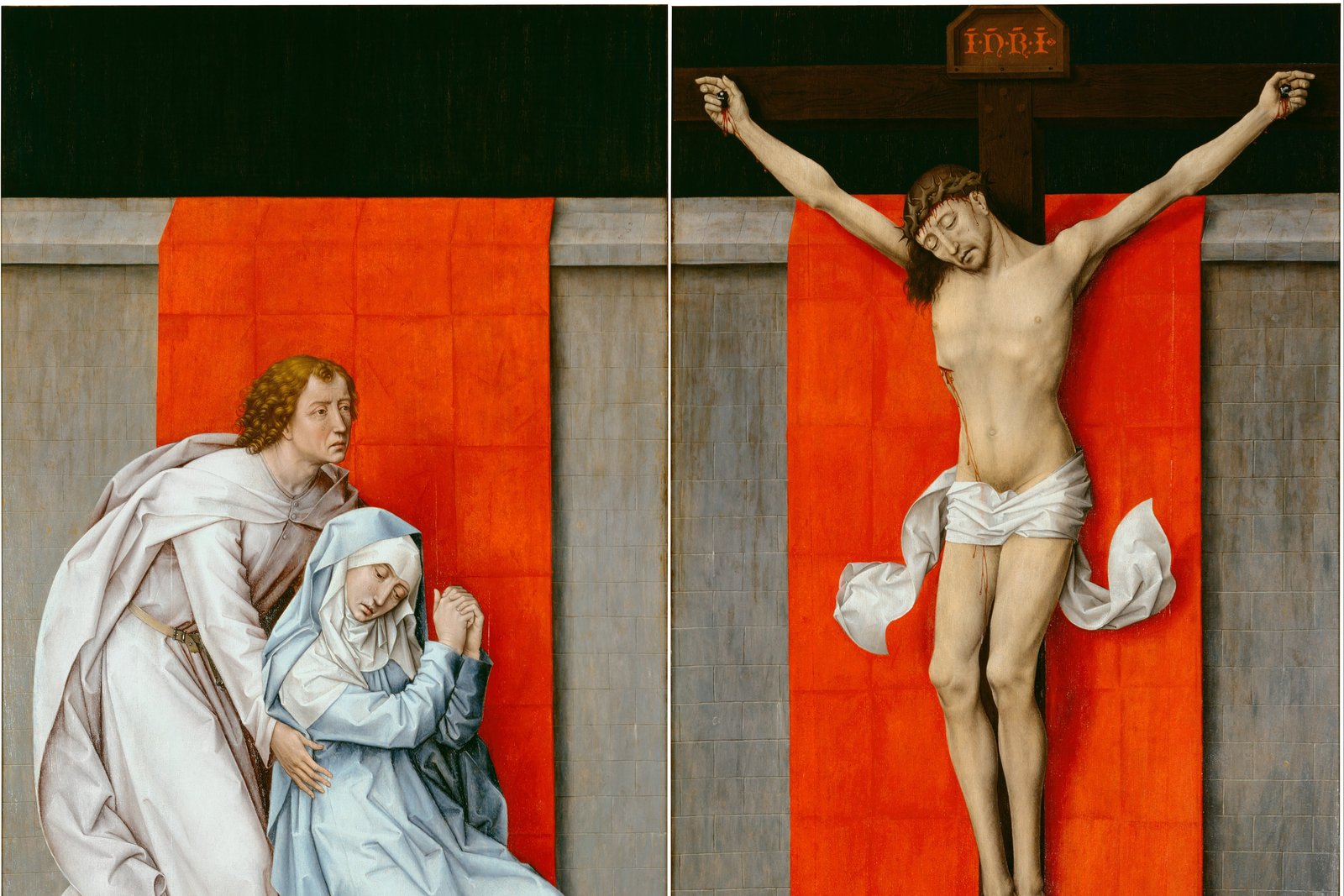
The most familiar shape in Western Christianity is the Latin cross, or crux immissa — a long vertical beam crossed by a shorter horizontal one set above the midpoint, rather than centered. This asymmetry reflects, at least traditionally, the practical shape of a Roman execution cross, tall enough to display a placard above the condemned. The Gospel of John records exactly such a placard over Jesus at the crucifixion: "Pilate also had an inscription written and put on the cross. It read, 'Jesus the Nazorean, the King of the Jews'" (John 19:19, NABRE), written, John adds, "in Hebrew, Latin, and Greek" (John 19:20, NABRE) so that it could be read by everyone passing by. That inscription is the source of the familiar "INRI" lettering seen at the top of crucifixes across Western art, an abbreviation of the Latin Iesus Nazarenus Rex Iudaeorum.
The Latin cross became the default shape for freestanding crucifixes, processional crosses, and church architecture throughout the Western Church, and it remains the shape most people picture first when they hear the word "cross" at all.
The Greek cross
Where the Latin cross is asymmetrical, the Greek cross is not: four arms of equal length, meeting at a true center point, forming a plus sign. This shape appears constantly in the earliest Christian art, catacomb carvings, and mosaic floors, often disguised inside a decorative circle or rosette to avoid drawing hostile attention during periods of persecution. It later became closely associated with Eastern and Byzantine church architecture, where cathedral floor plans were frequently built on a Greek-cross layout, with four equal transepts radiating from a central dome. Its balance and symmetry gave it a natural role in baptismal fonts, altar linens, and liturgical vestments as well, where a compact, evenly weighted mark was more practical than a tall Latin cross.
The Celtic cross
Instantly recognizable by the ring intersecting its arms, the Celtic cross developed in Ireland and Britain from roughly the early medieval period onward, most dramatically in the towering stone "high crosses" that still stand in churchyards and monastic sites across Ireland — carved, often, with biblical scenes and interlacing knotwork running the full height of the shaft. Historians differ on exactly why the ring appears: some read it as a structural reinforcement, helping a heavy stone crossbeam bear its own weight; others see a deliberate visual fusion of the cross with older solar or cosmological imagery from the region, reinterpreted in a Christian key rather than erased. Whatever its origin, the ring reads naturally today as a kind of halo around the whole cross, and the Celtic cross remains one of the most popular forms for memorial and cemetery markers well outside Ireland itself.
The patriarchal and papal crosses
Several cross forms carry a second, smaller crossbar above the main horizontal beam, and the two are easy to confuse. The patriarchal cross has two horizontal bars, the upper one shorter, and has long been associated with patriarchs and archbishops in both Eastern and Western tradition — it appears, for instance, in the coat of arms of Lorraine and in various archiepiscopal insignia. The papal cross goes a step further, with three horizontal bars of graduated length, the topmost shortest. It functions today mainly as a heraldic symbol representing the papacy in coats of arms and ceremonial contexts, distinct from the actual processional cross carried before the pope at liturgies, which in practice is typically a plain single-barred crucifix rather than the triple-barred heraldic form.
The Orthodox cross
The eight-pointed Russian Orthodox cross adds two smaller elements to the standard Latin form: a short horizontal bar near the top, representing the titulus or inscription placard, and a slanted bar near the bottom, representing a footrest. Tradition reads the tilt of that lower bar symbolically as well as historically, oriented upward toward the penitent thief crucified at Jesus's right, who asked to be remembered in his kingdom, and downward toward the unrepentant thief at his left — a visual echo of Luke's account, where one thief mocks Jesus while the other says, "Jesus, remember me when you come into your kingdom," and is told, "Amen, I say to you, today you will be with me in Paradise" (Luke 23:42-43, NABRE).
The cross as a road, not just a symbol
Beyond these named forms, the cross functions in Catholic devotion as something closer to a path than a static image — most visibly in the Stations of the Cross, which walk the faithful physically or meditatively through fourteen moments of Christ's passion, and in the September feast of the Exaltation of the Holy Cross, which celebrates the cross's transformation from an instrument of shame into what Saint Paul called his only true boast: "may I never boast except in the cross of our Lord Jesus Christ, through which the world has been crucified to me, and I to the world" (Galatians 6:14, NABRE). Whichever shape a particular cross takes — Latin, Greek, Celtic, patriarchal, or Orthodox — that same reversal is what all of them are ultimately built to hold in view.
Trivia
What is the difference between a Latin cross and a Greek cross?
Why does the Celtic cross have a circle around the center?
What is a papal cross and who uses it?
Why do some Orthodox crosses have a slanted bottom bar?
Related Reading