The Halo in Religious Art

A borrowed light
The halo is one of the oldest visual devices in sacred art, and one of the least original — which is precisely what makes its Christian adoption interesting. Long before any Christian painter picked up a brush, artists across the ancient Mediterranean and Near East were already circling the heads of gods, emperors, and heroes with radiant disks or rays. Coins of Hellenistic and Roman rulers show sun-crowns and radiate halos meant to associate the emperor's authority with the sun itself; Persian and Buddhist art used comparable radiance to mark divine or enlightened figures centuries before Christianity existed as an organized faith at all. When Christian artists began developing a visual language of their own in the third and fourth centuries, they didn't reject this shared symbolism — they absorbed it and gave it new content, using the same circle of light to mark not political power but the presence of God's grace in a person.
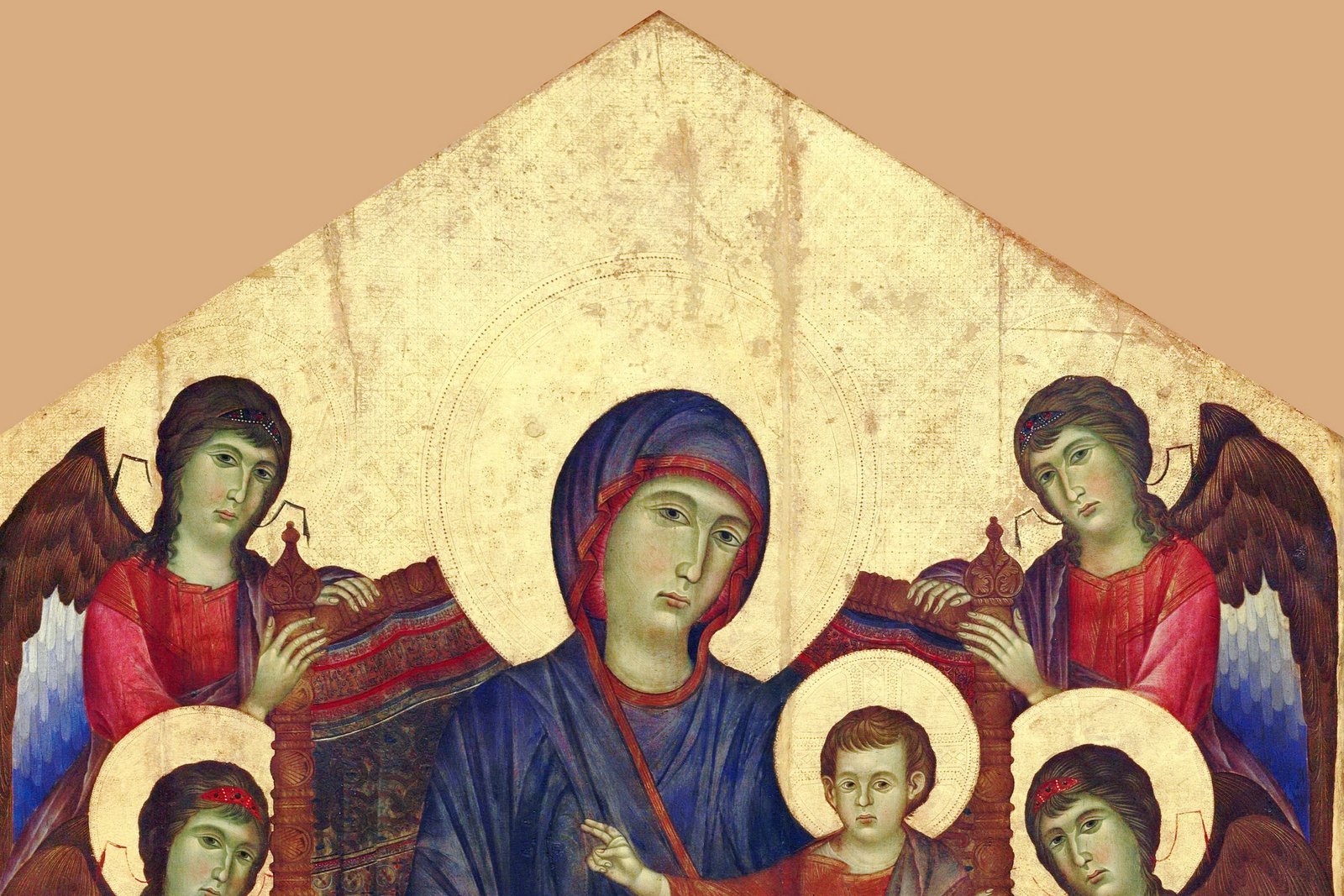
Cimabue, "The Virgin and Child Enthroned with Angels," c. 1280, Musée du Louvre, Paris — public domain.
From the classical world into the Church
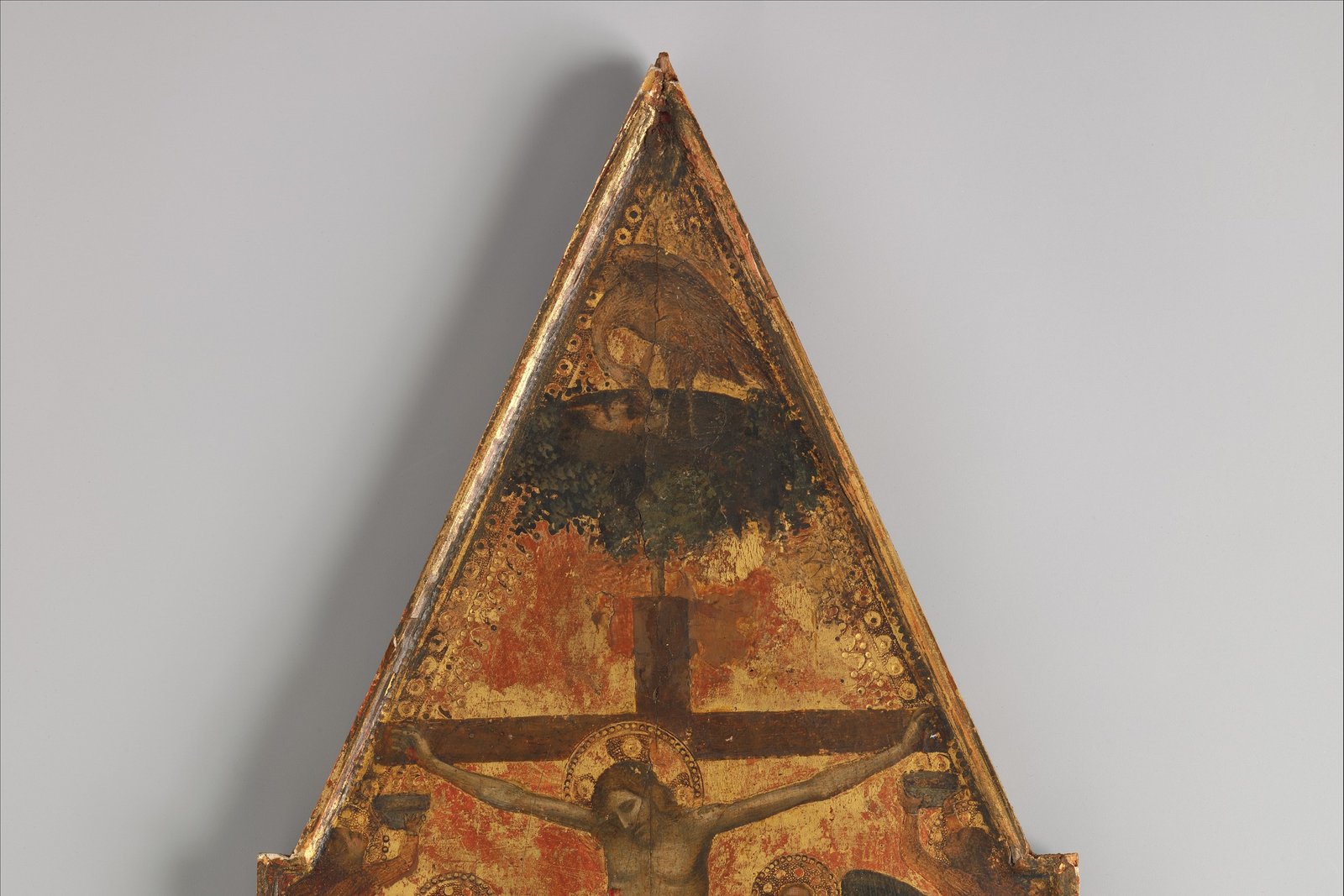
The earliest surviving Christian halos appear in Roman catacomb art and, more prominently, in the mosaics of the fourth and fifth centuries, where Christ is shown with a distinctive halo bearing a cross inscribed within it — the cruciform nimbus — a form reserved for him alone and never used for saints, angels, or even the Virgin Mary. That distinction has held remarkably consistently across Christian art ever since: a plain gold disk marks general holiness, but a cross inside the circle marks divinity specifically. By the Byzantine period, halos had become a fixed, almost technical part of icon painting, rendered in gold leaf to catch candlelight and communicate literal, physical radiance rather than a flat decorative shape. Western medieval painters, working in the same gold-ground tradition — as seen in Cimabue's late-thirteenth-century Virgin and Child Enthroned with Angels, shown above, where seven figures each wear a wide gold disk stamped with tooled patterns — treated the halo less as a ring floating in three-dimensional space and more as a flat emblem of sanctity laid directly onto the picture's surface, gold itself standing in for uncreated light.
Reading the shapes
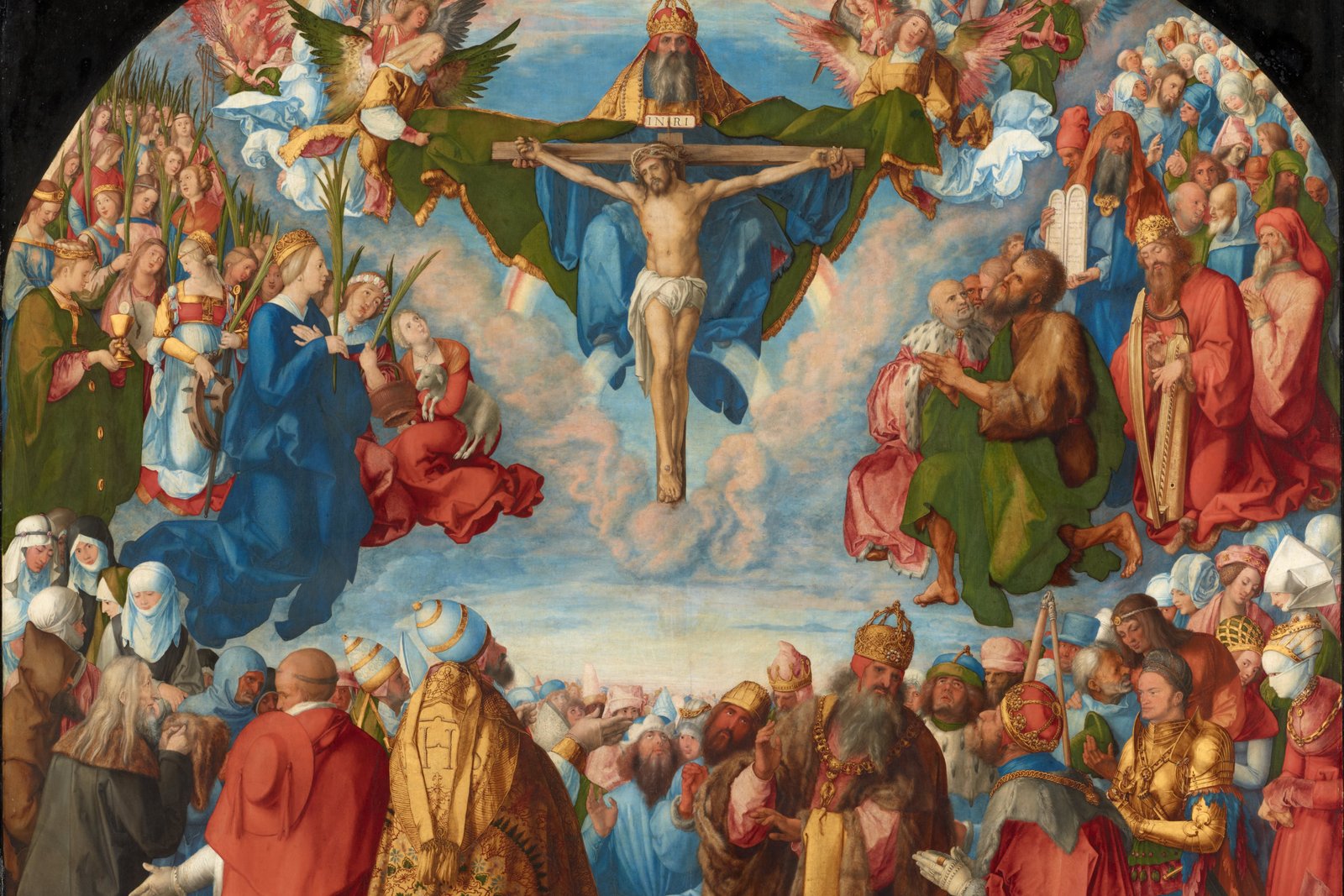
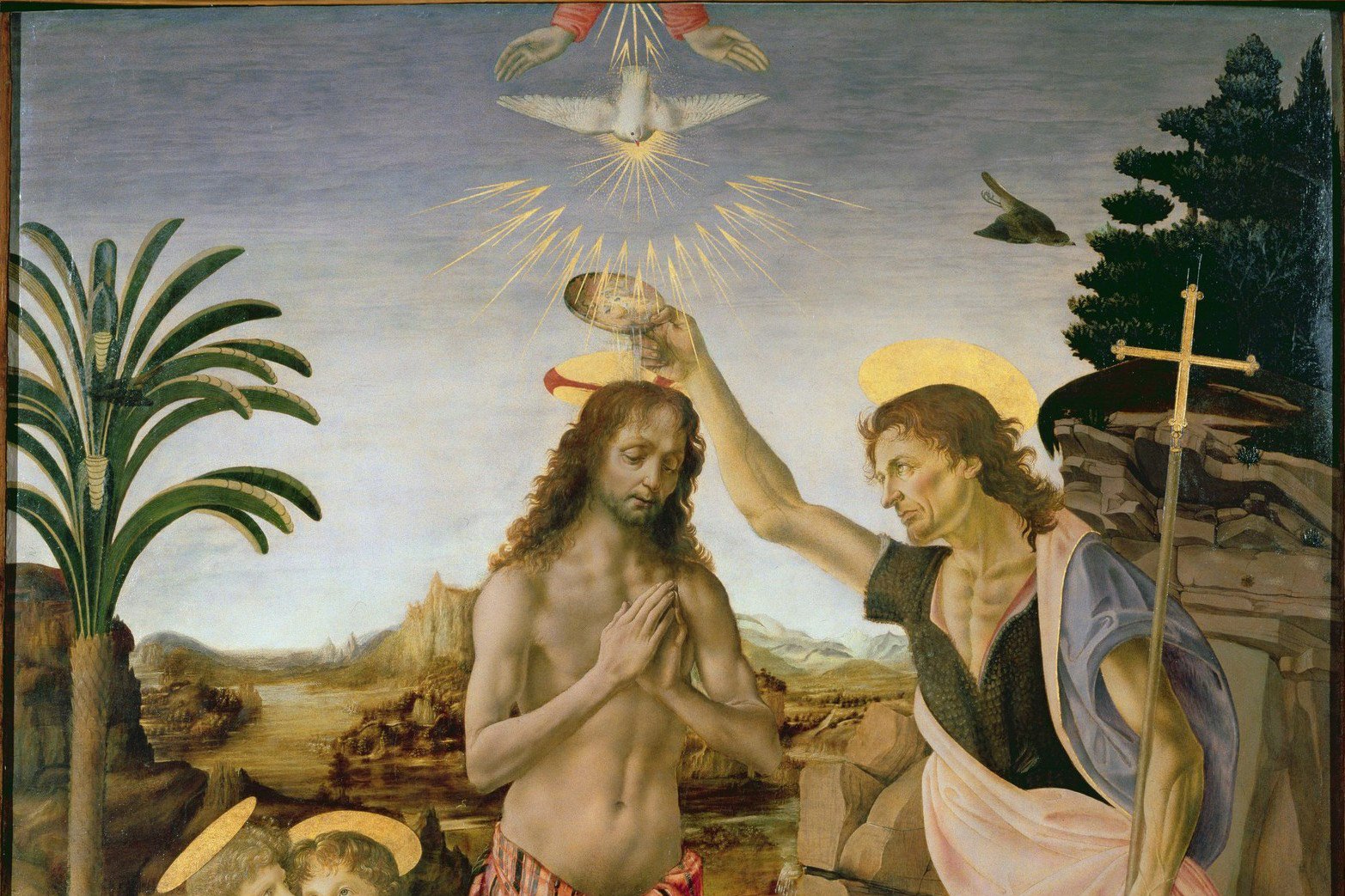
Beyond the basic circle, halo shapes in Christian art follow a set of conventions worth knowing, because artists used them deliberately to distinguish who's who in a crowded composition. A square halo, comparatively rare, was sometimes used in early medieval Roman art for living persons being honored — popes or donors portrayed in mosaics during their own lifetimes — under the logic that only the dead who had already entered eternal glory deserved the traditional round form. A triangular halo became a specific marker for God the Father from the medieval period onward, its three sides standing for the three Persons of the Trinity united in one God, a useful way for artists to visually distinguish the Father from the Son when both appear together in the same scene. Angels and the Holy Spirit as a dove typically receive the standard round halo as well, marking their heavenly nature without claiming Christ's unique cruciform distinction.
Scriptural roots of radiant faces
Christian art didn't invent the underlying idea that closeness to God produces visible light — it found that idea already present in scripture and gave it a fixed visual form. In the Book of Exodus, Moses comes down from Mount Sinai transformed by his encounter with God: "As Moses came down from Mount Sinai with the two tablets of the covenant in his hands, he did not know that the skin of his face had become radiant while he spoke with the Lord" (Exodus 34:29, NABRE), so much so that "Aaron, then, and the other Israelites saw Moses and noticed how radiant the skin of his face had become, they were afraid to come near him" (Exodus 34:30, NABRE). The New Testament offers an even more direct precedent at the Transfiguration, where Christ's face and clothing become visibly luminous before three of his apostles: "he was transfigured before them; his face shone like the sun and his clothes became white as light" (Matthew 17:2, NABRE). Artists reaching for a way to depict that kind of holiness settled, over centuries, on the halo as its standard shorthand.
Why the halo still works
Part of what makes the halo such a durable device is how little translation it requires. A viewer doesn't need to know Latin, Greek, or a saint's specific legend to register instantly that a person circled in gold light belongs to a different category than everyone else in the frame — a silent, universal signal that survived the fall of empires, the shift from mosaic to panel painting to print, and centuries of stylistic change without losing its meaning. Whether stamped in tooled gold leaf on a thirteenth-century altarpiece or painted with a soft photographic glow in a modern devotional print, the halo is still doing the same job it did for the earliest Christian artists: marking the place where holiness becomes visible.
Trivia
Did Christian artists invent the halo?
What is the difference between a round halo and a cross-shaped halo?
Why is God the Father sometimes shown with a triangular halo?
Why do halos sometimes look like flat gold disks rather than glowing rings?
Related Reading