Veronese's Wedding at Cana: A Miracle Disguised as a Party

A miracle told through spectacle
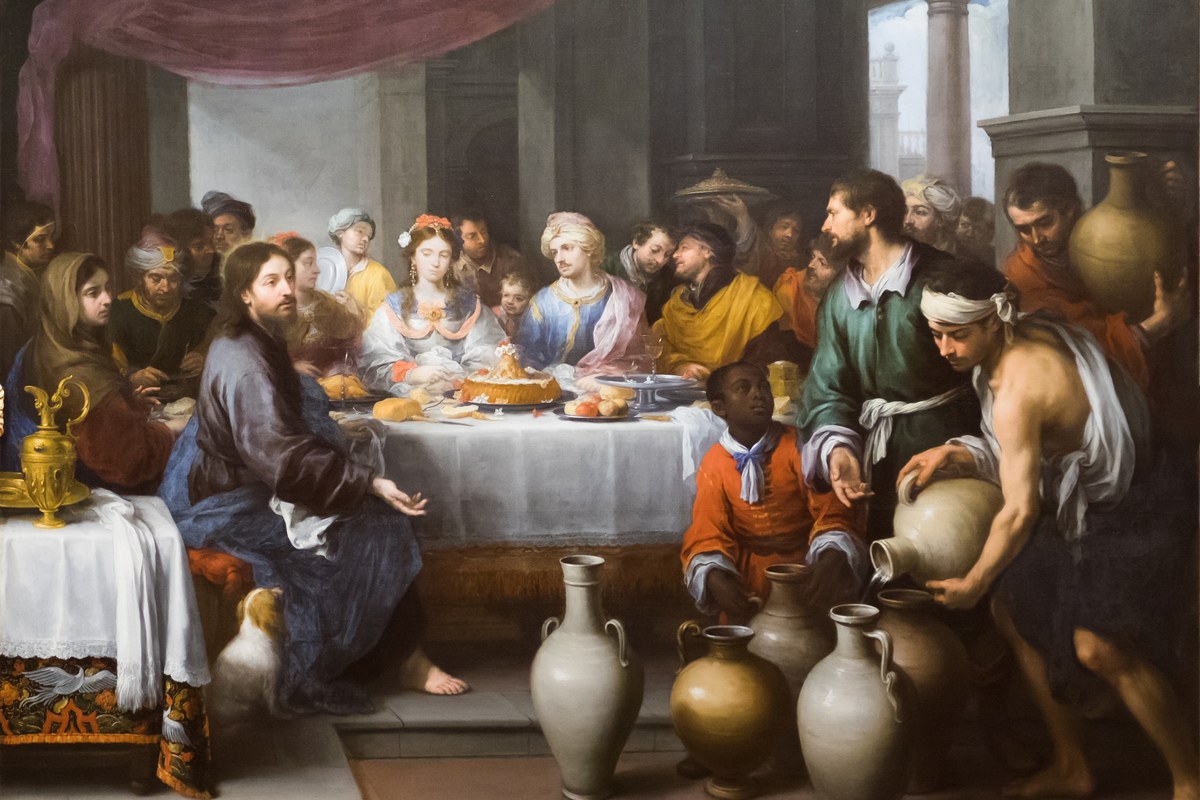
The Gospel account itself is brief and almost domestic in scale: a wedding in the small town of Cana in Galilee runs out of wine, Jesus' mother Mary brings the problem to her son's attention, and Jesus quietly instructs servants to fill stone jars with water, which is then found to have become wine — "the beginning of his signs in Cana in Galilee," as John's Gospel puts it, "and so revealed his glory" (John 2:11, NABRE). Paolo Veronese, commissioned in 1562 by the Benedictine monks of San Giorgio Maggiore in Venice to paint this scene for their monastery refectory, responded with a canvas of almost unimaginable scale and ambition: roughly 130 figures, spread across nearly 22 by 32 feet of canvas, in a scene that reads less like a small-town wedding and more like the grandest banquet the Venetian Republic could imagine.
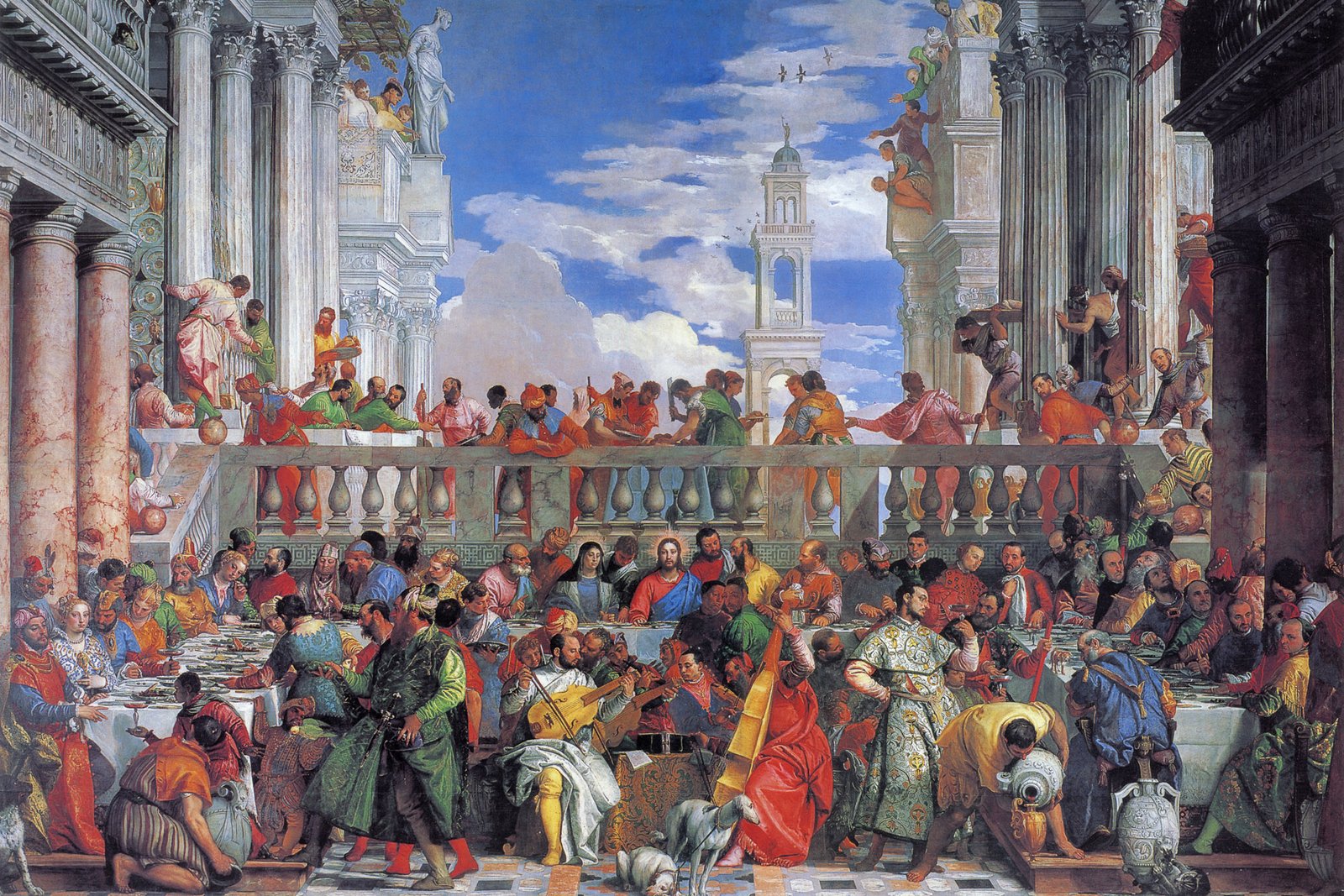
Paolo Veronese, "The Wedding at Cana," 1563, Musée du Louvre, Paris — public domain.
Where is Christ, exactly?
One of the most commented-upon features of the painting is how easily Christ himself can get lost within it. He sits at the center of the long banquet table, calm and still amid the surrounding motion, but Veronese gives him no dramatic spotlight, no isolating gesture, nothing that visually separates him from the crowd of richly dressed guests, musicians, and servants around him — a viewer has to actually look for him rather than being led there automatically by the composition. Some art historians read this as a deliberate theological point: the miracle happens quietly, almost unnoticed by most of the assembled guests, who continue eating, drinking, and conversing entirely unaware that anything extraordinary is taking place just a few seats away. The true action of the painting, in other words, is largely invisible to the very crowd Veronese painted enjoying it.
A refectory built for feasting on two levels
The choice to install this particular painting in a monastery dining hall was almost certainly deliberate. Benedictine monks eating their daily meals in the refectory would have looked up from their own table to see an enormous painted banquet directly in front of them, one that culminated in a miracle involving abundant wine — a pointed visual reminder, delivered at every meal, that ordinary eating and drinking could be understood in light of a far greater feast and a far greater abundance, tied directly to Christ's own presence and generosity. This kind of intentional pairing between a painting's subject and its physical setting was common in Renaissance religious commissions, though few examples matched Veronese's scale and sheer theatrical ambition. Readers interested in how other Venetian and Italian painters approached grand religious commissions can find further context in our guide to Catholic sacred art.
Venice at its own party
Veronese famously dressed his enormous cast not in first-century Judean clothing but in the sumptuous silks, brocades, and jewels of contemporary sixteenth-century Venetian high society, set against classical Renaissance architecture rather than anything resembling ancient Galilee. This anachronism was entirely typical of the period's approach to religious painting — accuracy to historical costume mattered far less than making the scene visually and emotionally immediate to its actual Venetian audience. The result is as much a document of Venetian Renaissance wealth, fashion, and musical culture as it is a religious painting: liveried servants carve meat and pour wine, musicians in the foreground play period instruments, and a menagerie of small details — dogs, cats, exotic birds, dwarfs performing for the guests — fill out a scene of almost overwhelming material abundance.
Musicians who may be painters in disguise
A long-standing tradition, though not fully documented with certainty, holds that the group of musicians playing instruments in the painting's foreground represent a kind of self-portrait gathering of Venice's leading painters of the period — with Titian sometimes identified playing a double bass, Tintoretto a violin, and Veronese himself, dressed in white, playing a viola, completing the group. Whether or not every specific identification holds up to scrutiny, the general practice of painters inserting recognizable self-portraits or portraits of contemporaries into large religious commissions was well established by this period, and the musicians' prominent, brightly lit placement in the foreground certainly invites this kind of speculative identification.
From Venice to Paris, permanently
The painting remained in the San Giorgio Maggiore refectory for over two centuries until 1797, when Napoleon's forces, occupying Venice during the French military campaigns in Italy, removed it along with numerous other significant Italian artworks and transported it to Paris. It entered the Louvre's collection, where it remains today, hanging directly across from the Mona Lisa in the museum's largest gallery room. Despite periodic discussion over the years about a possible return to Venice, the painting's enormous size and fragile physical condition have made any such relocation impractical, and it has remained in Paris for well over two hundred years — a Venetian monastery's dining-hall commission that ultimately became one of the most visited paintings in the world, seen now by millions of people who will likely never set foot in the refectory it was originally built for.
Trivia
What miracle does Veronese's Wedding at Cana depict?
How many figures are in the painting, and how large is it?
Was Veronese's painting made for a religious or secular setting originally?
Are any real historical figures hidden in the crowd?
How did the painting end up in France instead of Venice?
You May Also Like
Related Reading