Relics of Saint John the Baptist: The Many Claims to His Head


A death ordered at a banquet
The Gospels tell the story of John's death with unusual narrative detail for a relatively minor figure in the surrounding account. Herod Antipas, the Roman-appointed ruler of Galilee, had John arrested and bound in prison because John had publicly condemned Herod's marriage to Herodias, the former wife of Herod's own brother — a marriage John had bluntly told him was "not lawful" (Mark 6:18, NABRE). Herodias held a grudge, and at a banquet celebrating Herod's birthday, her daughter danced in a way that delighted Herod enough that he offered her anything she wished. Prompted by her mother, the girl asked "for the head of John the Baptist" on a platter (Mark 6:24-25, NABRE paraphrase of the exchange). Reluctant but trapped by his own public oath, Herod sent an executioner to the prison, and John was beheaded there; his head was brought out on a platter and given to the girl, who gave it to her mother (Mark 6:27-28). Matthew's Gospel records the same essential sequence of events (Matthew 14:3-11).
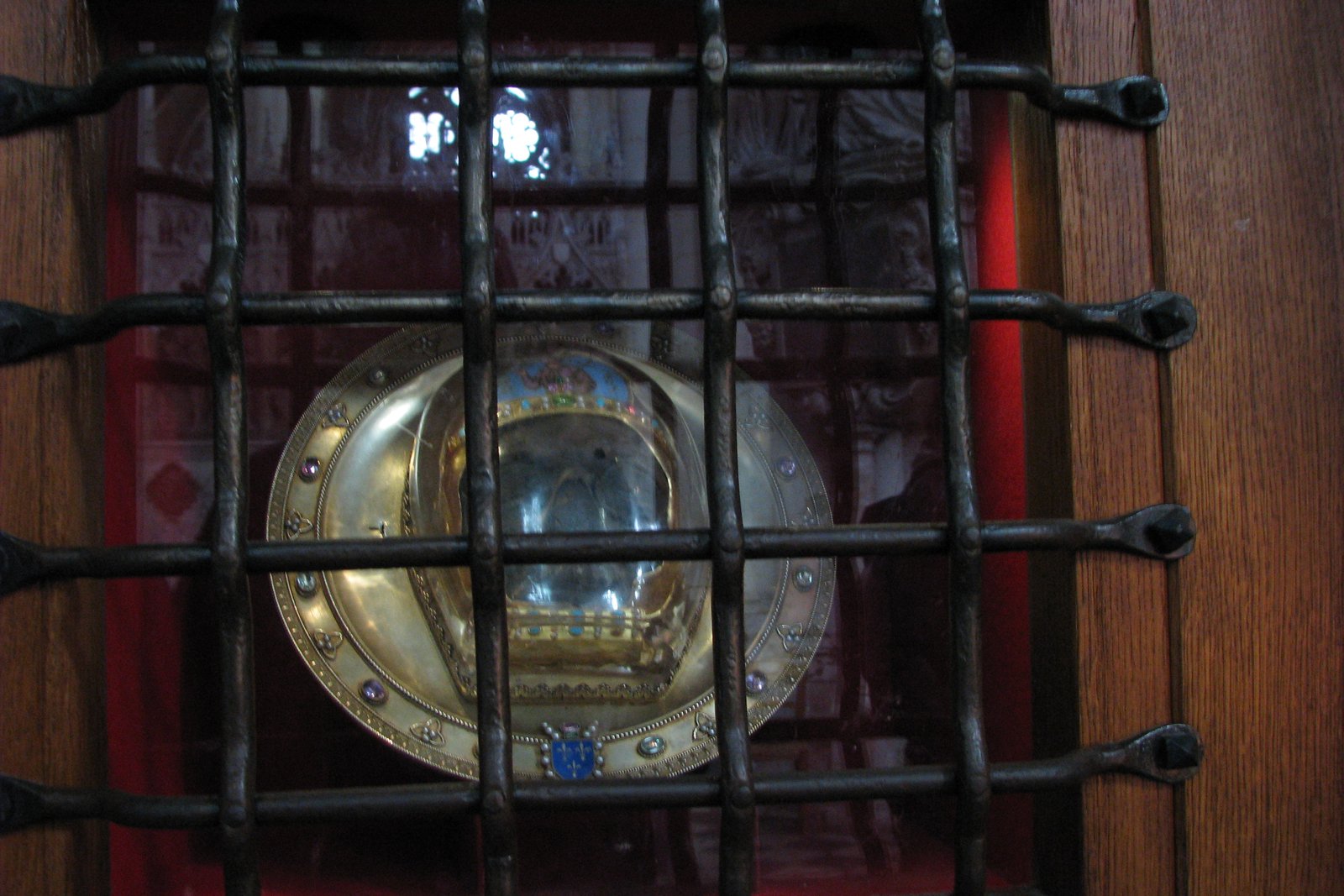
Wi1234, relic of Saint John the Baptist, Amiens Cathedral, photograph, 2007. CC BY-SA 3.0, via Wikimedia Commons.
What the Gospels do not record is what happened to John's remains afterward — where his body or his severed head were taken, by whom, or how either might have survived the centuries that followed. That silence left an open space that medieval devotion filled in, repeatedly and, as it turned out, competingly.
An unusually multiplied relic
Saint John the Baptist holds a strange distinction among venerated figures: his head relic is one of the most frequently claimed individual relics in all of Christian history. At various points across the medieval and early modern periods, multiple churches across Europe and the Middle East have each claimed to possess all or part of his skull or face, a number of claims large enough that researchers and journalists covering the subject have sometimes only half-jokingly asked how many heads John could possibly have had. It is worth naming that plainly rather than glossing over it: this is one of the clearest cases in Christian relic history where devotion outran any possibility of a single, unified, verifiable chain of custody, and historians and relic scholars alike generally treat the multiplication itself as a genuine historical curiosity rather than attempt to adjudicate which, if any, single claim is correct.
The relic at Amiens
Among the most prominent and best historically documented of these claims is the one preserved at Amiens Cathedral in northern France. According to the tradition recorded there, a Picard canon named Wallon de Sarton acquired a facial relic identified as belonging to John the Baptist while in Constantinople during the Fourth Crusade, the controversial 1204 campaign in which crusader forces sacked the Byzantine capital rather than reaching their intended target in the Holy Land. Wallon brought the relic back to France, and tradition records that Bishop Richard de Gerberoy formally received it at Amiens in December 1206.
The relic's arrival mattered enormously to the city. Historians closely connect the prestige of newly possessing such a relic to the decision, only years later in 1220, to begin construction of the vast Gothic cathedral that still stands in Amiens today — a building whose scale and ambition, like Cologne's own Shrine of the Three Kings, reflects how directly a major relic's prestige could reshape a city's architectural priorities. The relic survived at Amiens through the medieval and early modern periods before being lost during the chaos of the French Revolution; it was returned to the cathedral in the 19th century and remains there today, still an object of pilgrimage and veneration.
A shrine shared between two faiths
A very different, and in some ways more remarkable, claim sits inside the Umayyad Mosque in Damascus, Syria — one of Islam's most significant mosques, built in the early 8th century on a site with its own long layered religious history, having previously held a pagan temple and, before the mosque's construction, a Christian church dedicated to John the Baptist. Within the mosque stands a small domed shrine, known as the Maqam Nabi Yahya, traditionally venerated as containing the head of John the Baptist. According to the account recorded by the medieval historian Ibn Asakir, the relic was discovered during the mosque's construction, found in a hidden chamber beneath where one of the building's pillars was meant to stand.
What makes this claim distinctive is not its historical verifiability, which rests on medieval tradition rather than independent documentation, but the genuine shared veneration it represents. In Islamic tradition, John is honored as Yahya ibn Zakariya, a prophet named in the Qur'an among the righteous, so the shrine draws devotion from Muslim visitors on its own terms, not merely as a courtesy to Christian tourists. That shared reverence was significant enough that Pope John Paul II visited the Umayyad Mosque in 2001 specifically to venerate the relics of John the Baptist there — the first time in history a pope had set foot inside a mosque, a gesture widely understood as recognizing this particular site's unusual standing as common ground between the two faiths.
How the Church holds claims like these
Faced with so many mutually exclusive claims attached to a single relic, the Catholic Church does not attempt to formally rule which, if any, is the authentic one. The underlying principle goes back to the Second Council of Nicaea in the 8th century, which affirmed the legitimacy of venerating relics generally as an aid to faith and memory, without making that veneration depend on forensic proof of authenticity — a principle this site has noted applies just as directly to other multiply-claimed relics, such as the shrine of the Three Kings at Cologne Cathedral. What ties the many claimed heads of John the Baptist together isn't a single verified skull, but a shared devotion to the man the Gospels call the forerunner — the one who, by his own account, came only to prepare the way for someone greater than himself, and whose death at Herod's banquet has been remembered, in one relic or another, scattered across the Christian and Islamic worlds alike, for the better part of two thousand years.
Trivia
How did Saint John the Baptist die, according to the Gospels?
Why do multiple churches claim to have Saint John the Baptist's head?
What is the history of the relic at Amiens Cathedral?
What is the shrine of Yahya at the Umayyad Mosque in Damascus?
Does the Church require belief in any specific head relic's authenticity?
Related Reading