The Divine Mercy Image: Faustina's Vision and Its Two Paintings

A vision in a convent cell at Płock
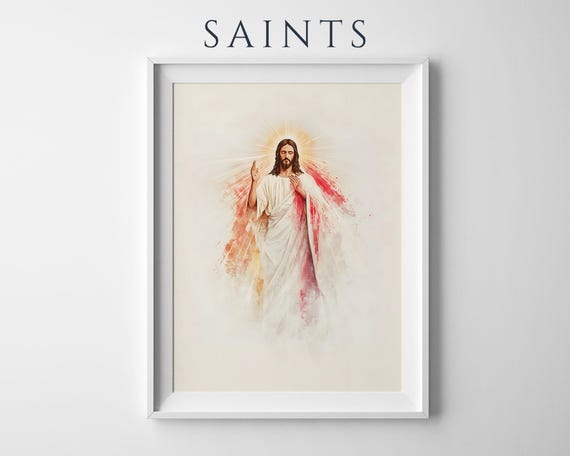
The vision that started it all came, by Faustina's own account, on the evening of February 22, 1931, in her cell at the convent of the Sisters of Our Lady of Mercy in Płock, Poland. She wrote that Christ appeared dressed in a white garment, his right hand raised in blessing, his left hand resting on his chest, from which two rays — one pale, one red — streamed out across the room. "Paint an image according to the pattern you see," she recorded him telling her, "with the signature: Jesus, I trust in You." He added, in her account, a promise attached to the finished image: that souls who venerated it would not perish.
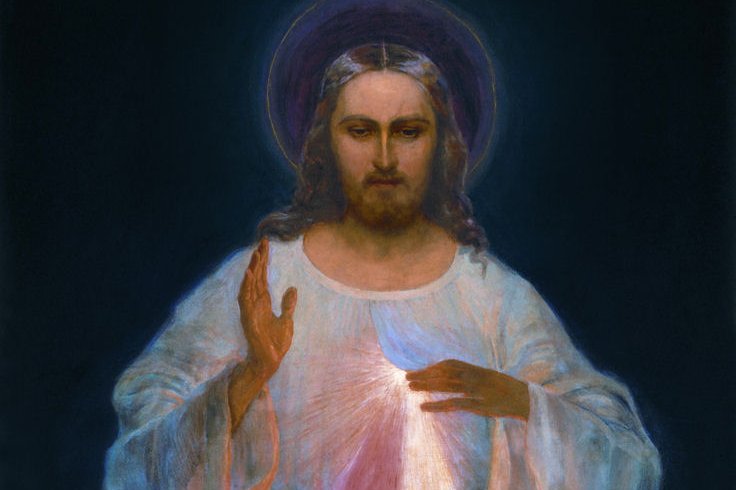
Eugeniusz Kazimirowski, Divine Mercy, 1934, Shrine of Divine Mercy, Vilnius. Public domain, via Wikimedia Commons.
If this scene sounds like the opening of a longer story you'd expect to know in full, it is — Faustina's own biography, including her childhood poverty, her years of domestic service before entering religious life, and her eventual canonization, is covered at length in our article on Saint Faustina Kowalska. What matters here is simply what happened next: a barely-educated nun, instructed to have a specific image painted, with almost no way on her own to make that happen.
The first painting, made under her own eyes
Faustina's confessor at the time, Father Michał Sopoćko, took her reported instructions seriously enough to act on them, but it took three years before a painter was found. In 1934, in Vilnius, where both Faustina and Sopoćko were by then stationed, the artist Eugeniusz Kazimirowski began work on the image under Faustina's direct supervision — she visited his studio repeatedly over roughly six months to check the painting against what she said she had seen. The finished canvas, showing Christ standing against a dark background with the two rays radiating from his heart, received its first public display during a Vilnius exhibition of religious art in April 1935, timed to coincide with the end of a special jubilee year for the Church.
By Faustina's own account, she was never fully satisfied with the result. Her diary records her disappointment that the painting couldn't match the beauty of what she had witnessed, and that when she brought the complaint to Christ in prayer, she said he answered that the image's power rested in his grace working through it, not in the skill of the painter's brush. That original Kazimirowski canvas survived a difficult twentieth century of its own — moved, damaged, and nearly lost to historical neglect during the Soviet period — before being restored and enshrined at the Shrine of Divine Mercy in Vilnius, where it remains today.
The painting most people actually picture
The image most Catholics now recognize as "the" Divine Mercy picture is not the Vilnius original, however, but a second version painted roughly a decade later. Around 1943, in Kraków, the painter Adolf Hyla produced a new rendering of the subject, created with input from Father Józef Andrasz, a Jesuit priest who had also served as one of Faustina's spiritual directors. Hyla's version shows Christ against a lighter background, with softer rays and a more approachable, gentler expression than Kazimirowski's darker original. It was installed at the Kraków convent where Faustina had died in 1938, and from that base — reproduced in prayer cards, parish churches, and eventually on a global scale as the devotion spread after World War II — it became by far the more widely copied of the two paintings. Most Divine Mercy images found in Catholic gift shops, home altars, and parish sanctuaries today descend from Hyla's composition rather than Kazimirowski's.
What the rays are meant to show
Both versions keep the detail Faustina insisted mattered most: the two rays flowing from Christ's heart, one pale and one red. According to her diary, she asked Christ directly what they meant and recorded his answer — that the pale ray represents the water which makes souls righteous, and the red ray the blood which is the life of souls, both said to have "gushed forth" from the depths of his mercy when his heart was opened by a lance on the cross. Many Catholics naturally connect that image to the Gospel account in John 19:34, where a soldier pierces the crucified Christ's side and blood and water flow out — a devotional reading consistent with the diary's imagery, even though the diary itself does not cite the verse directly. The two rays together, in the devotion's own theology, aren't meant as a historical illustration of the Crucifixion so much as a visual shorthand for mercy flowing continuously from Christ into the world.
A devotion restricted, then fully restored
The Divine Mercy devotion's path toward official Church approval was not smooth. In 1959, the Holy Office — the Vatican body now known as the Congregation for the Doctrine of the Faith — issued a notice restricting the devotion's promotion, a decision rooted largely in problems with the Italian translation of Faustina's diary then circulating, which had introduced theological imprecisions not present in her original Polish text. For nearly two decades, the devotion's public growth slowed under that cloud, even as private veneration continued in Poland.
The turning point came through the direct involvement of Karol Wojtyła, then Archbishop of Kraków and later Pope John Paul II, who had grown up with the devotion as part of his own archdiocese's spiritual life. After a thorough re-examination of the diary's original Polish wording and theological content, the Holy See lifted the restriction in 1978 — the same year Wojtyła was elected Pope. As pope, he moved decisively: he beatified Faustina in 1993, canonized her on April 30, 2000, and on that same day established Divine Mercy Sunday, observed on the Sunday after Easter, as a feast of the universal Church.
A global devotion today
More than ninety years after a young nun in a Polish convent described rays of light pouring from the chest of a figure she said was Christ, the Divine Mercy image is now one of the most recognizable devotional pictures in the Catholic world — printed on prayer cards, painted on parish walls, and reproduced in home shrines across every continent. The Chaplet of Divine Mercy, a short prayer Faustina also recorded receiving instructions for, is prayed daily by Catholics worldwide, and Divine Mercy Sunday draws large crowds to shrines in Kraków-Łagiewniki and Vilnius alike. For a devotion that spent two decades under a formal cloud of Vatican caution, its current reach — spanning both the austere original canvas in Vilnius and the gentler, far more reproduced Kraków version — is a striking turnaround, built entirely on one disputed but ultimately vindicated nun's insistence that she had seen exactly what she said she saw.
Trivia
What did Saint Faustina Kowalska see in her 1931 vision?
What do the two rays on the Divine Mercy image represent?
Why are there two different well-known versions of the Divine Mercy image?
Was the Divine Mercy devotion ever restricted by the Church?
When did Divine Mercy Sunday become an official feast of the Church?
Related Reading