Saint Clement I, Pope and Martyr

A bishop from the generation after the apostles
Clement occupies a distinctive place in early Church history as one of the Apostolic Fathers, a small group of Christian writers from the generation immediately following the apostles themselves, whose work provides some of the earliest surviving windows into how the very first Christian communities organized themselves, understood their faith, and handled internal conflict. Ancient tradition, recorded by the second-century bishop Irenaeus of Lyon among others, identifies Clement as the third or fourth Bishop of Rome, depending on how the earliest succession lists are counted, generally placed as having led the Roman church from around 88 to 99.
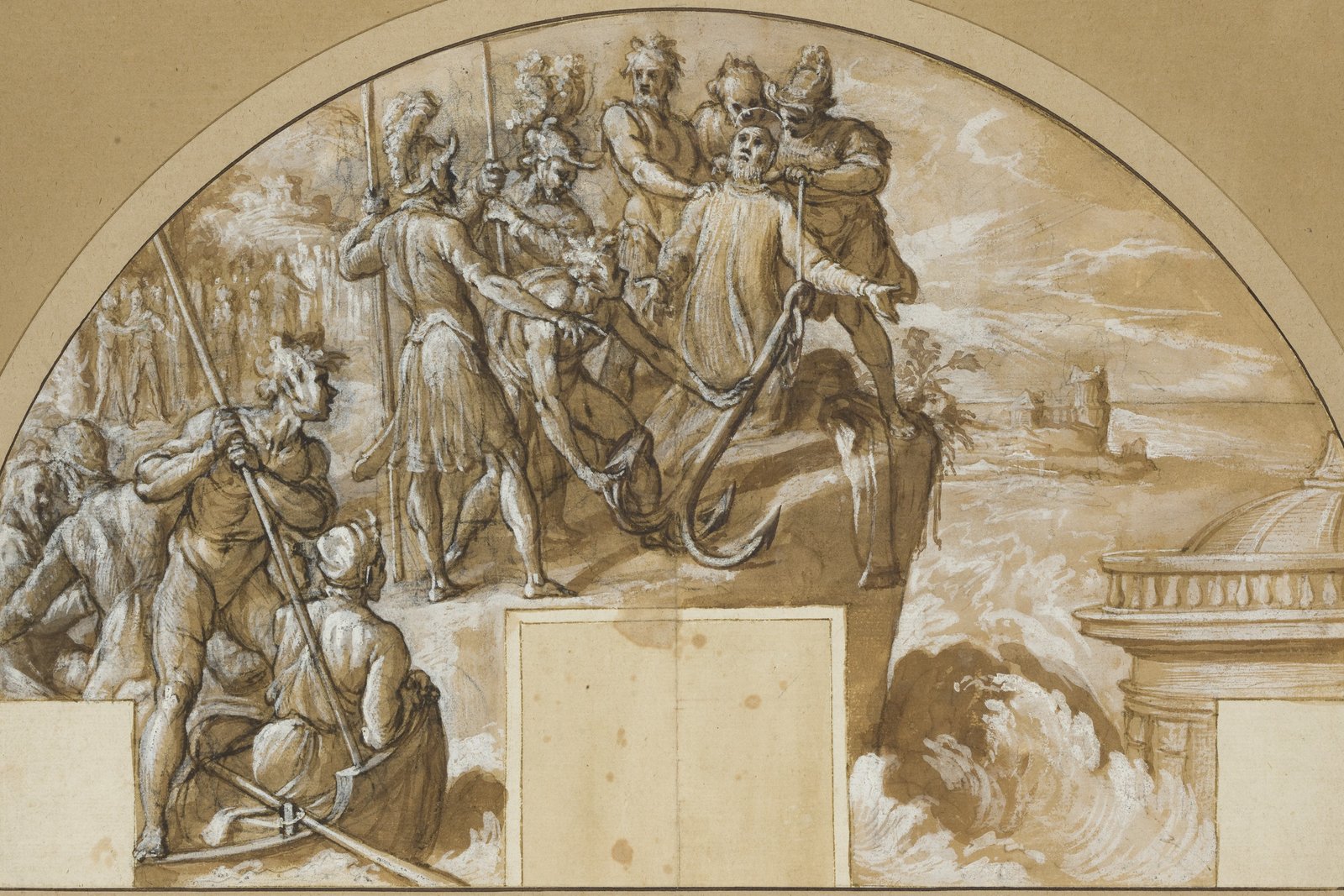
Agostino Ciampelli, The Martyrdom of Saint Clement I, Pope, 1596–97, The Metropolitan Museum of Art, CC0.
Little can be said with certainty about Clement's life before his episcopate. Later tradition, of uncertain historical reliability, holds that he may have been a freedman or the descendant of a Roman family with connections to the imperial household, and some ancient writers associated him, likely inaccurately, with a Roman consul of the same name executed by the Emperor Domitian on charges connected to Christianity, an identification most modern historians treat with considerable skepticism given the lack of solid corroborating evidence.
The letter that settled a crisis in Corinth
Clement's most historically significant and best-documented achievement is a letter he is traditionally credited with writing, or at least overseeing on behalf of the Roman church, addressed to the Christian community in Corinth around the year 96. The letter, known simply as the First Epistle of Clement, responded to a serious internal crisis in the Corinthian church, where a faction had risen up and forcibly removed from office a number of presbyters, church leaders, who had been legitimately and properly appointed, apparently over disputes concerning authority and leadership within the community.
Clement's letter is remarkable both for its content and its tone. It argues at length for order, humility, and respect for legitimately established church authority, drawing on examples from the Old Testament and from the natural order of creation to make its case for restoring the deposed leaders, and it does so with a confident, though notably respectful, sense of the Roman church's standing to intervene in the affairs of a distant Christian community it did not directly govern. Historians and theologians have long debated exactly what this intervention implies about the early development of papal authority, some seeing in it an early expression of Rome's growing sense of special responsibility for the wider Church, others cautioning against reading later, more developed doctrines of papal primacy back into a document whose precise ecclesiological assumptions remain genuinely debated among scholars.
Whatever its exact theological implications, the letter's simple historical value is considerable: it stands as one of the very oldest pieces of Christian writing to survive from outside the New Testament canon itself, offering scholars a rare, direct window into how a first-century Christian community outside Jerusalem or the circle of Paul's own letters understood church leadership, discipline, and Scripture only a few decades after the apostolic age had ended.
Exile and a legendary martyrdom
The circumstances of Clement's death are considerably less certain than the authorship of his famous letter, resting on later hagiographical tradition rather than contemporary documentation. According to accounts that developed some centuries after his lifetime, Clement was exiled under the Emperor Trajan to the Crimean peninsula, in the Black Sea region, and sentenced to forced labor in local stone quarries or mines alongside other Christian exiles. Rather than being broken by the punishment, tradition holds that he continued his ministry among his fellow prisoners, even reportedly working a miracle that produced a fresh water spring for the exiled laborers, and that his continued evangelization eventually provoked Roman authorities into ordering his execution.
The traditional account of that execution is vivid and specific: Clement was bound with an anchor and thrown into the Black Sea to drown, a punishment intended, according to the legend, to ensure that Christians would never be able to recover his body for veneration. Later tradition adds that the sea miraculously receded once a year to reveal his tomb, allowing pilgrims periodic access to venerate his relics, a detail that, like much of the account, belongs to the realm of pious legend rather than verified historical record.
Patron of sailors, and relics that traveled to Rome
Whatever its historical accuracy, the anchor imagery attached to Clement's traditional martyrdom shaped his patronage in later Christian devotion, and he became venerated as a patron of sailors, mariners, and those who work at sea, a natural association given the specific means by which tradition says he died. He is also associated with metalworkers and stonecutters, connections likewise traced back to the traditions surrounding his exile and execution.
His relics carry their own significant later history: according to tradition, the ninth-century missionary saints Cyril and Methodius recovered what were believed to be Clement's remains during their own mission to the Slavic peoples in the Crimean region and eventually brought a portion of them to Rome, where they were enshrined in the Basilica of San Clemente, a church built over multiple earlier layers of Roman construction, including an ancient house church that may date to Clement's own era, giving the site a rare, tangible connection to one of the earliest generations of Roman Christian leadership. Clement's feast day is celebrated on November 23, honoring a figure whose surviving letter remains, nineteen centuries later, one of the clearest surviving voices from Christianity's first, formative generations.
Trivia
Who was Saint Clement I and when was he pope?
What is Clement's Epistle to the Corinthians?
How did Clement die, according to tradition?
Why is Clement the patron saint of sailors and metalworkers?
What is Clement's feast day?
You May Also Like
Related Reading