Saint Conrad of Constance

A noble upbringing directed toward the Church
Conrad was born around 900 into a noble Swabian family with connections to the influential Guelph line, and he received his early education at the cathedral school of Constance before continuing further formation there under the guidance of the diocese's clergy. His path toward eventual episcopal office followed a fairly conventional trajectory for a well-connected young nobleman of the period drawn to church life, though the sustained energy and discipline of his later decades as bishop set him apart from many of his contemporaries.
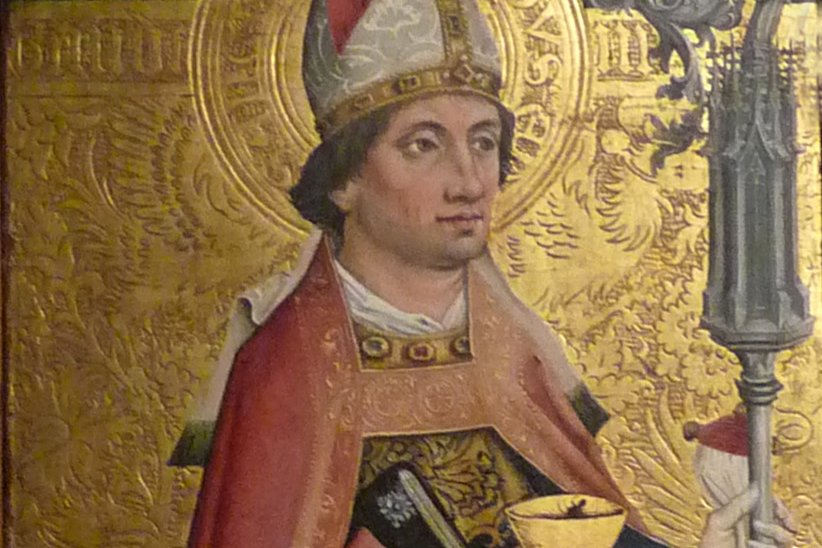
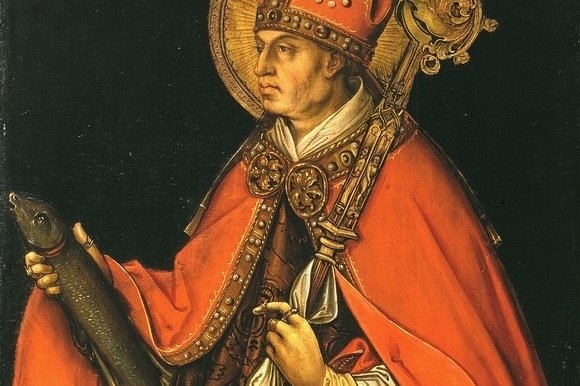
Master of the Drapery Studies, Saint Conrad of Constance, c. 1480-1485, Musée de l'Œuvre Notre-Dame, Strasbourg — public domain.
He became bishop of Constance in 934, a position he held for more than three decades until his death — a lengthy tenure that gave him, much like his approximate contemporary Saint Ulrich of Augsburg in a neighboring diocese, the opportunity to pursue sustained, long-term reform and building projects rather than the shorter, more disrupted episcopates common in this politically unstable period of German history.
A bishop who kept traveling
What distinguishes Conrad's episcopate in the surviving tradition is the degree to which he continued undertaking major pilgrimages even after settling into the demanding administrative responsibilities of governing his diocese. He is credited with multiple journeys to Rome over the course of his episcopate, and some accounts extend his travels as far as Jerusalem — extraordinarily demanding undertakings for a tenth-century European bishop, involving months of difficult and genuinely dangerous travel through territory that offered few of the protections a traveler might expect on more established pilgrimage routes within German lands themselves.
These repeated pilgrimages reflect a devotional practice well understood within medieval Christian spirituality: pilgrimage to Rome, seat of the successors of Saint Peter, and to Jerusalem, site of Christ's death and resurrection, were considered acts of profound penitential and spiritual significance, and a bishop's willingness to undertake them personally, repeatedly, rather than delegate such journeys or forgo them altogether, was read by contemporaries as a genuine sign of personal devotion extending well beyond the ordinary requirements of his office.
The legend of the spider in the chalice
Conrad's later popular veneration became closely associated with a specific and striking legend: that during the celebration of Mass, a spider — in medieval tradition often regarded as poisonous or dangerous — fell into the chalice of consecrated wine. Rather than discard the wine, which by that point in the Mass was understood within Catholic theology to have become the Blood of Christ, Conrad is said to have consumed it entirely, spider included, trusting that his reverence for the Eucharist and God's protection outweighed the physical risk.
This story belongs squarely to the category of pious legend rather than documented historical fact — it isn't attested in the earliest sources for Conrad's life and reflects a devotional storytelling pattern found attached to other saints across medieval Europe, emphasizing absolute trust in the Real Presence of Christ in the Eucharist. Its lasting popularity, regardless of its historical status, says a great deal about what later generations of the faithful most wanted to remember and emphasize about Conrad's character.
Building and pastoral work at Constance
Beyond his pilgrimages, Conrad's episcopate involved substantial, more conventional pastoral and building work: supporting the construction and expansion of churches across his diocese, including projects connected to Constance Cathedral itself, and maintaining the kind of sustained, personally engaged diocesan governance that later chroniclers, much as with Ulrich of Augsburg, singled out for particular praise. Tradition also credits him with notable personal charity toward the poor of his diocese, consistent with the broader picture of a bishop whose considerable resources and authority were directed outward rather than toward personal comfort or dynastic advantage.
Constance's place in the medieval Church
The diocese Conrad governed for over thirty years occupied a genuinely significant position in the medieval German church. Constance was one of the larger and older episcopal sees in the German-speaking lands, its territory stretching across a wide swath of what is now southern Germany, eastern Switzerland, and parts of Austria, and its bishops carried substantial secular as well as spiritual authority within the broader Ottonian imperial church system that also shaped the careers of contemporaries like Ulrich of Augsburg. A bishopric of this size and importance demanded sustained, competent administration simply to function, which makes Conrad's willingness to repeatedly absent himself for months at a time on pilgrimage to Rome and possibly Jerusalem all the more striking — it suggests either an unusually well-organized diocesan administration capable of running smoothly in his absence, or a degree of personal devotional priority that he was willing to place ahead of the more routine demands of hands-on governance, or, most plausibly, some combination of both.
A formal canonization nearly a century and a half later
Conrad's canonization in 1123 by Pope Callixtus II is itself a notable data point in the broader history of how the medieval Church formalized the process of declaring saints. Coming roughly thirty years after Ulrich of Augsburg's landmark 993 canonization — often cited as the first instance of a pope using a defined formal procedure to declare a saint — Conrad's case shows how quickly that emerging papal practice became an established, if still developing, tool for recognizing sanctity, rather than remaining a one-off event tied specifically to Ulrich. The gap of roughly a century and a half between Conrad's death in 975 and his formal canonization in 1123 also illustrates how canonization processes in this period, still far less systematized than the modern procedure, could depend heavily on sustained local advocacy, the survival and promotion of a saint's cult at the diocesan level, and favorable timing at the papal court, rather than following any fixed timetable.
Feast day and canonization
Conrad died on November 26, 975, and was formally canonized in 1123 by Pope Callixtus II. His feast is celebrated on November 26. In art, he is typically shown as a bishop in full vestments, often holding a chalice — sometimes with a small spider depicted nearby, a direct visual reference to his best-known legend, as seen in the late-medieval panel painting that anchors this article.
Readers interested in other tenth-century German bishops whose long, stable tenures allowed for sustained reform, building, and pastoral achievement may also want to read about Saint Ulrich of Augsburg, Conrad's near-contemporary in a neighboring Swabian diocese, whose own decades-long episcopate followed a strikingly similar pattern of personal austerity, extensive travel, and lasting institutional legacy.
Trivia
Who was Saint Conrad of Constance?
Why did Saint Conrad make so many pilgrimages during his time as bishop?
What is the legend of Saint Conrad and the spider in the chalice?
What building projects is Saint Conrad associated with?
When is the feast of Saint Conrad of Constance?
You May Also Like

Related Reading