Saint Ulrich of Augsburg

A long episcopate in a turbulent century
Ulrich was born around 890 into a noble Swabian family with connections to the influential monastery of Saint Gall, where he received part of his early education. He became bishop of Augsburg in 923, at the start of what would prove to be an unusually long tenure — half a century governing a diocese during one of the most turbulent periods of early medieval German history, marked by ongoing Magyar raids from the east, internal conflicts among German nobility, and the gradual consolidation of royal power under the early Ottonian kings.
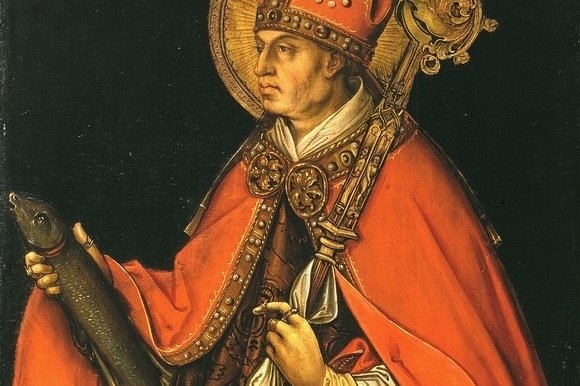
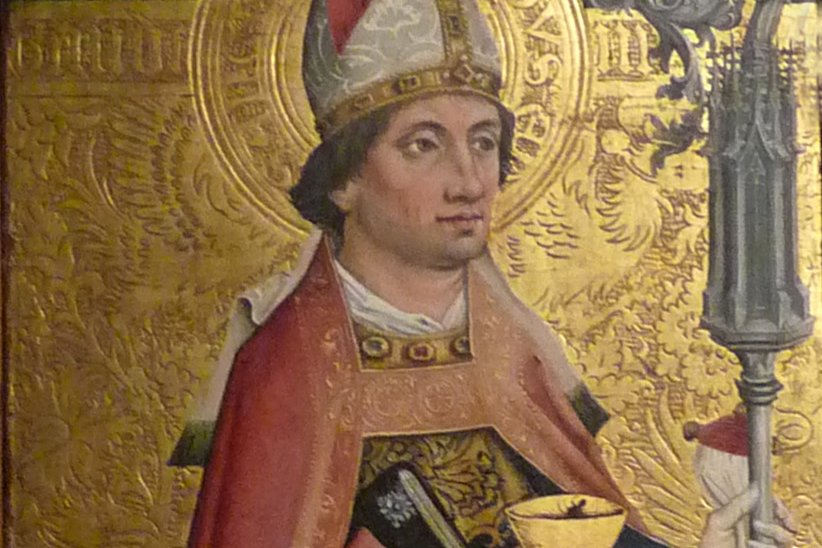
Leonhard Beck, Saint Ulrich of Augsburg, c. 1510, Veste Coburg — public domain.
Ulrich earned a reputation over these decades as a conscientious pastoral bishop, known for visiting his diocese regularly, supporting the poor, and maintaining close and generally productive relationships with the developing Ottonian monarchy — connections that would prove critical when Augsburg itself came under direct military threat.
The siege of Augsburg
In August 955, a large Magyar army, part of a broader wave of raiding that had troubled German territories for decades, advanced on Augsburg and laid siege to the city. King Otto I was marching to relieve it with an imperial army, but in the days before his arrival, the city's defense depended on its own garrison and population holding the walls under difficult and dangerous conditions.
Contemporary and near-contemporary accounts describe Ulrich, by then a man in his sixties — later legendary elaborations pushed his age even higher — playing an active and visible role in sustaining the defenders' morale, appearing along the walls in his episcopal vestments, unarmed, encouraging the soldiers and townspeople under fire rather than remaining in safety within the cathedral. The siege held. Otto's army arrived and decisively defeated the Magyar force at the nearby Battle of Lechfeld, a victory recognized by historians as one of the truly consequential battles of the entire medieval period, effectively ending large-scale Magyar incursions into Western Europe and securing Otto's growing authority as the dominant power in Germany.
Ulrich's role in the episode, real and later somewhat embellished by legend alike, cemented his reputation among his contemporaries as a bishop whose spiritual authority translated directly into practical courage and civic leadership during a genuine crisis.
Reform and pastoral care
Beyond the drama of 955, Ulrich's long episcopate was marked by sustained, less dramatic pastoral work: reforming clerical discipline within his diocese, supporting monastic life, and maintaining the kind of consistent, personally engaged oversight of Augsburg that later chroniclers repeatedly praised as a model of what a medieval bishop's office should look like in practice, not merely in title. His fifty years in office gave him a rare opportunity, denied to many bishops whose tenures were cut short by political upheaval or early death, to see long-term reform efforts through to real, lasting effect.
The first formal canonization
Ulrich died in 973, and two decades later, in 993, Pope John XV formally canonized him — a landmark moment in the history of the Church's saint-making process. Earlier saints throughout Christian history had generally been recognized through local acclaim, episcopal approval, or gradual popular veneration rather than through any single defined papal act. Ulrich's canonization, by contrast, followed a specific formal procedure initiated at the papal level, establishing a precedent that the Church built on and centralized further over the following centuries into the modern canonization process still used today — making Ulrich, by this technical historical measure, the first saint canonized by a pope through a formal procedure.
Why the canonization mattered
The significance of Ulrich's 993 canonization is easy to understate. Before this point, a local church typically recognized its own saints through the bishop's own authority, popular veneration at a tomb, or the gradual spread of a cult from one diocese to another — there was no single, centralized mechanism by which the wider Church confirmed that recognition. When Pope John XV issued a formal bull canonizing Ulrich at a Roman synod, acting on a petition from Ulrich's own successor as bishop of Augsburg, he was not simply praising a respected local figure; he was exercising, for what appears to be the first clearly documented time, the specific papal authority to declare sainthood that later centuries would develop into an elaborate, centralized process involving formal investigation, the evaluation of miracles, and eventual beatification before canonization itself. Historians of canon law still point to Ulrich's case as the origin point of that long institutional development, even though centuries would pass before the process took the more familiar, tightly regulated shape it has today.
Relics and later veneration
Ulrich was buried in the abbey church of St. Afra in Augsburg, a foundation he had himself supported during his lifetime and which was later rededicated to honor both Afra, an early local martyr, and Ulrich together — it is known today as the Basilica of SS. Ulrich and Afra. The dual dedication reflects how thoroughly Ulrich's own cult became interwoven with the older, pre-existing veneration of Augsburg's earlier patron, giving the city two major saints tied to the same church and reinforcing Augsburg's identity as a center of sanctity stretching back to the Roman persecutions and forward through the Ottonian era. Pilgrims visited his tomb throughout the medieval period, and he remains one of the patron saints most closely associated with the city and diocese of Augsburg to this day, and the joint basilica remains a focal point of local devotion centuries after his death.
Feast day and iconography
Ulrich's feast is celebrated on July 4. In art, he is typically shown as an elderly bishop in full vestments, often holding a fish — a reference to a popular legend in which meat served to him on a fast day was miraculously transformed into fish before a suspicious observer could catch him breaking his fast, a story reflected in the Renaissance panel painting by Leonhard Beck that anchors this article.
Readers interested in other German bishops whose long, capable episcopates shaped the Ottonian imperial church may also want to read about Saint Bernward of Hildesheim, a near-contemporary bishop whose own combination of pastoral leadership and lasting institutional legacy closely parallels Ulrich's decades of service at Augsburg.
Trivia
Who was Saint Ulrich of Augsburg?
What was the Battle of Lechfeld, and what role did Ulrich play in it?
Why is Saint Ulrich called the first canonized saint?
Why is Saint Ulrich sometimes shown holding a fish?
When is the feast of Saint Ulrich?
You May Also Like
Related Reading