Saint Denis, Bishop, and Companions, Martyrs

A missionary bishop sent to Roman Gaul
The historical record around Denis of Paris is thin, which is typical for Christians who lived and died under Roman persecution before the Church had any institutional means of preserving detailed biography. What survives comes largely from Gregory of Tours, the sixth-century historian whose brief account is the earliest solid reference to Denis, followed centuries later by much more elaborate hagiography that added the details modern readers find most striking.
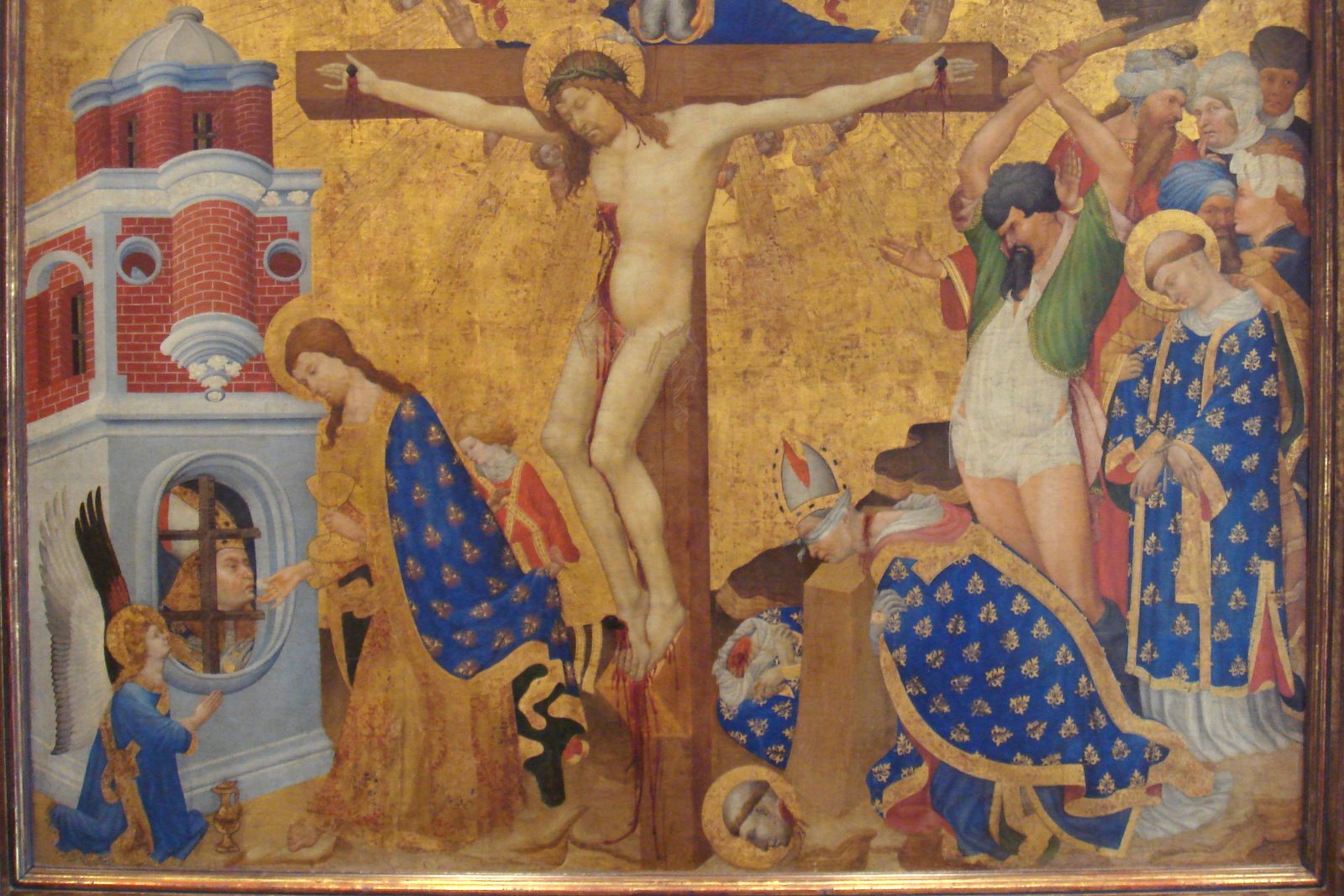
Henri Bellechose, Retable de Saint Denis, 1415–16, Louvre — public domain.
The core outline is this: sometime in the mid-third century, likely during the reign of the Emperor Decius, a bishop named Denis was sent from Rome, or possibly from Italy more broadly, as part of a group of missionary bishops dispatched to evangelize the still largely pagan provinces of Gaul. Denis made his way to the small settlement on an island in the Seine known to the Romans as Lutetia, and there he established a Christian community that would eventually grow into the city of Paris. He was accompanied, tradition says, by a priest named Rusticus and a deacon named Eleutherius, both of whom would share his fate.
Martyrdom on the hill of the martyrs
Christian communities in Gaul faced periodic, often locally driven persecution throughout the third century, and Denis's growing congregation eventually drew the hostile attention of Roman authorities. He, Rusticus, and Eleutherius were arrested, interrogated, and — when they refused to renounce their faith — sentenced to death by beheading. The execution took place on a hill just outside the city, a site that later generations came to call Montmartre, a name widely believed to derive from Mons Martyrum, the "Mountain of Martyrs," though some scholars trace it instead to an older dedication to the Roman god Mercury.
It is here that the historical account gives way to legend, though a legend that shaped French religious imagination for over a thousand years. According to the tradition recorded in later medieval sources, after the executioner's blow separated Denis's head from his body, the bishop did not simply fall. He rose, picked up his own severed head, and carried it several miles north, preaching a sermon of repentance the entire way, until he finally collapsed at the spot where he wished to be buried. A woman named Catulla is said to have retrieved the body for proper burial. Whatever its historical accuracy, the story of the cephalophore, the "head-carrier," became one of the most recognizable images in French sacred art, and Denis is depicted this way in sculpture and stained glass across the country, most famously on the west facade of Notre-Dame de Paris itself.
The abbey that became a royal necropolis
The site where Denis was said to have finally fallen became the location of a modest shrine, and over succeeding centuries that shrine grew into one of the most consequential religious institutions in French history: the Abbey of Saint-Denis. By the early Middle Ages, it had become closely associated with the Merovingian and later Capetian monarchy, and beginning with King Dagobert I in the seventh century, it became customary for French kings to be buried there. Nearly every monarch of France, from the early medieval period through the execution of Louis XVI during the Revolution, found their final resting place within its walls, making the basilica a kind of national mausoleum unmatched anywhere else in Europe.
That royal association elevated Denis from a regional martyr into a figure of genuine national significance. Medieval French armies rallied under the battle cry "Montjoie Saint Denis," invoking his protection in combat, and the oriflamme, the sacred war banner of the French kings, was traditionally kept at his abbey and carried into battle as a symbol of both royal and divine authority. Few saints anywhere achieved such a direct, sustained fusion with the political identity of a nation.
Birthplace of Gothic architecture
Saint-Denis holds a second, entirely separate claim to fame that has nothing to do with martyrdom or monarchy: architectural history. In the 1140s, the abbot Suger undertook a major rebuilding of the church, introducing pointed arches, ribbed vaults, and large stained-glass windows designed to flood the interior with colored light, an approach Suger justified theologically as a way of drawing worshippers' minds toward the divine light of God. The result is widely regarded by architectural historians as the first true expression of what would later be called the Gothic style, a design vocabulary that would spread across Europe over the following centuries and produce cathedrals from Chartres to Cologne.
Distinguishing Denis from Dionysius the Areopagite
One persistent complication in the history of Denis's cult involves mistaken identity. The Acts of the Apostles mentions a Athenian convert of Saint Paul named Dionysius the Areopagite, and medieval French tradition, beginning around the ninth century, increasingly identified this New Testament figure with the third-century bishop of Paris, treating them as the same person separated by supposed centuries of extraordinary longevity. This identification also attached a body of influential mystical theology, actually written considerably later by an anonymous author now called Pseudo-Dionysius, to the cult of the Paris martyr. Modern scholarship treats the Areopagite, Pseudo-Dionysius the theological writer, and Denis of Paris as three distinct figures, but the confusion shaped centuries of devotional literature and helps explain why Denis's cult carried such intellectual as well as popular weight in medieval France. His feast day, shared with his companions Rusticus and Eleutherius, is celebrated on October 9.
Trivia
Who was Saint Denis and when did he live?
What is the cephalophore legend associated with Saint Denis?
Why is Saint Denis the patron saint of France?
What is the Basilica of Saint-Denis?
Is Saint Denis the same person as Dionysius the Areopagite?
You May Also Like
Related Reading