Saint Devasahayam Pillai, India's First Lay Martyr-Saint

A trusted man at a Hindu royal court
Devasahayam Pillai was born in 1712 in what was then the Kingdom of Travancore, a powerful Hindu-ruled state occupying much of present-day southern Kerala and southern Tamil Nadu. He rose to a position of real influence at the royal court, eventually serving in a senior administrative role that put him in direct, regular contact with the king, Marthanda Varma, and gave him a standard of living and social standing most of his contemporaries could never have expected to reach.
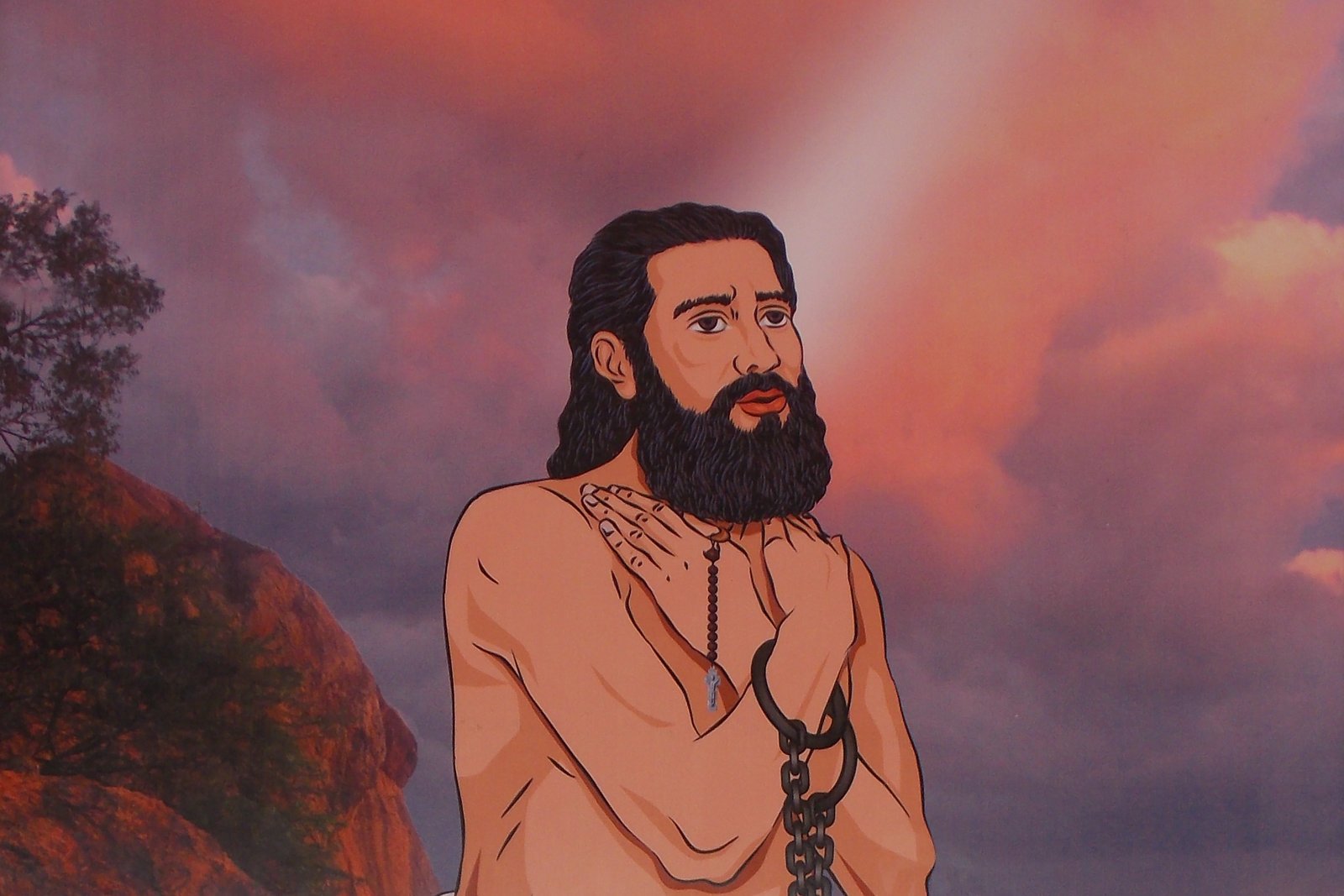
Devotional painting of St. Devasahayam Pillai, photographed by Jayarathina — CC BY-SA 3.0, Wikimedia Commons
His path to Christianity, according to the accounts gathered during his later canonization process, began through his contact with a Dutch naval officer, Eustachius De Lannoy, who had been captured after a battle with Travancore's forces and was subsequently employed, remarkably, to help modernize the kingdom's own army. Conversations with De Lannoy about Christianity, combined with what witnesses later described as a growing personal spiritual searching, led Devasahayam toward baptism, which he received around 1745, taking the name Lazarus — rendered in the local Tamil and Malayalam context as "Devasahayam," meaning roughly "help of God" or "God is my help."
A conversion the court could not tolerate
In eighteenth-century Travancore, religious identity and caste were tightly bound up with political and social order, and a senior court official abandoning the traditional religion of the kingdom for the faith of European traders and missionaries was not treated as a private matter of conscience. Devasahayam's situation worsened as he began speaking openly against practices he considered unjust — testimony from the canonization process describes him criticizing certain court and social customs on explicitly moral and religious grounds, conduct that made him enemies among officials who had reason to resent both his continued influence and his new faith.
Those rivals moved against him with an accusation of treason that the surviving historical record treats as almost certainly fabricated — a pretext that gave the court legal cover to move against a Christian convert without appearing to punish religious conversion directly, a pattern of persecution-by-proxy that appears in the history of religious minorities across many different times and places. Devasahayam was stripped of his position and property and placed under arrest.
Years of public humiliation before death
What followed was not a swift execution but a prolonged campaign of public humiliation stretched across roughly three years, apparently intended as much to make an example of him and pressure his recantation as to punish him directly. Court records and testimony gathered later describe him imprisoned under harsh conditions, tortured, and repeatedly paraded through villages and towns seated backward on a buffalo, his face deliberately blackened and a jester's cap placed on his head — a calculated public spectacle meant to strip him of the dignity his former rank had carried.
Throughout this ordeal, according to the testimony gathered for his cause, Devasahayam was repeatedly offered the chance to recant his Christian faith and be restored to his position and property, and he consistently refused. It's this specific detail — years of sustained, humiliating pressure rather than a single dramatic moment of testing — that distinguishes his case within the broader history of Christian martyrdom, and that Church officials examining his cause treated as central to recognizing him as a genuine martyr rather than simply a victim of court politics.
Death near Aralvaimozhy, and a shrine that followed
In January 1752, Devasahayam was taken to a remote, hilly wooded area near Aralvaimozhy, close to the present-day border between Tamil Nadu and Kerala, and shot. Local Christian tradition holds that his body was left in the forest rather than returned for burial, though it was later recovered and interred at the Catholic cathedral in Kottar (present-day Nagercoil), which remains a site of pilgrimage and veneration today. A separate shrine near the site associated with his death, at a location known as Kattadimalai, also draws pilgrims who trace the route of his final ordeal.
The first Indian layperson to be canonized
Devasahayam's cause moved through the Church's official processes over more than two and a half centuries — he was beatified by Pope Benedict XVI in 2012, and Pope Francis formally canonized him on May 15, 2022, alongside nine other new saints. His canonization carried particular weight within the Church in India: he became the first layperson born in India — someone who had never been a priest, religious brother, or bishop — to be recognized as a saint, a distinction Indian Catholic communities and bishops highlighted at the time as recognition of the country's long, often overlooked history of lay Christian witness stretching back centuries before the more widely known missionary era.
His story, stripped of its distance in time and geography, describes something familiar across the history of religious persecution everywhere: a person given every practical incentive and repeated opportunity to simply say the words that would restore his comfortable former life, who instead treated a new, costly conviction as more binding than the privileged position he had already spent years building.
Trivia
Who was Saint Devasahayam Pillai?
Why was he punished for converting to Christianity?
What did his imprisonment and punishment actually involve?
How did Devasahayam Pillai die?
When was he canonized, and why is his canonization historically significant?
You May Also Like
Related Reading