Saint John Ogilvie

A Calvinist upbringing and an unexpected conversion
John Ogilvie was born in 1579 (some sources give 1580) at Drum-na-Keith in Banffshire, Scotland, into a landed Calvinist family with connections to the Scottish nobility. Like many sons of the Scottish gentry, he was sent abroad at thirteen for his education, studying at Catholic institutions on the European continent — a common practice at the time even for Protestant families, since much of the continent's established educational infrastructure remained in Catholic hands.
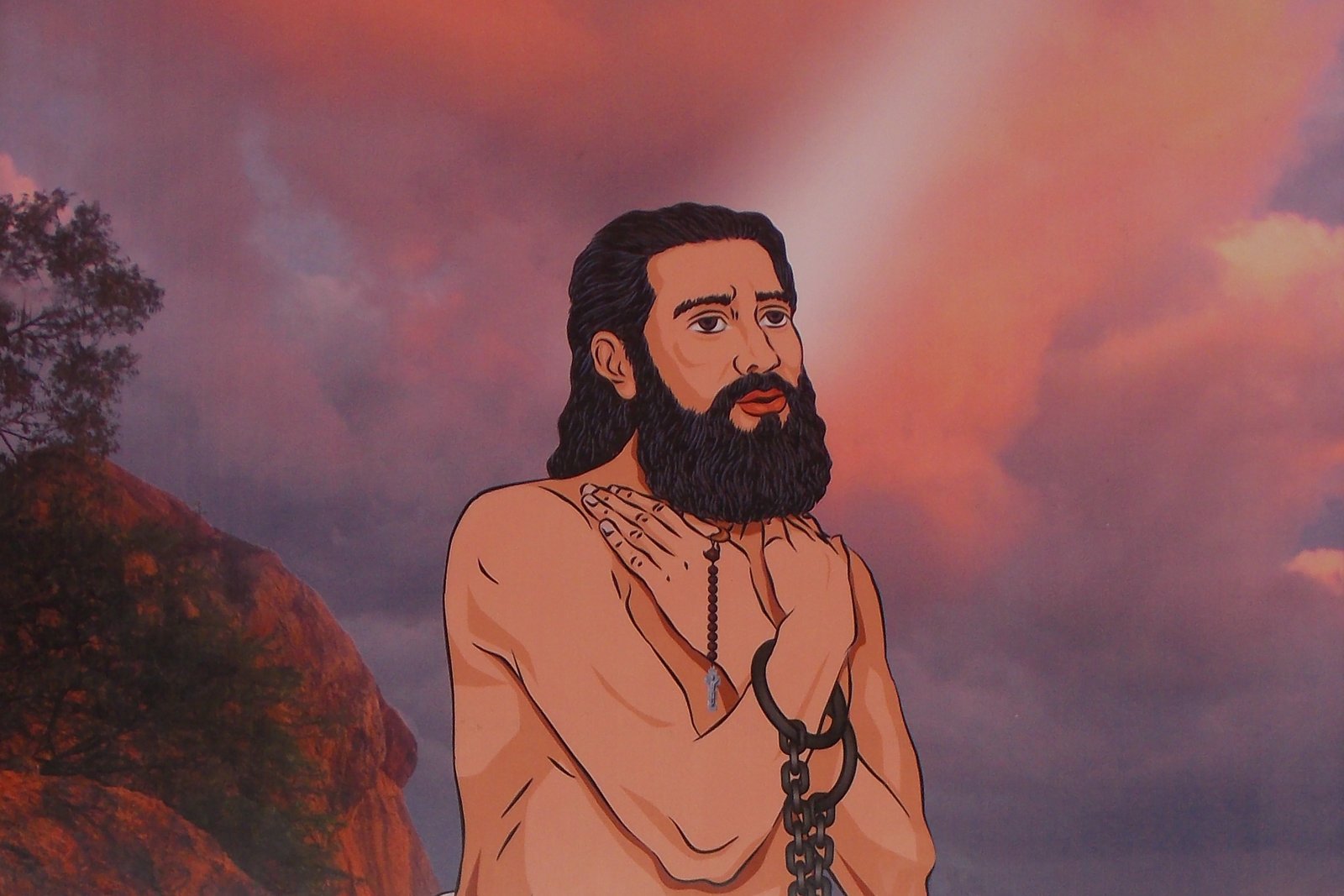
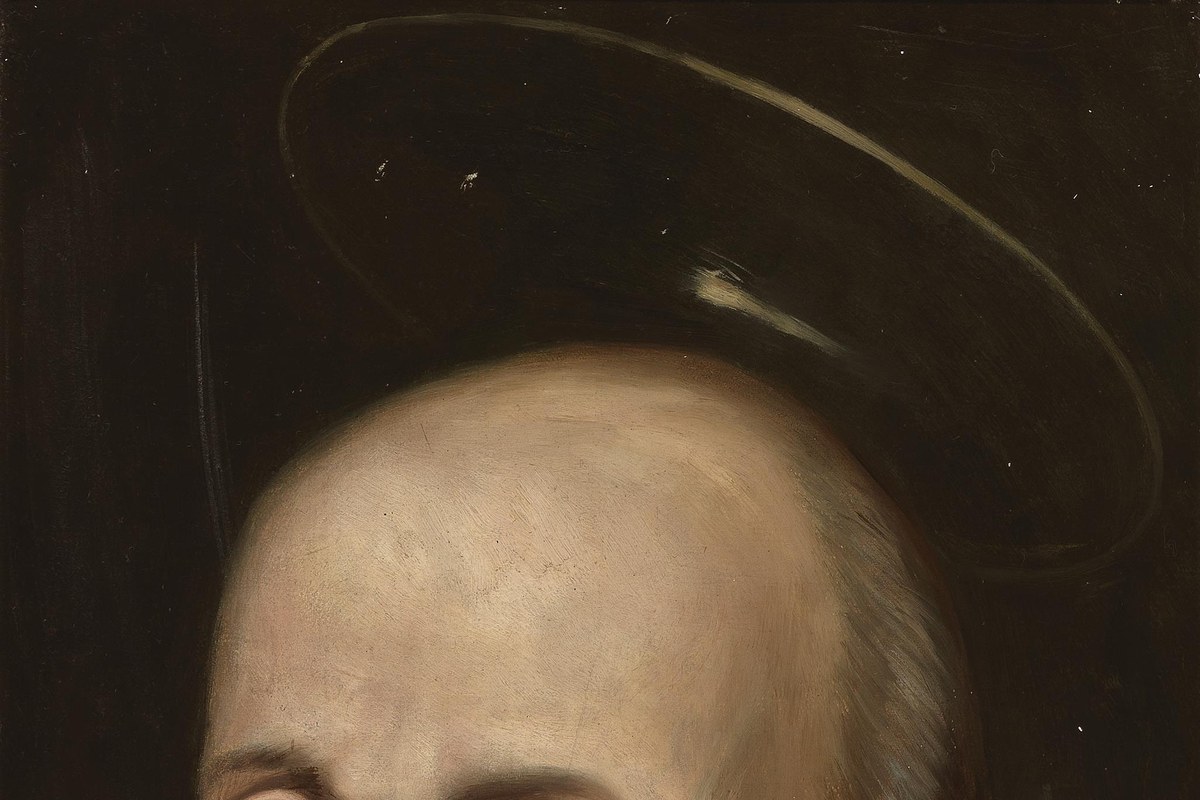
Anonymous devotional portrait of Saint John Ogilvie with a martyr's palm, artist unknown — public domain.
It was during these years abroad, still a teenager, that Ogilvie underwent a serious personal crisis of religious conviction. By his own later account, he engaged directly with the pamphlet literature and formal arguments circulating on both sides of the Reformation divide, comparing Protestant and Catholic positions point by point on the doctrinal questions dividing them. He concluded that the Catholic arguments held up better under scrutiny, and in 1596, at seventeen, he was formally received into the Catholic Church at Louvain, in what is now Belgium — a decision that permanently separated him from the religious and, to a significant degree, the social world of his own family and homeland.
Training as a Jesuit missionary priest
Ogilvie spent the following years in Catholic religious formation across the continent, eventually entering the Society of Jesus — the Jesuits — in 1596 and being ordained a priest in Paris in 1610. Jesuit training at the time placed heavy emphasis on missionary readiness, and Ogilvie specifically petitioned his superiors for an assignment to Scotland, a country where the practice of the Catholic priesthood had been made a capital crime under laws enacted after the Scottish Reformation decades earlier.
Scotland by this period had an underground Catholic minority, largely concentrated among certain noble and gentry families who maintained their faith privately, along with ordinary people in some regions who had never fully embraced the new Presbyterian church settlement. Jesuit missionaries operating in this environment worked in disguise, under assumed names, moving secretly between sympathetic households to say Mass and administer the sacraments — extraordinarily dangerous work, given both the legal penalty and the network of informants the state relied on to detect it.
Ministry, capture, and torture
Ogilvie returned to Scotland in 1613, disguised as a horse trader or soldier depending on the account, and began ministering secretly to Catholics primarily in and around Edinburgh and Glasgow. His time in active ministry lasted less than a year. In October 1614, he was betrayed — by most accounts, by someone posing as a potential convert seeking instruction — and arrested in Glasgow.
What followed was a sustained interrogation aimed less at proving his priesthood, which the authorities already knew, than at forcing him to name the other Catholics he had served in secret, information that would have exposed an entire underground network to arrest. Ogilvie was subjected to prolonged sleep deprivation — reportedly kept awake for more than a week at one stretch through physical torment — and was offered, at multiple points, release, money, or even a benefice within the state church if he would renounce his priesthood or simply provide the names his interrogators wanted. He refused every offer.
Trial and execution
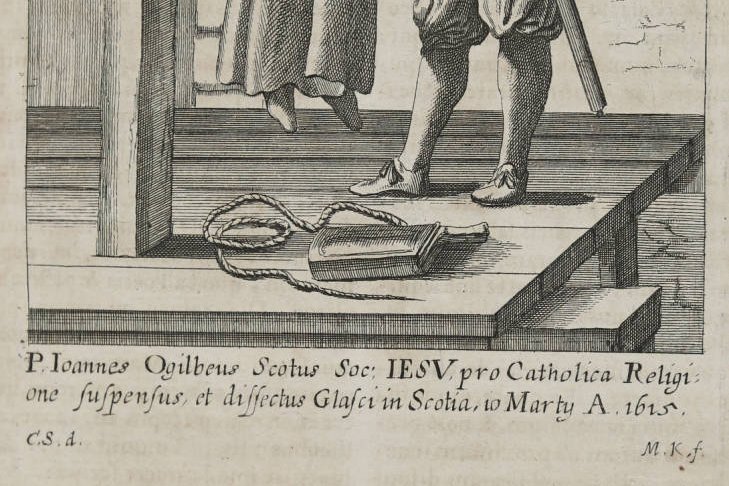
Ogilvie was tried principally on a charge of high treason, on the grounds that as a Catholic priest, he denied the king's claimed spiritual authority over the Church in Scotland — a position the state treated not merely as religious dissent but as a direct challenge to royal authority itself. He was convicted and sentenced to death. On March 10, 1615, he was hanged and then beheaded in Glasgow, reportedly proclaiming his loyalty to the king in all temporal matters while maintaining, to the end, that no earthly monarch held spiritual authority over the Church.
Canonization
John Ogilvie's cause moved slowly over the following centuries, in part because of Scotland's continuing small Catholic population and complicated religious politics well into the modern era. He was beatified in 1929 by Pope Pius XI and canonized on October 17, 1976, by Pope Paul VI — becoming, and remaining today, the only person born in Scotland to be canonized a saint since the Scottish Reformation of the 16th century, a distinction that gives his cause particular significance for Scotland's modern Catholic minority.
Caught in the politics of a divided kingdom
Ogilvie's execution needs to be understood against the specific political backdrop of Jacobean Britain. James VI of Scotland, who had become James I of England in 1603, was actively working to consolidate royal authority over religion across both kingdoms, and he took a particular personal interest in defending the principle of royal supremacy over the Church — a doctrine he defended at length in his own theological writings. A Jesuit priest publicly refusing to concede the king's spiritual headship was, in this specific political climate, not simply a private matter of conscience but a direct challenge to a cornerstone of Jacobean state ideology, one the king and his officials in Scotland treated with particular severity. Glasgow's role as the site of Ogilvie's trial and execution reflected the city's status as a center of strict Presbyterian church government in this period, making it a symbolically pointed location for the state to make an example of a captured Jesuit missionary.
The miracle behind his canonization
Ogilvie's canonization in 1976 required, per standard Catholic procedure following his 1929 beatification, a documented miracle attributed to his intercession. The case accepted by the Church involved John Fagan, a Glasgow man diagnosed with terminal cancer in the early 1960s, who recovered fully after prayers were offered for his healing through Ogilvie's intercession — a recovery that the medical and theological investigators examining the case found could not be explained through natural medical means available at the time. The approval of this miracle, centered on a healing in Ogilvie's own city of martyrdom nearly three and a half centuries after his execution, gave Scotland's small Catholic community a direct, modern link to a saint whose story had otherwise belonged entirely to the distant world of Reformation-era persecution, and it remains a frequently cited episode in Scottish Catholic devotion to him today.
Feast day
His feast is celebrated on March 10, the anniversary of his execution.
Related reading
Ogilvie's story belongs to the broader wave of Reformation-era Catholic martyrdoms across the British Isles — readers may also want to read about Blessed Miguel Pro, a priest executed centuries later under comparably severe anti-Catholic state persecution in Mexico, or Saint Oscar Romero, another cleric killed for refusing to submit his priesthood to political demands.
Trivia
Who was Saint John Ogilvie?
Why did John Ogilvie convert from Calvinism to Catholicism?
What exactly was John Ogilvie executed for?
How was John Ogilvie treated after his capture?
When is Saint John Ogilvie's feast day?
You May Also Like
Related Reading