Saint Notburga, the Servant Who Left Work at Sunset

A kitchen servant with a habit that made trouble
Notburga was born around 1265 in Rattenberg, in what is now the Tyrol region straddling Austria, and spent her life working as a domestic and agricultural servant for local noble families — not a saint from a monastery or a royal court, but a working laborer, which is precisely why her story resonated so strongly with the ordinary rural communities that kept her memory alive for centuries.
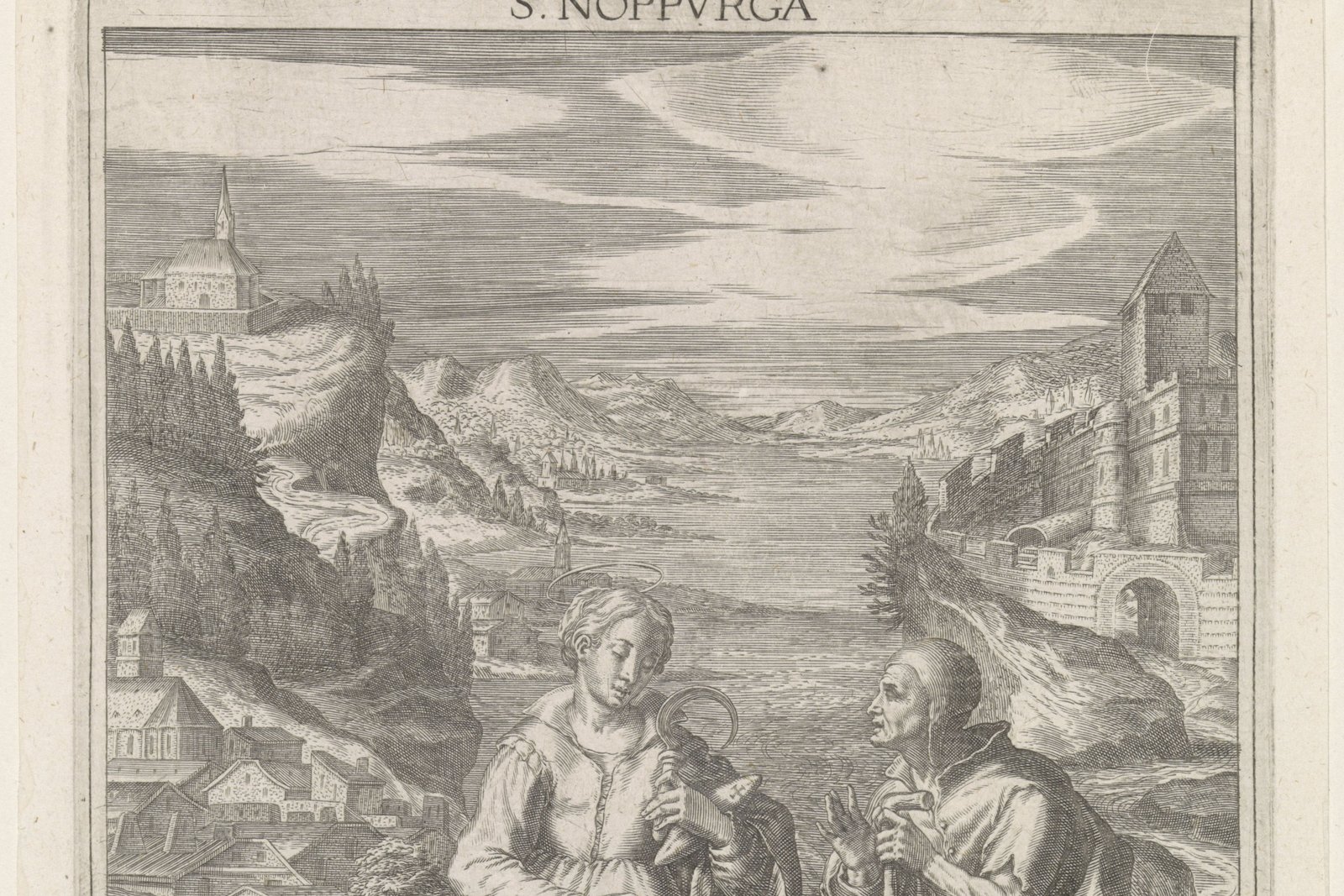
"Heilige Notburga van Eben," 1627, Rijksmuseum. CC0 (Wikimedia Commons).
Her first well-known position was in the kitchen of the Lord of Rottenburg, where tradition says she developed a habit of setting aside leftover food from the household's table to give to the poor rather than letting it go to waste or be discarded. This was, by several accounts, a fairly ordinary act of charity common among servants of the period — until her employer's household situation changed and the practice was explicitly forbidden, with orders that scraps go to feed livestock instead. When Notburga was later told by a new mistress in the household to abandon the poor she'd been quietly feeding, she chose instead to leave the position altogether, taking work with a farmer named Hütter.
The choice to walk away from steady employment over a matter of conscience wasn't a small one for a servant of her era, when a household position meant food, shelter, and basic security in a world offering few safety nets to unmarried working women. That willingness to give up material security rather than abandon charity toward the poor is part of why later generations of Alpine laborers, who faced their own precarious dependence on the goodwill of landowners and employers, found her story so easy to recognize as their own.
The sickle that wouldn't fall
The story most closely associated with Notburga's later veneration takes place during her time working for Hütter's household. During a harvest, laborers in the fields were ordered to keep working past the customary evening bell — the traditional signal marking the end of the workday and the start of rest — because the farmer wanted the crop brought in before a coming storm.
Notburga, according to tradition, refused to keep working once the bell rang, insisting that laborers were entitled to their rest regardless of the weather or the employer's convenience. To make her point, she is said to have thrown her sickle into the air — and, in the legend as it's been passed down through generations, it did not fall back to the ground but remained suspended, a sign read by those present, and by the devotion that grew from the story, as divine confirmation that her insistence on a servant's right to rest was justified.
This is squarely a matter of popular legend rather than documented event, preserved through oral tradition and later folk hagiography rather than any contemporary record. What the Church has affirmed, in tolerating and eventually blessing centuries of local devotion to Notburga, is not the literal physics of a floating sickle but the underlying conviction the story defends: that laborers, however humble their station, are owed dignity, rest, and fair treatment — a message that made Notburga an enduring figure of comfort and advocacy for agricultural workers across the Alpine world for over seven hundred years.
The detail of the evening bell matters more than it might first appear. Many medieval European communities regulated the working day through exactly this kind of communal signal, a fixed, publicly heard marker that applied to everyone regardless of individual employer or field — meaning Notburga's stand wasn't simply personal stubbornness but an appeal to a shared, recognized custom that her employer was trying to override for his own convenience. That's part of why the story carried such weight among later generations of laborers: it wasn't framed as one servant's private grievance, but as loyalty to a rule the whole community was supposed to honor together.
A burial left to providence
Another tradition surrounding Notburga concerns her death. She is said to have asked that, after she died, her body be placed on a cart drawn by a pair of oxen and buried at whatever spot the oxen chose to stop, rather than at a location dictated by any single household or patron seeking to claim her remains for prestige. The oxen, according to the story, brought her body to the chapel of Saint Rupert near Eben am Achensee, where her relics remain venerated today.
A saint the people canonized before Rome did
Notburga was never processed through a formal modern canonization. Her sainthood rests instead on the older path of longstanding, widespread popular veneration — a form of recognition the Church has historically accepted for figures whose devotion predates the more formalized canonical procedures developed in later centuries. Local pilgrimage and devotion to her grew steadily in the centuries after her death in 1313, and her feast, kept on September 13 or 14 depending on region, remains a significant local celebration across Tyrol, Bavaria, and neighboring Alpine areas.
She's remembered today as the patron saint of servants, farmhands, and agricultural laborers — a distinction that sets her apart from the many saints drawn from nobility, clergy, or religious orders. Notburga's holiness, as her story has been told and retold for centuries, was found in an ordinary kitchen and an ordinary field, in the stubborn insistence that even the lowest-ranked worker in a household deserved both mercy toward others and rest for herself.
Trivia
Who was Saint Notburga?
What is the story of Notburga giving away food to the poor?
What is the famous legend of Notburga's sickle staying suspended in the air?
Why is Notburga associated with farm animals and the location of her burial?
When is Saint Notburga's feast day?
You May Also Like

Related Reading